
Kite or wakeboard: which to choose and which is easier for beginners
The two boards look alike, but the sports are different. On a wakeboard a boat or a cable winch pulls you on a rope. On a kite the wind pulls you through a large wing, and you need no rope at all. Everything else grows from that: where you ride, what it costs, what you depend on, and where you go next.
22 July 2026 · JollyKite
There's no «best» here. Wakeboarding gives you a fast first kick and doesn't depend on wind. Kiting gives you freedom — open water, space and travel — but takes its due at the start, while you learn the safety basics. We're a kite school and we love what we do, but we won't put wakeboarding down: it's a great sport. Our job is to lay out the differences so you choose what fits you.
In short: who should pick what
- Wakeboard — if you want to get on the board fast, ride without wind, and you're fine with laps behind a boat or in a cable park. Quick start, but space is limited by the rope.
- Kite — if you want freedom, the space of open water, jumps and travel, and you're ready to invest your first lessons into a safety foundation with an instructor.
What's the difference, really
Wakeboard. You stand on a short board with bindings, hold a handle, and a line pulls you forward. The power comes from a boat or a cable-park winch system. You ride in loops or straight lines within the rope's reach. The boat's wake serves as a ramp for jumps and tricks.
Kite. A large airborne kite on lines pulls you, steered by a bar. The power comes from the wind. There's no rope: you ride wherever you want within the spot, turn around, head off into the distance and come back. Jumps come from the wing's lift — upward, with hang time. The core difference: a wakeboard is tied to a boat or park, a kite is tied to the wind.
Where it's easier to start
Wakeboarding is easier at the start. Many beginners get their first proper ride quite quickly: the instructor in the boat controls the pull and sets the speed, and your job is to get up out of the water and hold your balance. Many stand up and ride their first stretch on day one. The foundation is short because a person in the boat handles safety and speed.
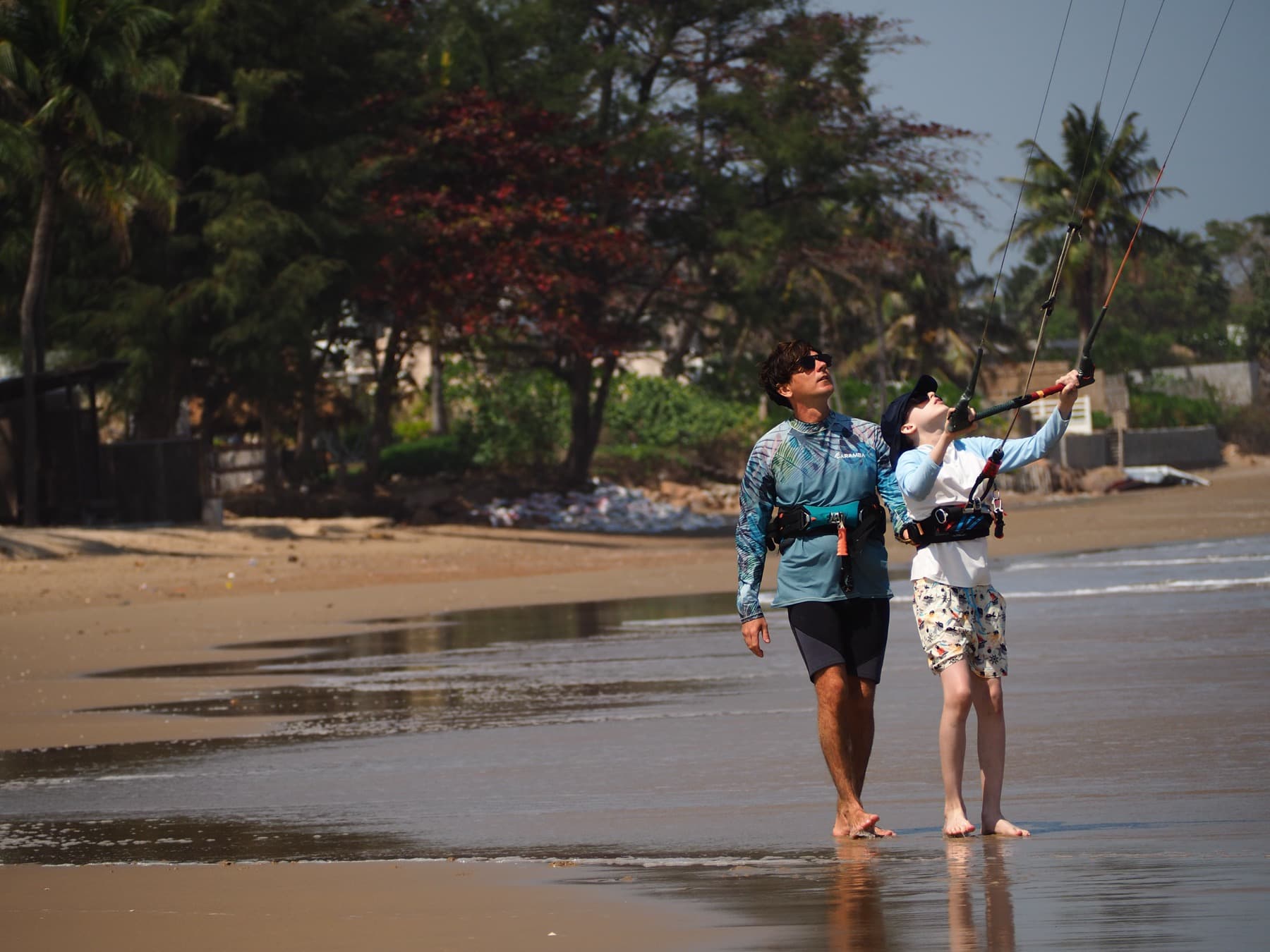
Kiting has a longer foundation. Before you ride, you need to understand the lines, the wind window (the sector where the kite flies), and how the quick-release works. It's not hard, but it takes time and always an instructor: kiting is learned on the water under supervision, not from videos. The good news: once the basics are in place, with steady wind you reach your first independent riding fairly quickly — especially in the even, predictable wind we have in Pak Nam Pran.
Cost of entry
Wakeboard. Your own gear is cheap (a board with bindings), but you can't ride without a boat or a park. That means either renting a boat with a driver by the hour (expensive if regular) or a cable-park pass. Every session on the water costs money: you pay for the pull.
Kite. The gear is more expensive up front (kite, bar, board, harness), but the pull is free — the wind provides it. After buying the kit, every session on the water costs nothing: show up at a windy spot and ride as long as you like. Exact numbers depend on country, park and gear class, so we won't quote sums. But the logic is simple: wakeboarding is cheaper to start, kiting is cheaper to continue.
What you depend on
Wakeboarding depends on infrastructure. You need a boat or a cable park nearby. No park in your town, no riding — or you travel for it. But the weather barely matters: the boat pulls in a dead calm; you don't need wind or waves.
Kiting depends on the wind. The working range is usually 12–25 knots. In a calm the kite won't fly; in a storm it's dangerous. But you need no infrastructure at all: open water and wind are enough. No boat, no park, no company — you get to the spot and go.
Freedom of movement
Wakeboarding is a loop. You're always within the rope: the line's length, the radius behind the boat, or the winch's path in the park. Space is limited but predictable and controlled. Kiting is open space. No rope: you ride along the shore for kilometres, out to the horizon and back, upwind, exploring a lagoon. That sense of freedom is what kiters love most.
Injury and safety
Wakeboard. Falls at speed onto the water are the main source of trouble: hitting the surface, sprains, strain on knees and back from hard landings off a ramp. Plus the boat nearby. But a person in the boat manages speed and pull, which markedly lowers the risk at the start.
Kite. The risks are of a different kind — tied to the wind's power and to steering the wing. That's exactly why the safety foundation in kiting is longer: lines, wind window, quick-release. Once you've learned the basics with an instructor, you get a controllable, safe sport. The one rule: start with lessons, not on your own.
Where progress leads
Wakeboarding leads toward tricks and style: jumps off the wake and kickers, spins, slides across park features. Progress goes deep into technique within familiar space. Kiting leads wide. After the basics, branches open up: calm cruising on flat water, jumps and hang time, freestyle, then kite foiling, wave riding, long downwinders and travel to spots all over the world.
And one more thing: wakeboard experience helps in kiting. A confident stance on the board and a feel for the edge and balance carry over directly — a wakeboarder usually has it easier at the stage when it comes down to the board itself. So it's not an «either/or» for life: many come to kiting straight from wakeboarding.
Comparison table
| Wakeboard | Kite | |
|---|---|---|
| Source of power | Boat or winch (rope) | Wind (wing) |
| What you depend on | Boat / cable park nearby | Wind 12–25 knots |
| Ease of entry | Easier, fast first kick | Longer base, then quick |
| Time to first riding | Often day one | A few lessons with the base |
| Cost to continue | You pay per session | Wind is free |
| Freedom of movement | Loop within the rope | Open water, space |
| Instructor needed | Helpful | Mandatory (safety) |
| Where progress leads | Tricks, style, park | Flat, waves, foil, travel |
How to choose for yourself
- Want to get on the board fast, ride without wind, and have a cable park or boat nearby? Your pick is the wakeboard: the fastest first kick and clear riding in familiar space.
- Want freedom, open water, jumps with hang time and travel to spots? Your pick is the kite: the first lessons go to the safety foundation, but after that — untethered space and a ticket to kite travel worldwide.
And these sports aren't rivals — they complement each other well. Wakeboarding works great as trick training and a board base, while kiting gives what a wake can't by definition: the freedom of open water and independence from a boat.
What about Pak Nam Pran
Here the conditions work for kiting. Pak Nam Pran and Hua Hin bay mean long sandy beaches, a wide shallow zone, even predictable wind and calm flat water. For starting in kiting it's one of the best places in Asia: shallow, safe, soft and steady wind, the safety foundation covered under an instructor's eye, and quick progression to independent riding.
There's no classic cable park within walking distance here — the spot is built for wind and open water. So when beginners come to us asking where to start, we suggest kiting: the conditions are predictable, learning is pleasant, and then the whole world of kite travel opens up.
FAQ
Where's it easier to start as a beginner — kite or wakeboard?+
Wakeboarding is easier at the start: many beginners get their first proper ride quite quickly because the instructor in the boat controls speed and pull, and your job is to get up out of the water and hold balance. Many ride on day one. Kiting has a longer safety foundation (lines, wind window, quick-release), but after it, with steady wind, you reach independent riding fairly quickly.
How does a kite differ from a wakeboard?+
By the source of power. In wakeboarding a boat or winch pulls you on a rope; you ride within its reach and don't depend on weather. In kiting the wind pulls you through a large wing on lines, there's no rope, and you ride freely across open water — but you need wind of 12–25 knots. Wakeboard is tied to infrastructure, kite to weather.
Which is cheaper — kite or wakeboard?+
Depends what you count. Wakeboarding is cheaper to start: your own gear is inexpensive. But you can't ride without a boat or cable park, so you pay for every session. Kiting has a pricier kit up front, but the pull is free — the wind provides it, and after buying the gear every session costs nothing. In the long run kiting is often cheaper.
Which is safer?+
Both are manageable with a proper approach. In wakeboarding the main risk is falls at speed onto the water and joint strain from tricks, but a person in the boat watches the speed. In kiting the risks relate to wind power, so the safety foundation is longer and kiting is always learned with an instructor. The one rule for both: start with lessons, not on your own.
Does wakeboarding help with learning to kite?+
Yes. A confident board stance and a feel for the edge and balance carry straight over into kiting. A wakeboarder usually has it easier at the stage of steering the board itself. Many come to kiting straight from wakeboarding, so it's not a lifelong choice — the skills add up.
Where does progress lead in kiting and wakeboarding?+
Wakeboarding leads into tricks and style: jumps off the wake and kickers, spins, slides across park features — deep into technique in familiar space. Kiting leads wide: calm flat-water cruising, jumps and hang time, freestyle, kite foiling, waves, long downwinders and travel to spots all over the world.