
Kitesurfing, surfing, windsurfing or SUP: which to choose as a beginner
You're standing on the beach, looking at the water — and you see it all at once. Someone paddling calmly, standing on a wide board. Someone bobbing on a wave with a sail. Someone lying flat, catching a wave with their hands. And someone flying off into the distance under a bright wing, jumping metres into the air. Four different sports, one body of water, and the natural beginner's question: "Where do I start?"
27 June 2026 · JollyKite
In short: who should pick what
If you don't have time to read it all — here's the gist in four lines.
- SUP (paddleboarding) — if you want calm, no wind or waves, for the whole family and any age. The easiest way onto the water.
- Surfing — if you're in love with waves and you're going somewhere with a real surf spot. Romantic, but a long road.
- Windsurfing — if you like sailing and the classics, and bulky gear doesn't scare you.
- Kitesurfing — if you want wind, speed, jumps, adrenaline and compact gear, and you're ready to invest in a safety foundation with an instructor first.
Now, one by one.
SUP (paddleboarding): the easiest entry
What it is. You stand on a big, stable board and paddle. No wind, motor or wave needed — calm water is enough. Hence the name: SUP, stand-up paddle.
Difficulty. Minimal. Most people stand up and start paddling within the first few minutes. It's the most accessible way to get onto the water standing — no long training, no gear to tune, no fear.
What it depends on. Almost nothing. Calm water and off you go. Light wind and small waves don't bother SUP — if anything, they add variety for the experienced.
Pros: simple, fast start; suits all ages and the whole family; great fitness and balance; peaceful cruising on the water; you can do it solo.
Cons: little adrenaline or speed. It's about relaxed leisure, meditation and the body — not thrills. If you crave excitement and movement, SUP gets boring fast.
Who it's for. Anyone who wants calm, no dependence on weather, for the whole family and at any age. A great "first contact" with the water and a lovely background activity alongside any other sport.
Surfing: the romance of the wave
What it is. You catch a wave lying on the board, paddle with your arms, pop up at the right moment and glide down the wave face. No motor, sail or wind as the driving force — just you and the wave.
Difficulty. High at first, and not because of physics but because of the wave. Paddling, popping up at the right moment, holding balance, and above all learning to read the wave and be in the right place — that's a long foundation. Many spend months just learning to stand up consistently.
What it depends on. Entirely on waves. No suitable surf spot, no surfing. That's the key limitation: surfing is tied to geography far more rigidly than the others.
Pros: iconic, incomparable romance; a huge global culture and community; gear is just one board; an unbelievable feeling when the wave carries you.
Cons: you need a surf spot, and there aren't that many; a long road from first tries to confident riding; heavy dependence on conditions — on a flat day there's literally nothing to do.
Who it's for. Those truly in love with waves, ready to travel to where they are and be patient. One honest caveat: there are almost no waves in Hua Hin bay — it's not a surf spot, and you can't come here "to learn surfing".
Windsurfing: the classic under sail
What it is. A board with a sail fixed to it. You hold the boom (the sail's crossbar) and steer both sail and board at once, catching the wind. It's the grandfather of board sports, a classic with a long history.
Difficulty. Two-sided. The basic sensation of starting comes relatively quickly — raising the sail and riding straight in light wind works for many on day one. But beyond that it's a long haul: the path to planing (when the board gets up to speed and skims over the water), to turns, to tricks — that's months and years.
What it depends on. On wind. No wind, no sail to fill.
Pros: a beautiful classic with culture; a relatively clear first "I'm moving" feeling; a wide range of levels — from cruising to wave windsurfing and slalom.
Cons: gear is bulky and heavy — the board with sail is physically hard to carry and get into the water; the path to real thrill (planing, tricks) is long; logistics and transport are tricky.
Who it's for. Those who love the sail and the classics, ready to put up with bulky gear for the feeling of "wind in the sail" and a steady, thorough progression.
Kitesurfing: wind, speed and jumps
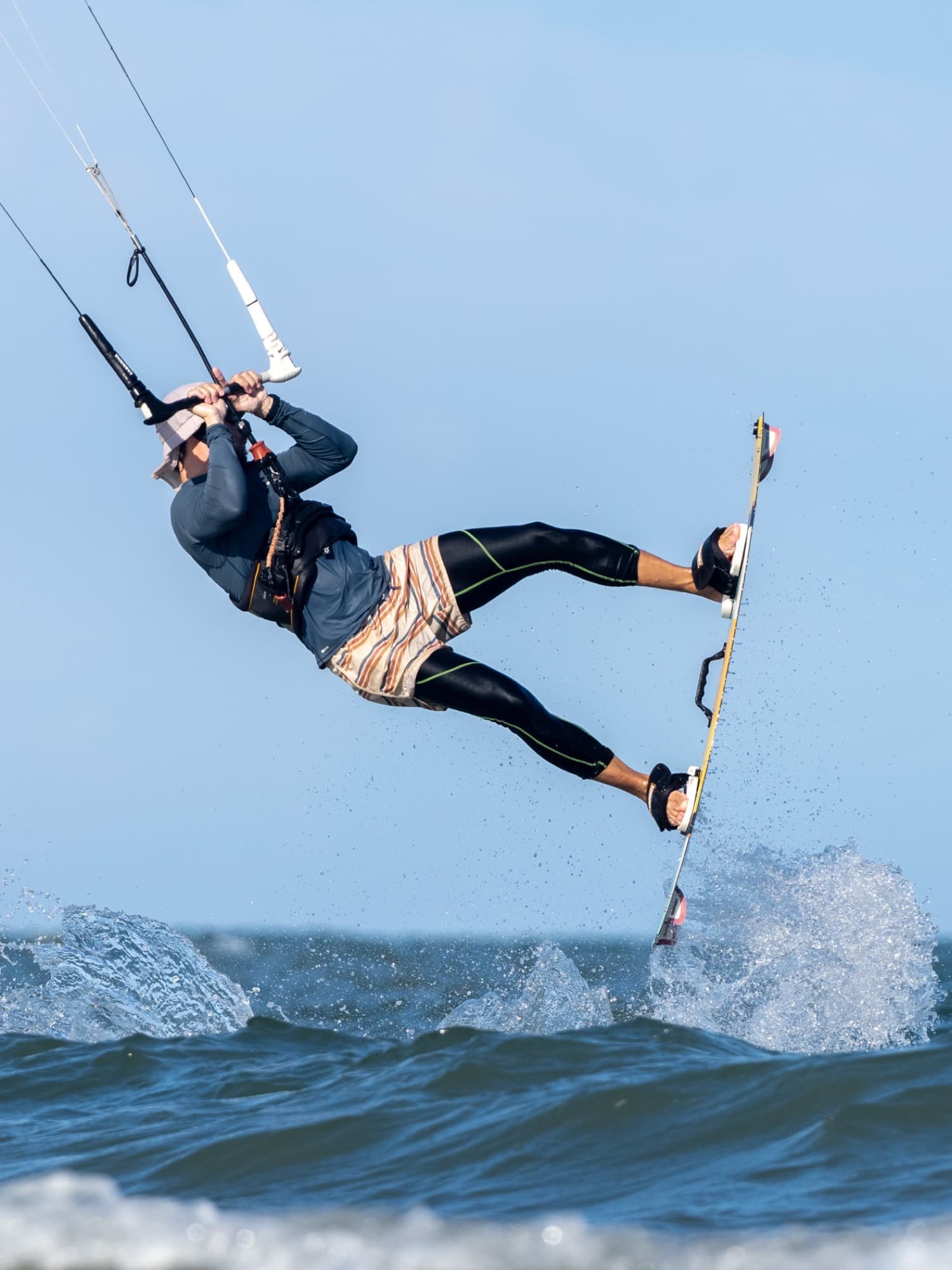
What it is. A large airborne kite (wing) on lines pulls you while you stand on a small board and steer the kite via a bar. The wind fills the kite, the kite pulls you across the water and, if you want, lifts you into the air. You need wind, usually a working range of 12–25 knots.
Difficulty. Honesty matters most here. The safety foundation in kiting is longer than in SUP or early windsurfing: you need to understand the lines, the "wind window", and how the quick-release (rapid-detach system) works — so kiting is always learned with an instructor, never "from videos". But here's the good news: once the basics are in place, with steady wind you reach your first independent riding fairly quickly — especially in the even, predictable wind we have in Pak Nam Pran.
What it depends on. On wind of 12–25 knots. In a calm the kite won't fly; in a storm it's dangerous. But you don't need waves: kiting works great on flat water.
Pros: a huge range — from calm relaxed riding to jumps, hang time and freestyle; a powerful boost upward the others don't offer; gear more compact than windsurfing — the kite packs down, the board is small; quick progression to riding after the basics; thrill and speed.
Cons: a mandatory safety foundation and lessons with an instructor; dependence on wind; the first hours require discipline and attention to safety.
Who it's for. Those who want wind, speed, jumps, compact gear and real thrill — and are ready to spend their first lessons building a solid foundation. For a detailed look at learning from scratch, see: /blog/obuchenie-kajtsurfingu-s-nulya. And we honestly cover the fears and real risks here: /blog/opasen-li-kajtsurfing.
Comparison table
- What nature must provide — Calm water — Waves (surf spot) — Wind — Wind 12–25 knots
- Ease of entry — Very easy — Tough start — Moderate start — Longer base, then quick
- Time to first kick — Minutes — Weeks–months — A day (straight), planing far off — A few lessons with the base
- Gear — Board + paddle — One board — Bulky, hard to carry — Compact, kite packs down
- Thrill and speed — Low — Medium (on a wave) — From cruising to high — High, jumps and hang time
- Dependence on conditions — Minimal — High (no wave, no sport) — Medium (needs wind) — Medium (needs wind)
- Instructor needed — Helpful, not critical — Helpful — Helpful — Mandatory (safety)
- Who it suits — Calm, family, all ages — Wave lovers — Sail and classics fans — Wind, speed, jumps, thrill
How to choose for yourself
Strip away the romance and the choice comes down to a few simple questions to ask yourself.
- Want calm, no dependence on weather, for the whole family and any age? → your pick is SUP. The easiest entry and relaxed time on the water.
- In love with waves and have somewhere to travel for a real surf spot? → your pick is surfing. Prepare for a long foundation — but also for incomparable sensations.
- Like the sail and the classics, and bulky gear doesn't scare you? → your pick is windsurfing.
- Want wind, speed, jumps, compact gear and thrill? → your pick is kitesurfing. The first lessons go to the safety foundation, but after that — open space and flight.
One more honest point: these sports aren't rivals. Many combine SUP for calm days and kite for windy ones, and it's a great pairing — SUP doesn't depend on weather, and kite brings the adrenaline when it cranks up. And if you're already eyeing a wing on the water, it's worth comparing kite and wing foil separately — we did that here: /blog/ving-fojl-ili-kajt.
What about Hua Hin and Pak Nam Pran
Here geography decides for us. Hua Hin bay and Pak Nam Pran mean long sandy beaches, a wide shallow zone, steady predictable wind and calm flat water. The combination of "even wind + flat" is close to ideal conditions for two things: kitesurfing and SUP.
Pure surfing, on the other hand, is almost absent here: there are few waves in the bay, it's not a surf spot. So if your dream is specifically surfing on a wave, Hua Hin isn't the spot on the map. But for starting in kiting it's one of the best places in Asia: shallow, even, safe, with soft and predictable wind — pleasant and quick to learn on. And on a calm, windless day you can always grab a SUP and just cruise the water.
That's exactly why, when beginners come to us asking "where do I start", we most often suggest kiting: the conditions work for you, the safety foundation is covered under an instructor's eye, and with our even wind you reach independent riding quickly. More on the method, prices and formats is on the /obuchenie page.
Shall we go riding?
Write to us — tell us what you want from the water (calm, waves, wind or jumps), and we'll honestly suggest which sport fits you best and whether to start with kiting right here with us. WhatsApp +66 98 367 9769, Telegram bot @JollyKite_kite_bot.
FAQ
What's easiest for a beginner — SUP, surf, windsurf or kite?+
The easiest entry is SUP: standing on the board and paddling works within minutes, and you need neither wind nor waves. Surfing is hardest at the start because of the long work with waves. Windsurfing gives a quick first "I'm moving" feeling but a long road to speed. Kiting has a longer safety foundation, but after it, with steady wind, you reach riding fairly quickly.
How does kitesurfing differ from windsurfing?+
In windsurfing the sail is rigidly fixed to the board and you hold the boom — the gear is one piece, bulky and heavy to carry. In kitesurfing a separate kite on lines pulls you, steered by a bar, and the board is small and separate. The kite is more compact, delivers powerful jumps and a wide riding range, but requires a more serious safety foundation at the start.
Do you need wind or waves to start?+
It depends on the sport. SUP needs nothing but calm water. Surfing absolutely needs a wave and a surf spot. Windsurfing and kitesurfing need wind: the kite's working range is usually 12–25 knots. A wave isn't required for kiting — it rides great on flat water.
What's safer for a beginner?+
SUP is the gentlest: falling off it is safe and low. Kiting has a longer safety foundation (lines, the wind window, the quick-release system), which is why it's always learned with an instructor — and with that approach it becomes controllable and safe. The main rule for any wind sport: start with proper lessons, not "from videos".
What suits a start in Hua Hin and Pak Nam Pran?+
Here the steady wind and calm flat water are ideal conditions for kitesurfing and SUP. There's almost no pure surfing in the bay: few waves. For a beginner who wants thrill, it's one of the best places in Asia to start kiting; and for calm, windless days there's always SUP.