
Is kitesurfing dangerous? An honest look at the risks and safety
"Isn't it dangerous?" is probably the most common question we hear from people just starting to consider kitesurfing. And it's a fair question: from the outside it looks like a person is being dragged across the water by a huge wing, sometimes launched into the air, all of it a little on the edge. Let's look at it calmly and by the facts — no scaremongering, but no sugar-coating either.
27 June 2026 · JollyKite
What the data says
Let's start with the key fact that removes half of the unfounded fear: most kitesurfing injuries are minor. Not serious fractures or disasters, but the kind of thing that happens in any nature-contact sport.
If you look at the breakdown of injuries, the picture is roughly this:
- Cuts and grazes — about 23–25% of cases. Most often from the board, from shells and rocks in shallow water, or from the lines.
- Bruises — about 20%. From falls, contact with the water at speed, or with your own gear.
- Sprains — about 17%. Mainly ankle and knee, from awkward landings and sudden loads.
So the three most common categories are things almost any active person runs into. Serious injuries do happen, but they're a minority and, importantly, are more often linked to jumps and tricks rather than basic riding.
Now about frequency. By available estimates, injuries occur at a rate of roughly 7–10.5 per 1,000 hours of riding. To put that in perspective: 1,000 hours is a lot of time on the water — years of regular sessions for an amateur. But here's what really matters: for beginners with less than a year of experience the rate is noticeably higher — around 17.5 per 1,000 hours.
That gap is the main takeaway of this section. Risk in kitesurfing isn't fixed — it falls with experience. The most vulnerable period is the first few months, when movements aren't yet automatic and your feel for the wind is only forming. And that period is exactly the one that makes most sense to go through with an instructor rather than alone by trial and error.
What actually causes problems
If you break down the causes of incidents, an uncomfortable but reassuring thing emerges: in the vast majority of cases the culprit isn't "the danger of the sport itself" but the human factor. And the human factor is something you can influence.
Here's how the causes break down by available estimates:
- Rider errors, often from fatigue — up to ~77%. The clear leader. A tired person reacts slower, reads gusts worse, overestimates themselves and depowers the kite too late. Most problems start with "just one more last run".
- Lack of experience — about 16%. The very gap from the previous section: a beginner can't yet anticipate how the kite and wind will behave.
- Loss of control over the kite — about 11%. An overpowered kite, an unexpected gust, riding into a zone of strong pull.
- Equipment failure — about 3%. A rarity. Modern gear is reliable, and hardware failures are almost never the cause of serious problems.
Worth singling out separately are gusty wind and big jumps. Statistically, the most serious injuries happen precisely in jumps and tricks, especially in unstable, gusty wind when the kite can suddenly "shoot" with power. Basic riding on flat water in steady wind is a completely different story in terms of risk.
The conclusion of this section is simple and important: the main risk factors are fatigue, haste, inexperience and disrespect for the conditions. None of them is inevitable. All of them can be influenced through training, discipline and choosing the right moment to go on the water.
Why it's safer now than before
If you've heard scary kitesurfing stories somewhere, there's a good chance they date from the early 2000s. Back then the gear really was raw: kites depowered poorly, emergency release systems barely existed, and a runaway uncontrolled wing was a real problem. Since then the industry has come a long way.
Today every modern kite has a well-thought-out safety system with two levels of release:
- Depower on the bar. Just let go of the bar and, by changing the angle of attack, the kite loses most of its pull. This is the first, fastest reflex: your hand simply opens and the wing "deflates".
- Quick release on the harness. If that's not enough, with a push-away motion of one hand you activate the quick release — and the kite detaches from the harness, "flags out" on a single line and stops pulling.
This is standard, not an option. A modern kite is designed so you can kill the power in a fraction of a second, with one hand, even under stress. Compared with early-2000s gear this is a huge step forward — and one of the main reasons kitesurfing today is noticeably more predictable and safer.
We've written separately and in detail about how the safety system, leash, quick release and flagging out work: "Kite leash and safety system". That's the foundation it's important to understand and drill from the very start.
What reduces the risk: a checklist
The good news is that almost all risk factors are manageable. Here's what actually makes kitesurfing safer, gathered into one list.
- Learn with an instructor. The most vulnerable period is the first few months, and it makes more sense to go through it supervised than alone. An instructor keeps you safe, builds the right habits and prevents typical beginner mistakes.
- Drill the quick release and self-rescue to reflex. Your hand should know the release motion in advance. Learning the gear during an emergency is too late.
- Ride in suitable conditions. Avoid offshore wind (blowing from the shore out to sea) — if you break down or tire, it carries you away from the beach. Avoid strong gusts and crowds on the water.
- Don't overpower yourself on kite size. The right size for your weight and the wind strength is half of safety. An overpowered kite is a common cause of losing control.
- Helmet and impact vest — when appropriate. During lessons, in waves, and in shallow water with a hard bottom, a helmet and a buoyancy vest won't go amiss.
- Don't overestimate yourself — progress step by step. Build up gradually: confident basic riding first, then jumps and tricks. Most serious injuries are an attempt to skip a step.
- Watch the forecast. Check the wind in advance, don't go out in unstable, squally conditions, and don't ride yourself to exhaustion.
- Keep your distance from people, kites, boats and obstacles — on the beach and on the water.
None of this takes heroism. It's just discipline and common sense — and they're exactly what turns a "dangerous sport" into a manageable, hugely enjoyable one.
Why it matters to start with an instructor and at the right spot
If we boil all of the above down to one thought, it's this: risk in kitesurfing is mostly the risk of inexperience and wrong conditions. Which means two decisions remove most of the problems right at the start — learning with an instructor and starting at a suitable spot.
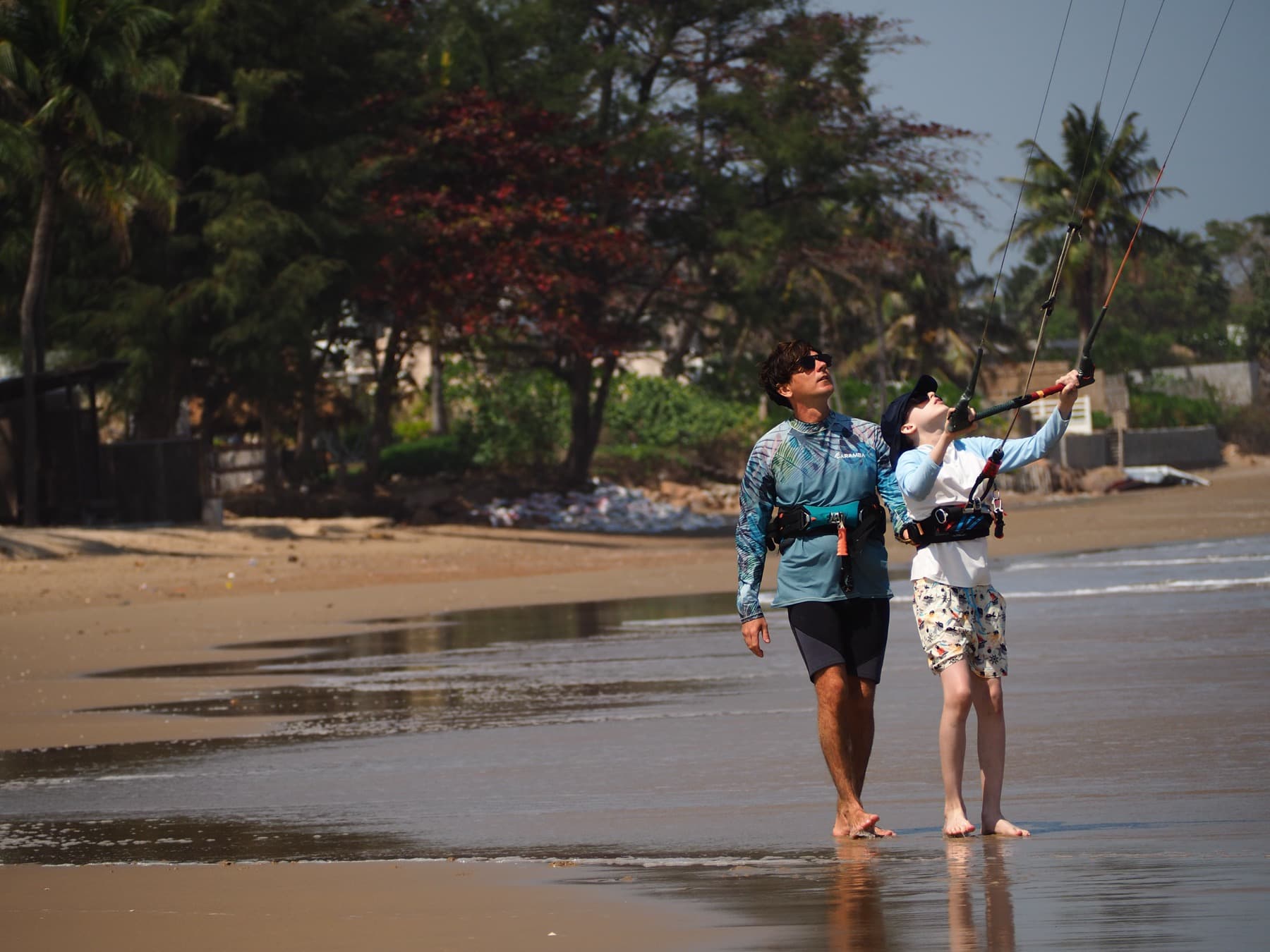
With an instructor you go through the most vulnerable first period supervised. You don't have to guess on your own which kite size to take, how to attach the leash or what to do in a gust — there's someone next to you keeping you safe and building the right reflexes. The gear during lessons is checked and tuned, the safety system is sound. This sharply cuts that "beginner" injury rate. We've described how learning from scratch works separately: "Learning to kitesurf from scratch".
The same goes for the spot. A place for your first steps should forgive mistakes. Pak Nam Pran is exactly that: flat, shallow water where you can stand on the bottom and calmly repeat a movement, plenty of space without crowds, and side-shore wind (along the beach) that doesn't carry you out to the open sea. This greatly lowers the cost of a mistake — and at the start mistakes are inevitable. For what wind there is here and when, read "Wind season in Hua Hin and Pranburi month by month".
Put the two together — proper training plus the right spot — and a sport that sounds frightening turns into a calm, controlled way of learning a new skill.
Let's go riding?
If the fear is there but the interest is stronger — that's normal and right. Send us your weight, level and preferred dates: we'll match the gear to the wind, start on flat shallow water, drill the safety system and go step by step, without haste or heroics. Booking and prices are on the /obuchenie page, contact us via /kontakty. WhatsApp +66 98 367 9769, Telegram bot @JollyKite_kite_bot.
FAQ
Is kitesurfing dangerous for a beginner?+
There are risks, and for beginners they're objectively higher: estimates put the injury rate in the first year of experience at around 17.5 per 1,000 hours versus 7–10.5 for more experienced riders. But almost all of these risks are manageable. The most vulnerable period is the first few months, and it makes sense to go through it with an instructor rather than alone. Most beginner injuries come from lack of experience and fatigue, not from some unavoidable "danger of the sport". With instructor-led training, drilled safety systems and riding in suitable conditions, the risk for a beginner becomes manageable.
What kinds of injuries happen in kitesurfing?+
Most injuries are minor. The most common are cuts and grazes (about 23–25% of cases) — from the board, shells and lines; bruises (about 20%) from falls; and sprains (about 17%), mainly of the ankle and knee. Serious injuries do happen, but they're a minority and statistically are more often linked to jumps and tricks, especially in gusty wind, rather than to basic riding on flat water.
Can you learn kitesurfing safely?+
Yes — and that's the whole point of proper training. Most incidents are caused by the human factor — errors from fatigue (up to ~77%), lack of experience (~16%), loss of control over the kite (~11%) — and not at all by equipment failure (just ~3%). All of this is manageable: training with an instructor, drilling the quick release and self-rescue, gradual step-by-step progression, the right choice of conditions and kite size. The modern safety system with two levels of release lets you kill the power in a fraction of a second. With this approach, learning is calm and controlled.
Do you need a helmet in kitesurfing?+
In a number of situations — yes, and it certainly won't go amiss. A helmet and a buoyancy vest are worth wearing during lessons, when riding in waves, and in shallow water with a hard bottom where there's a risk of hitting your head on the bottom or the board. It's a simple measure that reduces the severity of a possible injury. During lessons your instructor will advise when protection is appropriate for your specific conditions.
What do you do if you lose control of the kite?+
Use the safety system — that's what it's there for. The first reflex is to let go of the bar: thanks to depower the kite immediately loses most of its pull. If that's not enough, a push-away motion of one hand activates the quick release on the harness — the kite detaches, flags out on a single line and stops pulling. It's important to drill these movements to reflex in advance, in shallow water and light wind under an instructor's supervision, so that in a real situation your body knows the sequence without thinking. There's more detail in the article on the leash and safety system.