
Wing foil or kitesurfing: which one should you choose
These days, alongside the kiters on the beach, you will see people holding an inflatable «wing» and gliding above the water on a thin board as if there were no wind at all. That is wing foiling — the fastest-growing water sport of recent years. And almost everyone who wants to learn something on the water hits the same question: where do I start, wing or kite?
27 June 2026 · JollyKite
There is no universal «better» here. There is only your goal. If what matters most is the simplest, safest possible start and compact gear, wing foiling is closer. If you are drawn to high jumps, freestyle, waves and pure adrenaline, with a big community around you, kitesurfing is closer. This article is not about bashing one sport to promote the other. It is a comparison built around your goal.
Upfront: JollyKite is a kite school — we have been teaching kitesurfing in Thailand since 2014, and that is our strong side. But we ride the foil too, we see how fast wing is growing, and we are not going to pretend it does not exist. So below is a balanced take on both sports.
In short: who should pick wing, who should pick kite
If you do not have time to read it all — here is the gist in three lines.
- Wing foiling is closer for you if you want the simplest, safest start, compact gear that is easy to carry and travel with, and you like the very idea of calmly flying above the water, including in light wind.
- Kitesurfing is closer for you if you are drawn to jumps, height, hangtime, freestyle and waves, you want powerful adrenaline and a big, lively community around the sport.
- You can combine both: many people today ride both — they start with one and add the other depending on mood and wind.
What it is and how it works
The main difference between the two sports is in the gear itself, and almost everything else flows from that.
Wing foiling. You hold an inflatable «wing» in your hands. It is not attached to you by lines: you simply hold it by the handle and catch the wind like a sail. You stand on a board with an underwater wing — the foil. As speed builds, the foil generates lift, the board rises off the water, and you glide above the surface almost silently. No lines, no bar, no powerful canopy in the sky — all the gear is compact and fits in a small bag.
Kitesurfing. Here you are pulled by a kite — a large canopy in the sky on lines, which you steer through a bar. The kite sits in the so-called wind window, and you have to steer it deliberately: send it to the zenith, drop it toward the water, hold the power. The board is usually a regular planing board (though foils exist in kiting too). The gear is bulkier: kite, bar, lines, harness, pump.
To simplify: with wing, the wind's power is in your hands and not tied to your body; with kite, it is a powerful canopy high in the sky on lines. That is where all the difference in feel, learning and safety comes from.
What's easier at the start and what about safety
Probably the most common question — and here wing has an honest advantage, but with an important caveat.
Wing is easier and safer specifically at the start. The wing is not attached to you by lines; you can simply let it go or fold it at any moment, and the power disappears. There is no wind window to keep in your head, no risk of a powerful canopy dragging you down the beach. Self-rescue is simpler: you hold on to the board and the wing and get back to shore calmly. The gear is light and easy to carry to the water alone. All of this lowers the entry stress and fear — and at the start, fear is exactly what slows progress the most.
Kite needs more time on basic safety. Before you stand on the board, you have to learn to control the canopy on lines, understand the wind window, practise launching and landing the kite, know the quick-release and self-rescue. That does not mean kite is dangerous — with an instructor and the rules followed, it is safe. But the basic safety set is larger here, which is exactly why kite is learned with an instructor, not «from videos».
And the honest caveat about wing. «Easier» is about the very start — handling the wing and basic safety. After that comes the foil, and balancing on an underwater wing is no small thing. The first attempts to get up on the foil mean a lot of falls, a feeling that the board has a life of its own, and not the fastest progress. So wing is not an «easy sport overall» — it is gentler on entry but demands its own patience at the foil stage.
Jumps, tricks and adrenaline
If you are drawn to the air — this one leans toward kite.
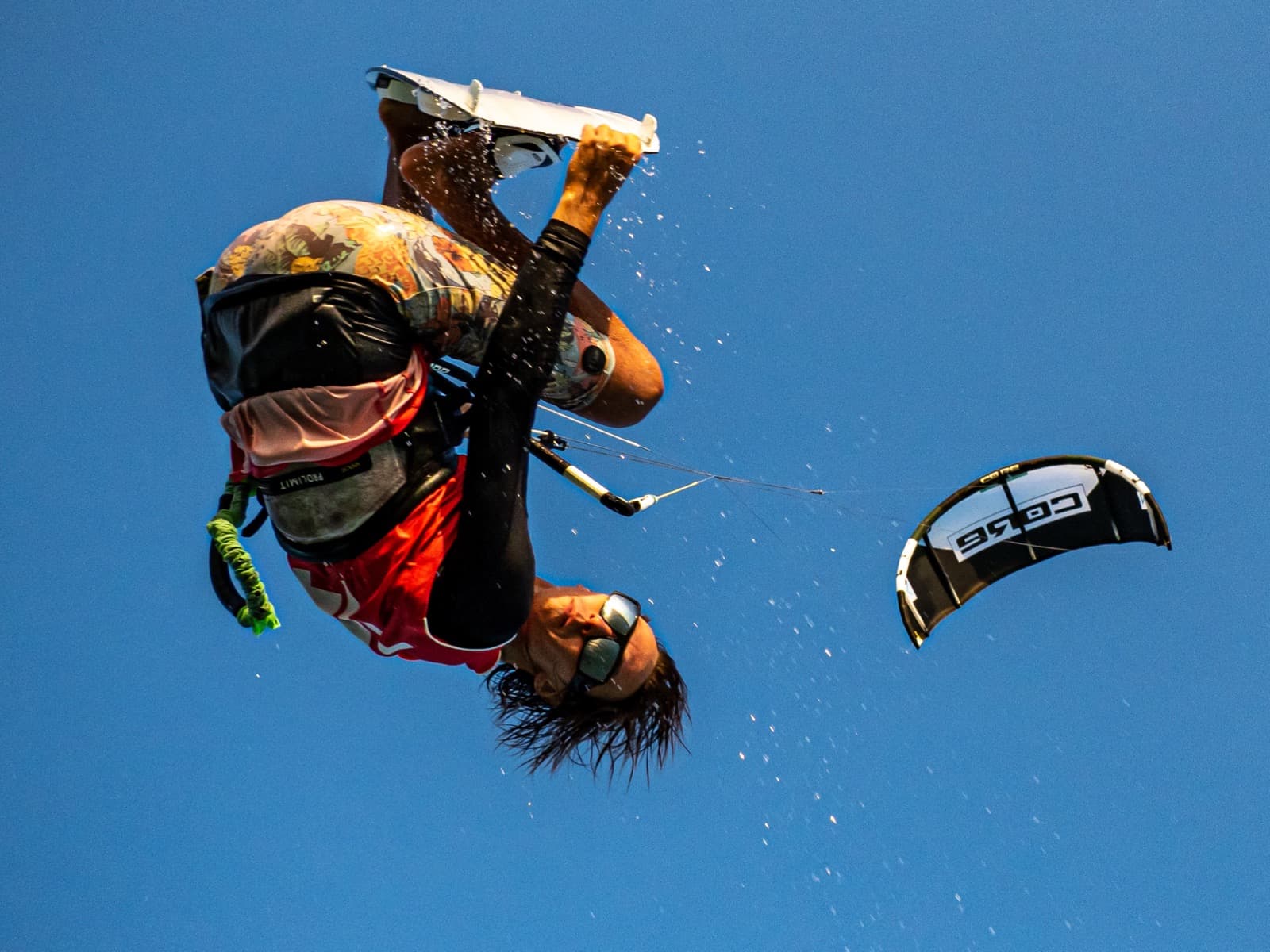
Kitesurfing is the king of jumps. The powerful canopy gives a huge boost upward and long hangtime: on a kite you can genuinely hang in the air for several seconds, jump high, spin rotations, learn a huge arsenal of freestyle tricks, kiteloops and wave riding. The range of styles is very wide — from powerful big air to technical freestyle and wave surfing. That is exactly why those who want adrenaline and growth «in height» gravitate to kite.
Wing foiling is more about flight and smoothness. People jump on wings too, there are tricks and foil freestyle, and the sport is developing fast technically. But the powerful boost and hangtime at kite level simply are not there by nature: the power is in your hands, not on lines in the sky. What wing gives instead is a different pleasure — silent gliding above the water, smoothness, control. It is not worse, it is just a different kind of joy.
In short: for high jumps, freestyle and wave drive — go kite; for smooth gliding — go wing.
Wind and gear
Two very practical parameters that often decide everything.
Light wind. Here wing foiling wins confidently. The underwater wing generates lift at low speed, so the foil goes where a regular kiteboard is already out of wind. If the wind in your region is often light and unstable, wing foiling will give you far more ridable days.
Steady, strong wind. This is where kite shines. When there is enough wind and it is steady, the kite delivers powerful pull, boost for jumps and full-on adrenaline. For jumps and freestyle, steady wind is a feast — and kite has no equal there.
Gear. Wing is more compact: wing, foil and board take up little space, fit in a single bag, are easier to fly with and carry to the water alone. The kite kit is bulkier — kite, bar, lines, harness, pump, board — and different winds call for different kite sizes. For travel and storage, wing is noticeably more convenient.
Side-by-side comparison
- In hands / on lines: wing — inflatable wing in your hands, not line-attached; kite — canopy on lines, steered via a bar.
- Board: wing — on a foil (underwater wing); kite — regular board, foil optional.
- Ease of start: wing — easier and safer on entry; kite — longer to learn basic safety.
- Main difficulty: wing — balance on the foil; kite — steering the canopy and the wind window.
- Self-rescue: wing — simpler, you can let the wing go; kite — harder: quick-release, self-rescue, rules.
- Jumps and boost: wing — modest, no strong hangtime; kite — huge boost and long hangtime.
- Tricks, freestyle, waves: wing — present, the sport is growing; kite — a very wide arsenal, king of tricks.
- Light wind: wing wins, it foils in light wind; kite needs more wind.
- Strong and steady wind: wing — good; kite shines fully.
- Gear: wing — compact, fits one bag; kite — bulkier, different kite sizes.
- Community and infrastructure: wing is growing fast but smaller for now; kite has a large, developed scene with many schools.
- Learning with an instructor: recommended for wing, essential for kite.
Can you combine them
Yes, and these days it is common. Wing and kite are not enemies to the death — many riders ride both, picking the gear to match the wind and mood: in light wind they grab the wing, in strong and steady wind, the kite.
The starting logic is flexible. You can begin with kite — especially if there is a big school, infrastructure and a community nearby — and then add wing for light days and calm gliding. Or the other way around: ease into the sport gently via wing, then master kite later for jumps and adrenaline. There is no universal «right order» — there is what is available near you and what suits your character.
Our honest verdict
We will not pretend kite is better at everything — that would be untrue. Here is how we see the choice.
- Want a simple, safe start, compact gear, calm gliding, and you often ride in light wind — your option is wing foil. It is gentler on entry and easier on logistics.
- Want jumps, height, hangtime, freestyle, waves, powerful adrenaline and a big community around it — your option is kitesurfing. For adrenaline and trick arsenal, nothing matches it yet.
- Want it all — combine them. Many people do: wing for light wind, kite for strong.
And one last honest point: both sports require learning. Wing being «easier» is about the very start and basic safety; after that, balancing on the foil is tricky and takes time too. There are no effort-free shortcuts in either sport — just different kinds of difficulty.
JollyKite specialises in kite. If jumps, adrenaline and a big community sound like you, we will gladly get you on the board in Thailand, in Pak Nam Pran, on a steady safe spot with a Russian-speaking instructor. Send us your level and goal — and we will honestly tell you what suits you: kite, wing, or both in turn.
FAQ
What's easier to learn — wing foil or kitesurfing?+
At the very start, wing foil is easier: the wing is not attached to you by lines, you can let it go at any moment, there is no wind window, self-rescue is simpler, and the gear is light. But «easier» is about the entry; after that comes balancing on the foil, which is tricky. Kite needs more time on basic safety, but it is learned clearly and through a proven school method.
What's safer — wing or kite?+
At the start, wing feels safer: there is no powerful canopy on lines, and the power is easy to dump by letting the wing go. Kite has a larger basic safety set — wind window, quick-release, launching and landing, self-rescue — which is why kite is learned with an instructor. With an instructor and the rules followed, both sports are safe.
What's better for jumping — wing or kite?+
For high jumps and long hangtime, kite is better: the powerful canopy gives a big boost upward and a wide arsenal of freestyle tricks. People jump on wings too, and the sport is developing fast, but the kite-level boost simply is not there by nature — wing is more about smooth gliding than height.
What should I choose if our wind is light?+
In light wind, wing foil wins. The underwater wing generates lift at low speed, so the foil rides where a regular kiteboard is already out of wind. If your region often has light, unstable wind, wing will give you more ridable days. For strong, steady wind, kite is the great fit instead.
Can you do both wing and kite at the same time?+
Yes, many people do. Wing and kite complement each other well: in light wind you grab the wing, in strong and steady wind, the kite. You can start with either: with kite if there is a big school and community nearby, or with wing for a gentle entry, then add the second later.