
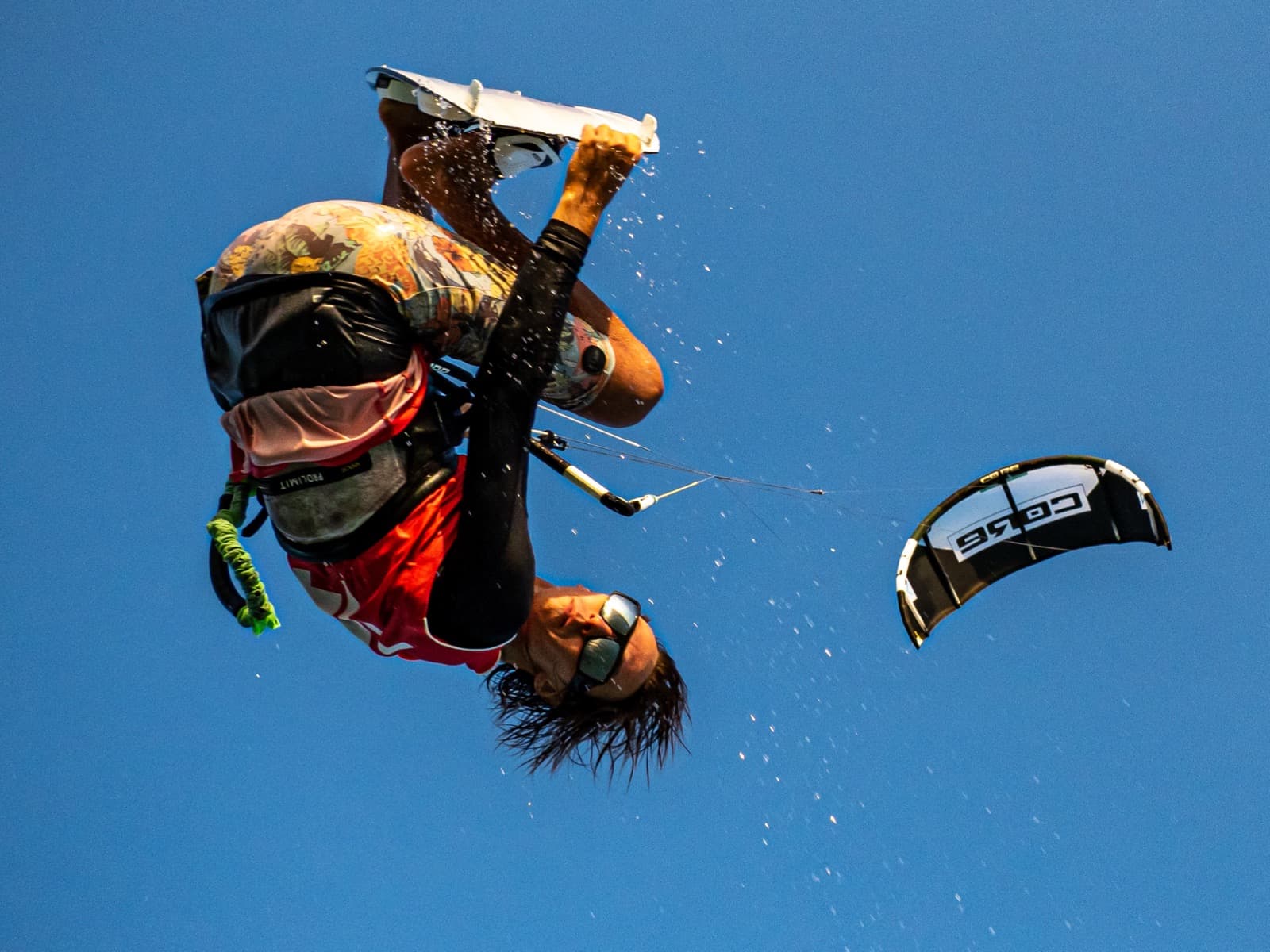
Wave riding gear: how to choose a directional board and a wave kite
The right directional board and wave kite can make the difference between enjoying the waves and struggling with them. A twintip and a freestyle kite are not built for waves: the board will not hold a line on the wave face, and the kite will not drift. That is why getting into wave riding almost always starts with changing your gear.
22 July 2026 · JollyKite
This is not about strapless technique — we cover that separately. Here it is only about the choice: which board to take by volume, length, weight and level, straps or strapless, and which kite will handle the wave — drift, turning, depower. And for which wave: at home in Pak Nam Pran we have shallow chop and small waves, while trips can serve up a serious reef break.
Let's break it down without the marketing hype. The goal is for you to buy one kit and ride, instead of building a quiver through expensive mistakes.
The directional board: where to start
A directional board (also called a surfboard or wave board) has a nose and a tail and rides one way. It has rocker (the curve of the profile), fins, and usually a grippy deck for bare feet or straps. It rides like a surfboard: you surf the face of the wave rather than dragging yourself with the kite.
Three parameters decide almost everything: volume, length, and whether it has straps. Let's take each one — that is how you match the board to your weight and level.
Volume: float and forgiveness
Volume (in litres) is about float. More litres means the board sits higher on the water, planes earlier in light wind, and forgives more mistakes. A lower-volume board generally feels more responsive, sharper in turns, but it demands both wind and technique.
- Choose a board with more volume if you’re new to wave riding, ride in light to moderate wind, weigh above average, or just want comfort and an early start. A board like this pulls you onto the plane even at the edge of the wind range.
- Less volume — if you surf confidently, chase strong wind and real waves, and value responsiveness and tight radii. A lower-volume board may sink when you slow down, but it responds more precisely.
If you're new to wave riding, choose a board with a little extra volume. That extra litre forgives a botched start and keeps you planing when the wind drops — and wind conditions at our Thai spot can vary.
Length: manoeuvrability versus drive
Length sets the character. A short board (roughly 5'0–5'6) is whippy, turns tight radii, cuts the wave face quickly — but it demands technique and sinks sooner on the pause. A long one (5'8–6'2) holds drive, planes earlier, tracks straighter and works better in light wind — but turns more lazily.
A rough guide by weight and level (a guide, not a law):
- up to ~65 kg: around 5'2–5'6
- 65–80 kg: around 5'6–5'10
- 80–95 kg: around 5'10–6'2
An improving rider is smart to go a touch longer and higher-volume than the top of the range — a steadier start, an easier line to hold, fewer nasty falls. An experienced wave rider may prefer a shorter, lower-volume board, for a sharp turn. If you want to dig deeper into board geometry, we have a general guide on choosing a kiteboard.
Straps or strapless
The main decision for riders switching to a directional board. Three options:
- With straps. The board stays on your feet in chop and jumps, it is easier to start, and you do not lose it in a fall. A good way in: you get used to a directional board without fighting a lost board. The downside is less surf freedom — you cannot reposition your feet.
- Strapless. A more natural surfing feel: your feet are free, the board obeys foot pressure, you move your feet for sections and turns. That is how most wave riders ride. The downside is the board comes off easily, starting and holding it are harder, and you need a base.
- A single front footstrap — a compromise between control and freedom. A front strap gives a bit of control while keeping freedom. A sensible transition from straps to pure strapless.
Our advice for beginners: start with straps or a single centre strap, and take them off once the board stops running away from your feet. Pure strapless technique is a separate job — we cover it in the article on strapless wave riding.
The wave kite: what matters on the wave
A wave kite differs from freestyle and freeride kites not in «coolness» but in character. On the wave the kite steps into the background: the wave gives the drive, and the kite should hang calmly and not get in the way. Three qualities decide everything.
Drift. The main property of a wave kite. Drift is the kite's ability to fly along the line of the wave and not fall when you drop the pull and surf on the board. Without drift the kite drops the moment you stop pulling it — and the surfing breaks. A good wave kite «flies by itself».
Turning. The kite has to move through the window fast and precisely, in tight radii. That is needed to keep it along the line of the wave, to flip it quickly through turns, and to work strapless freestyle. A sluggish kite falls behind you in the wave.
Depower. Long depower lets you cut the pull to almost zero and work the wave with your feet and board rather than your hand on the bar. The deeper the depower, the cleaner the drift and the calmer the kite on the pause.
By construction, wave kites are most often three-strut deltas and hybrids: those are exactly what give drift, turning and stability. But you do not have to pick one model: there are pure wave kites and there are do-it-all crossovers. We put together a detailed comparison of the two approaches using CORE — a specialised wave kite versus an all-rounder — in a separate article.
Specialist or all-rounder
If you ride mostly waves and want the maximum on them — take a specialised wave kite (in the CORE line that is the Section). It gives the best drift and depower, but it is narrowly focused.
If you want one kite for everything — waves, freeride, a bit of freestyle — take a crossover all-rounder (CORE's Nexus). In waves it performs slightly less well than a dedicated wave kite, but it covers most sessions and doesn't require a separate quiver. For your first own kite after lessons, that is almost always the smarter call. If you have not settled on a kite type at all, start with the basics.
What size
You pick the wave kite's size by wind, just like always: lighter wind — bigger kite, stronger — smaller. In typical wind at our Thai spot (15–22 knots on average) that is roughly 9–12 m for most riders, and on strong days people drop to 7–8 m. A smaller kite also turns faster — a plus on the wave. The exact size depends on your weight and the wind on the day; in lessons and rentals we match it to you.
For which wave: Pak Nam Pran and beyond
You choose gear for the wave you will ride most often. And the wave differs from spot to spot.
Pak Nam Pran and the spots around Hua Hin. Our water is shallow chop and small waves: wind swell rather than long clean reef walls. For those conditions a higher-volume board and a touch longer makes sense (it planes earlier in moderate wind), and a kite with good drifting characteristics, to maintain stable flight even when line tension drops on smaller waves.
A real break on trips. Reef and point breaks (Bali, Sri Lanka, Oman, safaris) give a long, steep wave. There a shorter, lower-volume board with more rocker for a sharp turn suits better, and a kite with maximum drift and depower. If you are planning trips like that, buy a board with them in mind, not just for your home chop.
There is no universal answer. But if you are unsure, bet on comfort: a higher-volume board and a kite with good drifting characteristics will handle both the shallow chop of Pak Nam Pran and your first trip to a real wave.
How not to overbuy
The typical mistake on entry is assembling a «dream quiver» for a wave you do not yet surf. Expensive and pointless. The sensible path is shorter:
- One all-rounder kite of the right size — it covers both waves and freeride while you grow.
- One directional board with spare volume and straps (or a centre strap) — you will build your base on it without fighting a lost board.
- Try before you buy. Ride the board and kite on the water before you pay. A couple of sessions on different gear saves more than any review.
Add more specialised equipment later — a shorter, lower-volume board, a dedicated wave kite or another kite size — once you understand which waves and what wind you actually ride. Gear for a discipline is best assembled as you grow, not in advance.
What's next
Gear is half the job. The other half is technique: how to read a wave, do a bottom turn and a cutback, and keep the kite drifting. Our breakdown of wave riding technique covers that. And the order of progress across disciplines is laid out in the JollyKite Trick School.
If you are just getting into kiting and the wave is still a long way off, start with the basics — learning to kitesurf from scratch. We'll help you choose gear suited to your weight, skill level and local wave conditions, let you try boards and kites on the water, and build technique under an instructor's supervision.
FAQ
Where do I start choosing wave riding gear?+
With two purchases: a directional board and a wave kite. A twintip and a freestyle kite will not do for waves — the board will not hold a line on the wave face, and the kite will not drift. You pick the board by volume, length and straps for your weight and level, and the kite by drift, turning and depower. For getting in, take a higher-volume board and an all-rounder kite.
How do I choose the size of a directional board?+
By weight and level. A rough length guide: up to ~65 kg — around 5'2–5'6, 65–80 kg — 5'6–5'10, 80–95 kg — 5'10–6'2. An improving rider should go a touch longer and higher-volume than the top of the range: a steadier start and an easier line to hold. A confident rider chasing a real wave goes shorter and lower-volume for a sharp turn. More volume forgives mistakes and planes earlier.
Straps or strapless on a directional board?+
For getting in, straps or a single centre strap are easier: the board stays on your feet, it is easier to start, and you do not lose it in a fall. Pure strapless gives the real surf feel and the freedom to move your feet, but it needs a base. The sensible path is to start with straps and take them off once the board stops running away from your feet.
What kite do I need for waves?+
A wave kite with three qualities: strong drift (the kite flies along the line of the wave and does not fall on the pause), fast precise turning, and long depower (you can cut the pull and work the wave with your feet). These are most often three-strut deltas and hybrids. The choice between a pure wave kite and a crossover all-rounder depends on whether you ride mostly waves or want one kite for everything.
What wave kite size should I take for Thailand?+
In typical Thai wind conditions (15–22 knots on average) it is roughly 9–12 m for most riders, and 7–8 m on strong days. A smaller kite turns faster, which is a plus on the wave. The exact size depends on your weight and the wind on the day — in lessons and rentals we match it individually.
Which board suits the waves at Pak Nam Pran?+
Our water is shallow chop and small waves, not long reef walls. For those conditions a higher-volume board and a touch longer makes sense: it planes earlier in moderate wind and forgives mistakes. For a real reef break on trips, riders take a shorter, lower-volume board with more rocker. If you are planning such trips, choose a board with them in mind.