
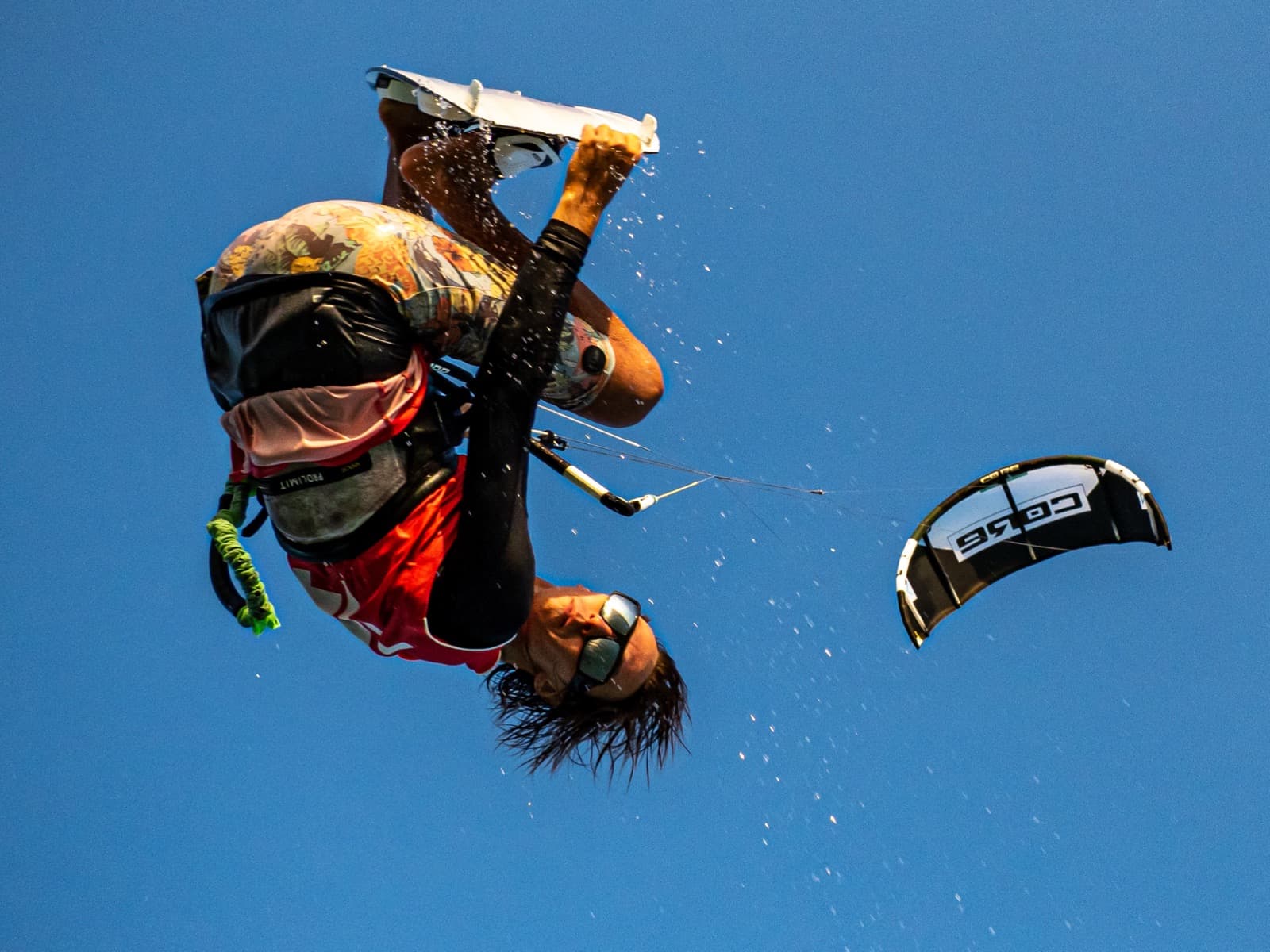
Strapless wave riding: the basics of riding waves on a kite
Wave riding is riding waves on a directional surfboard, most often without foot straps (strapless). Everything here is built around the wave: you do not drag yourself with the kite — the wave gives you the drive, and you read it like a surfer. It feels closer to surfing than to the usual twintip riding.
27 June 2026 · JollyKite
And it is not simply another level of the twintip — the logic here is different. On a twintip the kite is the engine: it pulls, accelerates, lifts you in the jump. In wave riding it all flips around: the engine is the wave, and the kite steps into the background, switching into a drift where it almost flies by itself. Your job is not to get in the wave's way — keep the kite low and along its line, and surf the face like on a regular surfboard.
Below we break down what you need before going out strapless in the waves, why kite drift is the key skill of the whole discipline, how to read and surf a wave, and which mistakes hold almost everyone back at the start. And separately — safety in the impact zone. This is an overview of the technique, not a replacement for in-person coaching: strapless in the waves is faster and safer to learn with an instructor.
What you need before going out in the waves
- Confident control of a directional board without straps. You ride a strapless board calmly, keeping it under your feet without losing it on every gust.
- Stable upwind on a surfboard. In the waves you are constantly pushed downwind, especially after turns.
- Toeside and basic gybes. Riding heelside and toeside plus simple gybe turns. Without this base you cannot ride along the wave or change direction along its line.
- Strapless water start. In the waves the board often comes off your feet, and you have to restart regularly.
- Comfort in the impact zone. You feel calm where the wave breaks: you do not panic, you understand how the water behaves, and you are ready for the chance of getting washed.
If all five describe you, move on to wave technique. If one of them is weak, fix it first on flat water or in small waves: it will save you dozens of unpleasant falls in the break.
Kite drift — the key skill
Drift is when the kite flies by itself: holding in the air with minimal pull, while you ride the wave separately from it. It sounds odd — we are used to the kite pulling. But here the wave accelerates you. A kite pulling at full power literally rips you off the face of the wave and does not let it accelerate the board. There is no surfing — just dragging across.
For the kite to drift, keep it low and deep in the window — closer to the edge of the wind window and lower, along the line of the wave, not at the zenith. In that position the kite keeps just enough lift not to fall into the water, but barely pulls you forward. That is the very pause of the kite in which the wave gets the right to accelerate the board.
The key counterintuitive idea: in wave riding you do not fly the kite actively. You hold it calmly and low and work with your body and the board. A beginner instinctively over-flies the kite back and forth through the window, trying to add pull — and that kills the drift. Drift does not come right away, and that is normal: at first the kite will either fall or rip you off the wave. Finding that fine balance is the main work of your first sessions.
How to read and surf a wave
- Pick a wall. Not every wave rolls the same. You learn to see which wave will give you a smooth, long, non-crumbling wall you can ride along.
- Stay in the pocket. The pocket is the steepest, most working part of the wave, just ahead of the foamy crest. It is the pocket that gives the drive: do not run too far ahead onto the flat part, and do not fall behind into the foam.
- Adjust speed with trim and gentle steering. Speed along the wave is set not by throttling the kite but by your position on the wave and light, careful steering inputs — gently, so as not to break the drift.
- Move your feet for sections and turns. The board has no straps and your feet are free: shift your weight fore and aft, reposition your feet for a top-turn at the crest and a bottom-turn at the base, just like a regular surfer.
The key idea: the wave gives the drive and the kite stays drifting. You surf the face of the wave rather than getting pulled off the board. The moment you start flying the kite instead of surfing, the wave is lost, and you are back to twintip logic — just on an awkward board.
Common mistakes
- Over-flying the kite instead of drifting. The most common mistake. The kite rips you off the wave and there is no surfing. Remember: the wave gives the drive, the kite drifts.
- Holding the kite too high. A kite at the zenith pulls upward and will not let the wave accelerate the board.
- Coming off the board. Without straps the board easily comes off your feet, especially if you yank yourself upward with the kite instead of surfing.
- Drifting away from the pocket. Run too far ahead and the wave stops rolling; fall behind into the foam and you get buried.
- Going into the waves without a base. Trying to surf without a confident strapless upwind, toeside and strapless water start turns every session into a fight for survival rather than learning.
Safety in the impact zone
In terms of consequences, strapless wave riding is the most serious of these disciplines, and the reason is the impact zone. The main danger is getting washed in the impact zone with the kite in the wave. A breaker buries you, the kite ends up in a working wave, and the lines under load in the foam behave unpredictably: they tangle, snap, or yank you sideways. This is not a situation to tough out — it is one where you act ahead of time and decisively.
Hence the basic rule: if the kite gets into the lip of the wave, be ready to fully release it via the quick release. Better to detach and lose a couple of minutes on a relaunch than to let loaded lines drag you in the break. A separate point is losing the board: without straps it easily separates from you in a fall, and in the break it drifts off. One more reason not to over-fly the kite but to surf calmly, keeping the board underfoot with foot pressure.
What is next
You enter strapless wave riding gradually: first a confident surfboard and drift on a gentle wave, then reading the wave and working the pocket, and only then a serious break and turning sections. If you are still choosing gear for the new discipline, see our piece on how to choose a kite: for waves and drift the selection logic is its own. And to understand where to move next in technique and in what order, check out the JollyKite Trick School.
We teach strapless in the waves under an instructor's supervision, with a breakdown of the specific spot, wind and state of the break, with radio comms on the water — which sharply lowers the risks of entering the discipline.
FAQ
What is strapless wave riding on a kite?+
It is riding waves on a directional surfboard, most often without foot straps (strapless). Unlike the twintip, the main engine here is not the kite but the wave itself: the kite switches into a drift and almost flies by itself, while you surf the face of the wave and read it like a surfer. It is a separate discipline, closer to surfing than to regular kiting.
What is kite drift?+
Drift is when the kite flies by itself with minimal pull, holding in the air while you ride the wave separately from it. For drift you keep the kite low and deep in the window, along the line of the wave, not at the zenith. It is the key skill of wave riding: the drive comes from the wave, and the kite must not rip you off its face.
What do you need before going out strapless in the waves?+
A solid base on the directional board: confident control of a strapless board, stable upwind, toeside and basic gybes, a strapless water start, and comfort in the impact zone. Wave riding is an add-on to confident surfboard riding, not a first step in kiting.
Is it dangerous to ride in the break?+
The impact zone is the most serious part of wave riding. The main danger is getting washed with the kite in the wave: lines under load in the foam can tangle, snap, or yank you sideways. The basic rule is — if the kite gets into the lip of the wave, be ready to fully release it via the quick release. That is why strapless in the waves should not be learned alone — better with an instructor.
How is a surfboard different from a twintip?+
A surf (directional) board has a nose and a tail and rides one way — to change direction you need a gybe; it is usually ridden strapless, steered by foot pressure, and built for surfing the wave and kite drift. A twintip is symmetrical, rides both ways without turning around, usually with straps, and is built for jumps and tricks where the kite pulls actively.