
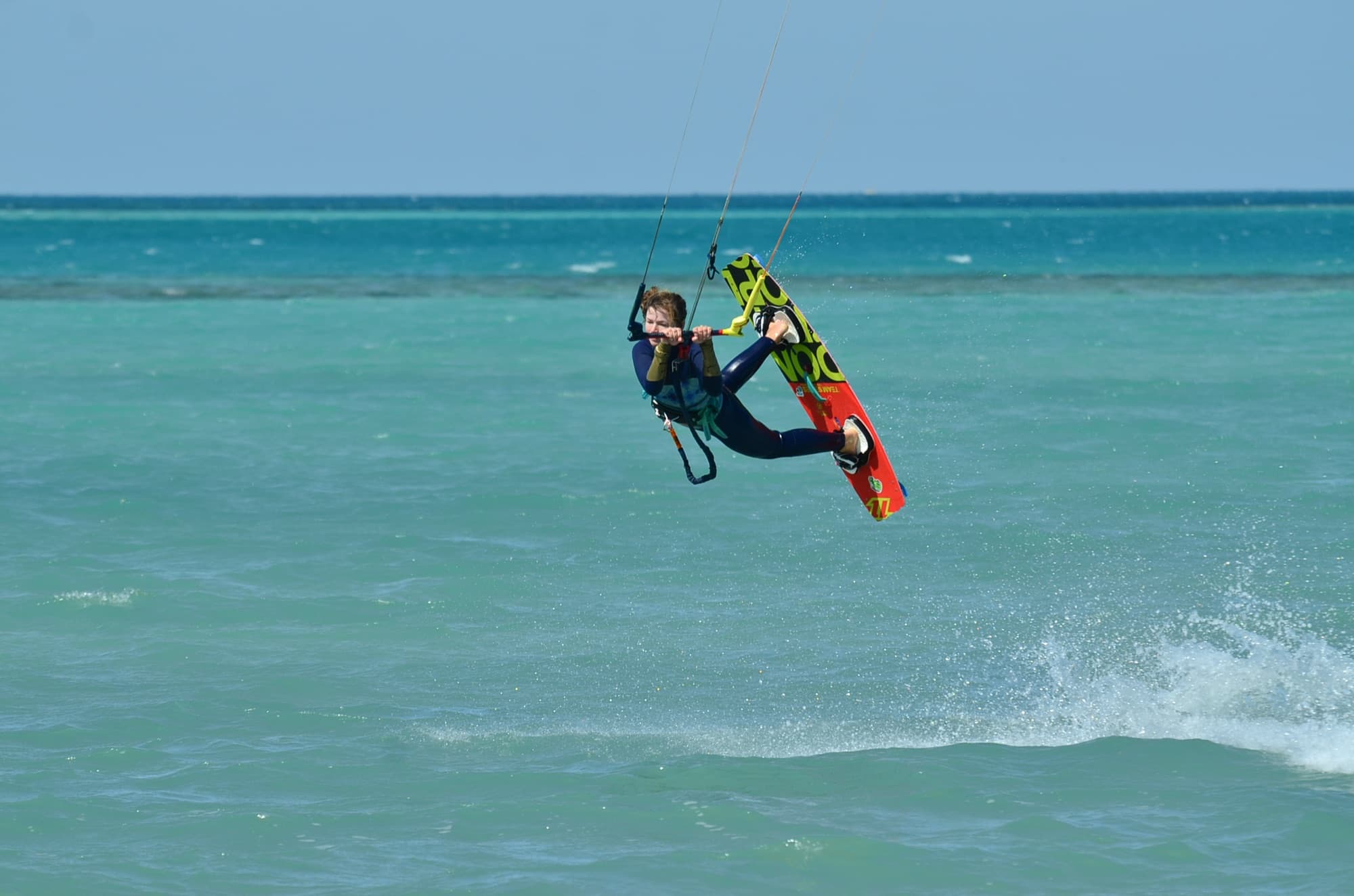
The raley on a kite: the classic powerful unhooked trick
The raley is an unhooked trick in which your body and board stretch into a single line parallel to the water. From the side it looks like a "superman" flying horizontally above the surface. If the backroll and frontroll are your first steps into the world of rotations, the raley is your entry into real wakestyle: executed cleanly, it gives you one of the most recognizable silhouettes in kiteboarding and sets the benchmark for that "flat" style riders chase.
9 July 2026 · JollyKite
What you need before the raley
The raley isn't a "from scratch" trick. It builds on an already confident unhooked base. Before you try it, cover three prerequisites:
- A strong, controlled pop. The raley lives on the energy you gather by edging and release at takeoff. Without a clean, powerful pop your body won't project forward — you'll just ride through the water. The pop has to be stable and predictable.
- Confident unhooked riding. You calmly release from the harness, ride and hold the pull on your hands without panic, feel the bar and control the kite with your hands alone. If unhooked riding is still hard, the raley is too early: all the trick's pull will go through your grip.
- Riding upwind at speed. The raley approach is speed and edge. After the trick you get pushed downwind, and you need to ride back upwind. If you lose your spot with every attempt, you'll quickly drift toward obstacles or shallow water — inconvenient and unsafe.
If all three describe you, move on to the technique. If one is weak, fix it first. With unhooked tricks this matters even more: they forgive less than hooked-in jumps.
The raley step by step
The main idea to keep in your head the whole time: the raley is a projection of the body forward, not a launch upward. You don't jump up — you gather energy by edging and fire yourself horizontally, in line with the board. The key tool for managing this is the kite's position. Here's the sequence:
- Approach with good speed. Build up speed and ride steady. Keep the kite low but safe — at roughly 10–11 o'clock (or 1–2 o'clock read from the horizon), not above 12. A low kite is what projects you forward instead of throwing you up. It's counterintuitive, but it's exactly the low kite position that makes the raley "flat."
- Bear off slightly downwind and unhook. Point the nose slightly downwind to build pressure and speed, and release the harness (unhook). Now all the pull is on your hands — you've switched into wakestyle mode.
- Lean back and edge hard against the wind. This is the heart of the trick. Edge sharply against the wind, lean your body back and load the lines — you're literally tensioning the system, gathering energy. The cleaner and sharper the edge, the more powerful the release. Important: actually lean back, don't squat down.
- Release the edge and fire your body forward. As you release, let your hands go forward, straighten your legs and take them back behind you — body and board stretch into a single line. Pull the front hand slightly so the pull goes more forward than up. This is the "superman": you fly horizontally above the water, stretched out like a string.
- Hold the position, then land. Shoulders back, hips up, body extended — hold that silhouette. On the way down, pull the bar toward your leading knee, tuck your knees, point the board's nose downwind. Land softly, on bent legs, keeping the bar close to you. Then ride off downwind, recover your balance and hook back into the harness.
At first the raley feels like one fused, sharp movement — that's normal. With each attempt you'll start to tell the phases apart: loading the lines, the release, the projection, holding the position. The first clean raleys usually come when you get the feeling that you're flying forward and flat, not up.
Common mistakes
Almost all raley difficulties come down to a few typical mistakes. Knowing them in advance, you'll get through the trick noticeably more safely and faster:
- Kite too high. The most common and most dangerous mistake. A high kite throws you up instead of projecting you forward: instead of a flat "superman" you get a high, uncontrolled flight. Keep the kite low (around 10–11) but safe — it's the foundation of a proper raley.
- Edging too long. Drag out the edging phase and you lose the pop: the energy leaks away and the release comes out limp. The edge should be sharp and short — gather and fire, not haul yourself out of the water.
- Squatting instead of leaning back. Many people instinctively squat as they prepare for takeoff. The raley demands the opposite: lean your body back and load the lines. Squatting kills the forward projection of the body.
- Pulling the bar too early. Pull the bar toward your knee too early and the board won't have time to lift off and straighten into the line — the trick doesn't open up. You only pull the bar on the way down, once the "superman" position is set.
Safety
The raley has its own risk profile, and you need to take it seriously. The main danger is simple: over-powered raleys send you high and flat — a direct route to hard back and ankle impacts on landing. To avoid that, stick to a few rules:
- Light or moderate wind. Don't learn the raley in strong wind. The stronger the wind, the higher the risk the trick over-powers and sends you too high. First raleys — only in comfortable, moderate wind.
- Kite below 12. This is both a technical and a protective rule: a low kite projects forward, not up. A kite above 12 is both a wrong raley and a higher risk of a high flight.
- Don't over-power yourself. Don't do your first raleys at maximum. An over-powered trick is the main source of injuries. Better to under-rotate and ride out than to over-power and land flat from height.
- Open space without obstacles. The raley pushes you downwind, and you need plenty of clean water — no other riders, boats, buoys, shallows or shore downwind.
- Instructor and gradual progression. Unhooked tricks forgive less than hooked-in jumps. Learn the raley under an instructor's supervision, with radio comms on the water. This article is a breakdown of the technique, not a replacement for in-person coaching.
What's next
Once the raley is solid — you reach a clean, flat position and land softly — the road into bigger wakestyle opens up. The logical next step is the s-bend: essentially a raley with a rotation added, and a confident raley is exactly what it's founded on. Having mastered projecting your body forward and controlling the position in the air, you carry that feeling into more complex unhooked tricks already prepared.
If you're still learning to ride unhooked, start with the basics — your first unhooked. The raley's energy is built on the pop, so it's worth breaking down the pop in kitesurfing. And to figure out which tricks to learn next and in what order, look into the JollyKite Trick School. Ready to add a rotation to your raley — head here: the s-bend on a kite.
We teach all powerful unhooked tricks under an instructor's supervision, with radio comms on the water and in the safe, flat, shallow water of Pak Nam Pran — which sharply lowers the risks while learning the raley. More on formats and booking is on the /obuchenie page.
Let's go riding?
Send us your dates and level — we'll suggest a format, match the season to your rhythm and plan your trip end to end. WhatsApp +66 98 367 9769, Telegram bot @JollyKite_kite_bot.
FAQ
What is a raley on a kite?+
The raley is a classic powerful unhooked trick in which your body and board stretch into a single line parallel to the water, forming a horizontal "superman" silhouette. It's the benchmark of "flat" wakestyle: you don't jump up, you project yourself forward using energy gathered by edging. A cleanly executed raley is one of the most recognizable tricks in kiteboarding.
What do you need before the raley?+
A solid unhooked base: a strong, controlled pop, confident riding released from the harness, and the ability to ride upwind at speed. The raley builds on a wakestyle base, it isn't a from-scratch trick. If your unhooked riding or pop are still unstable, fix them first, then move on to the raley.
Why keep the kite below 12?+
Because the kite's position decides where your body flies. A low kite (around 10–11) projects you forward and makes the raley flat — the way it should be. A high kite throws you up: instead of a clean "superman" you get a high, uncontrolled flight and a higher risk of a hard landing. So the kite stays below 12 — it's both technique and safety.
Why doesn't the board lift off in the raley?+
Most often because the bar is pulled toward the knee too early. The board doesn't have time to lift off and straighten into the line, and the trick doesn't open up. You only pull the bar on the way down, once the position is set. The second common reason is an edge that's too long or too limp: you lose the pop and don't have enough energy for the projection.
Is the raley dangerous?+
The raley has its own risk profile: an over-powered trick sends you high and flat, risking back and ankle impacts. To lower the risk, the raley is learned in light or moderate wind, with the kite below 12, without over-powering, in open space free of obstacles and under an instructor's supervision. With these rules followed, the raley is learned safely. This article is a breakdown of the technique, not a replacement for in-person coaching.