
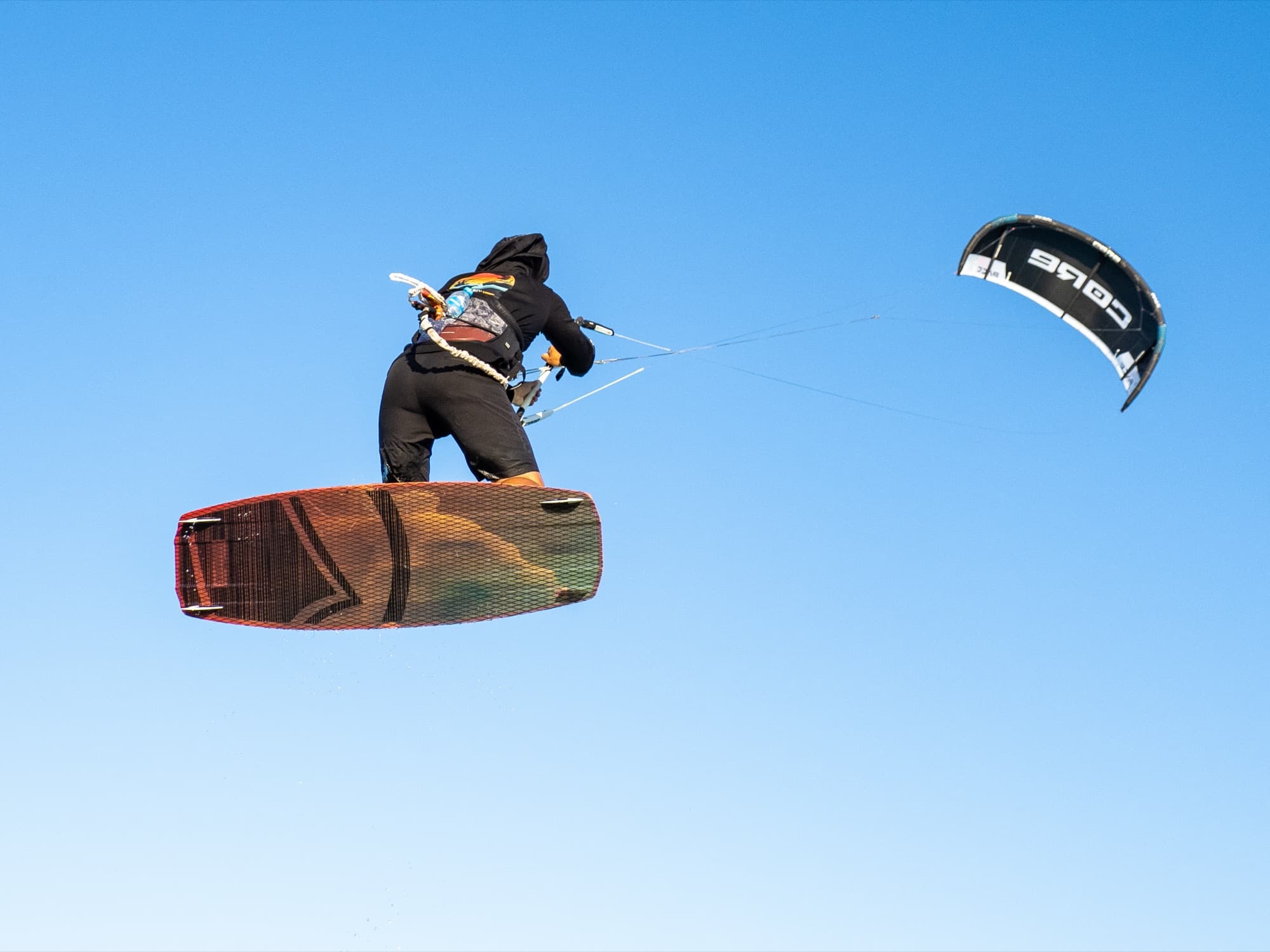
Your first kiteloop (hooked-in): how to send the kite through a loop
A kiteloop looks like the kite scoops the rider up and drags them across half the sky — powerful, spectacular, instantly recognizable. And that's exactly why people want to try it earlier than they should. Let's be clear: the kiteloop is an advanced and risky trick. Its main danger is a hard sideways yank or a fast downwind crash, especially in strong wind and on big, powerful loops. So it only makes sense to approach it with a solid base and under an instructor's supervision, in light or moderate wind, with plenty of space, and from small jumps.
9 July 2026 · JollyKite
What you need before the kiteloop
The kiteloop is an add-on to a confident jump, not a separate trick from scratch. Before you send the kite into a loop, you should have a solid base:
- A confident, stable jump and landing. You take off predictably, control your height, and consistently land on the board, nose downwind, without falling. The kiteloop adds a sharp yank to the jump — if your landing is still "hit or miss," it's too early to add the loop.
- Good edging. A clean rail against the wind on the approach gives you energy for height and for taking the loop's yank in a compact stance. Weak edging turns the loop into a wrecked, uncontrolled jerk.
- Getting used to the yank. It helps to "spin" the kiteloop in a bodydrag first — without the board, in the water, both ways. This gets you used to the feeling of the kite pulling you through the loop, without the risk of a hard landing. It's the best way to meet the yank before you add height.
If all three describe you, you can study the technique. If something is weak, fix the base first: on a kiteloop the cost of a mistake is higher than on a jump.
The kiteloop step by step
Keep the main thing in mind: you don't "yank and hope" — you deliberately drive the kite into a full loop and hold the pull to the end. Here's the sequence:
- Approach as for a small jump. Build up speed and edge against the wind. Send the kite from about 11 or 1 o'clock toward 12 (the zenith) — as for a calm, low jump. Start specifically with small jumps: less height means softer consequences for any mistake.
- Pop and pull the back hand. Take off. In the moment before the peak of the jump, sharply pull the back hand and hold — until the kite completely passes through the loop and starts climbing again. Not "yank and release," but pull and hold: the kite must complete the whole rotation. Release the pull early and the loop won't come round, and the yank will be harsh.
- Stay compact and watch the kite. Keep your core tight and don't lose sight of the kite — track it with your eyes as it goes through the loop. A compact body helps you take the yank without coming apart in the air, and watching the kite tells you when it's completing the rotation.
- Landing. Once the kite has passed the loop and is pulling up again, get ready to land: board flat, nose downwind, absorbing the impact with your legs. The calmer and lower the jump, the softer the landing.
At first everything happens fast and the yank feels sharp. That's normal on the first attempts in the right conditions. With each try, if you send the loop on time and hold the pull, the yank becomes smoother and more predictable, and the landing softer. It's precisely for this smoothness that people start learning the kiteloop in light or moderate wind and from small jumps, not the other way around.
Common mistakes
Most kiteloop problems come down to a few typical mistakes. They all lead to the same thing: a harsh yank and a hard landing.
- Sending the loop later than the zenith. If you send the kite into the loop too late — when the lines have already lost tension — the kite "drops" and then yanks sharply and unpleasantly. The loop should begin on time, while there's still line tension.
- Under-rotation (a half-loop). The most common cause is releasing the back hand too early. The kite only passes half the loop, doesn't complete the rotation and doesn't bring you back up — hence the wipeout and hard landing. The pull must be held until the kite completes the full loop.
- Edging against the loop. If you edge in the direction opposite to the loop, the kite tears you "against" the movement — the yank is especially harsh. Edging and loop direction should work together, not against each other.
Notice: all three mistakes lead to the same thing — a sharp, uncontrolled yank. That's why they're worked on first in safe conditions, where the cost of a mistake is minimal.
Safety: where and how to learn
The kiteloop is the kind of trick where conditions and control matter more than "bravery." A few principles to start on:
- Light or moderate wind. The main danger of a kiteloop is a hard sideways yank or a fast downwind crash. In strong wind and on big, powerful loops it's many times harsher. So the first attempts are only in calm wind.
- Open space and small jumps. A buffer of space downwind and low jumps mean any mistake costs less: less speed, less height, softer consequences.
- Bodydrag before the board. "Spinning" the loop in a bodydrag both ways is the best way to get used to the yank without the risk of a hard landing.
- Instructor and radio comms. On a kiteloop, real-time feedback is especially valuable: the instructor sees the moment of the pull, the edging direction from the outside, and helps you avoid locking in a dangerous mistake. Text can't replace that.
At JollyKite we teach advanced tricks in the flat, shallow water of Pak Nam Pran, with radio comms on the water and individual coaching — which sharply lowers the risks while learning the kiteloop. If you're still working toward height and a soft landing, start with the basics: how to jump higher and land softer. And it's worth refreshing the topic of the leash and kite safety — on loops it matters especially.
What's next
Once the hooked-in kiteloop is solid — you send the loop on time, hold the pull and land softly — the next branch opens up. The logical progression looks like this:
hooked-in kiteloop → downloop on the landing → unhooked tricks.
First comes working with the downloop — a downward loop that helps catch you on the landing and make it softer. Then — the world of unhooked tricks, where you unhook from the harness and work the kite differently. Both are separate big topics you move on to with a confident basic kiteloop already in place, not instead of it.
To figure out which tricks to learn next and in what order, look into the JollyKite Trick School — the whole progression is laid out there. And we teach all loop and takeoff tricks only under an instructor's supervision. More on formats and booking is on the /obuchenie page.
Let's go riding?
Send us your dates and level — we'll suggest a format, match the season to your rhythm and plan your trip end to end. WhatsApp +66 98 367 9769, Telegram bot @JollyKite_kite_bot.
FAQ
What do you need before a kiteloop?+
A solid base: a confident, stable jump and landing, and good edging against the wind. It helps to "spin" the kiteloop in a bodydrag both ways first — without the board, in the water — to get used to the yank without the risk of a hard landing. The kiteloop is an add-on to the jump, not a trick from scratch: if your landing is still unstable, fix the jump first.
When do you pull the back hand?+
In the moment before the peak of the jump. Sharply pull the back hand and hold the pull until the kite completely passes through the loop and starts climbing again. The key is not to release early: the kite must complete the whole rotation, otherwise you get under-rotation and a harsh yank.
Why does a kiteloop give a harsh yank?+
Most often because of three mistakes: sending the loop later than the zenith (the lines lose tension and the kite yanks sharply), under-rotation (the back hand released early, the kite only did half the loop), or edging against the loop (the kite tears you "against" the movement). All three give a harsh yank and a hard landing. The fix is timely loop initiation, holding the pull to the end, and coordinated edging.
Is the kiteloop dangerous?+
Yes, it's an advanced and risky trick. The main danger is a hard sideways yank or a fast downwind crash, especially in strong wind and on big, powerful loops. So you should learn it only with a solid base, under an instructor's supervision, in light or moderate wind, with plenty of space, and from small jumps. This article does not replace in-person lessons.
In what wind should you learn the kiteloop?+
In light or moderate wind. In strong wind and on big loops the yank and the consequences of a crash are many times harsher. The first attempts are made in calm wind, with plenty of space, and from small jumps — that way any mistake costs less.