
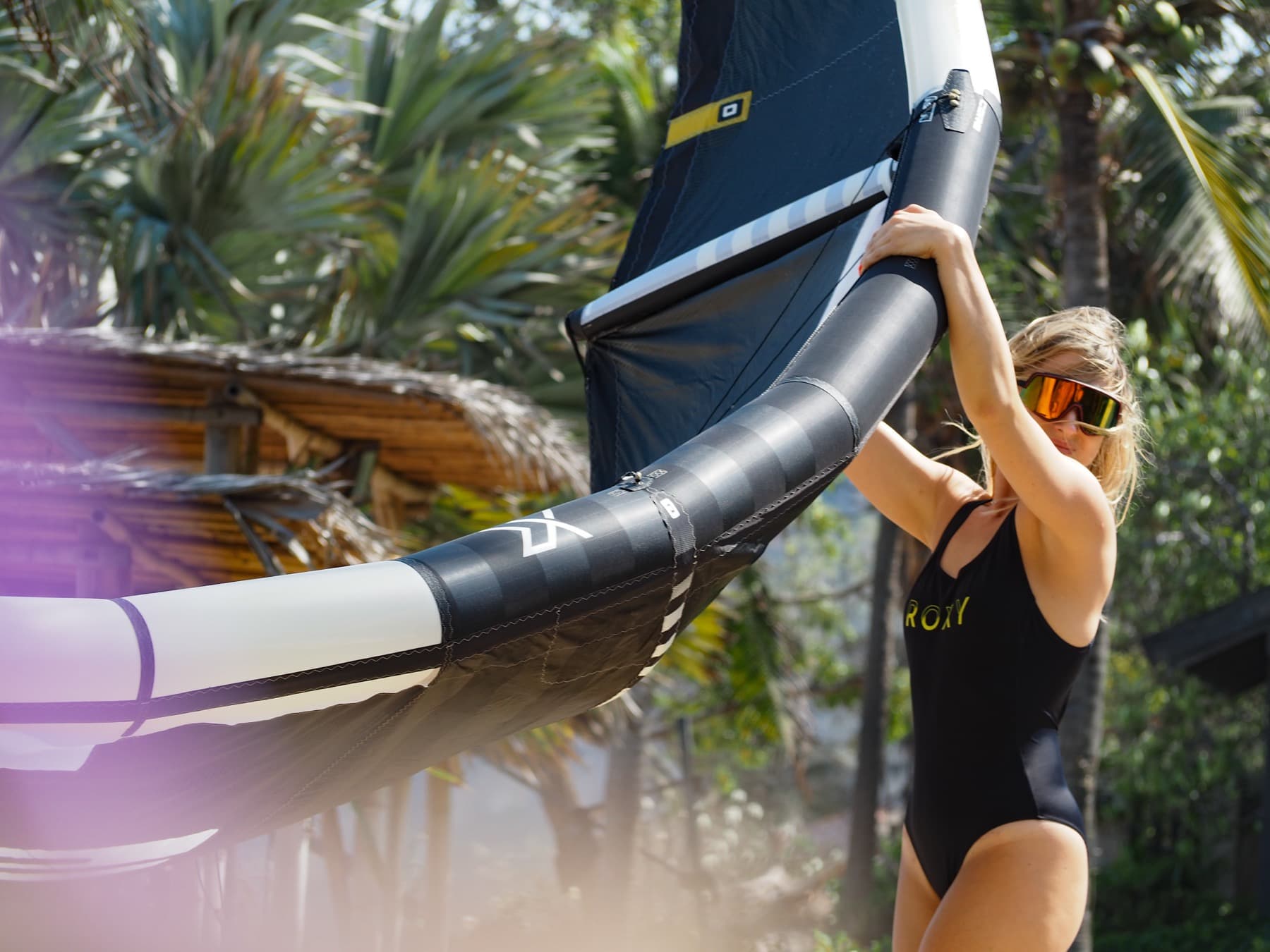
Kitesurfing for women: is it realistic, where to start, and what to know
«It's a men's sport.» «You need strength, and I won't manage.» «It's scary — the wind will carry you away.» If you've ever thought any of this watching kiters from the shore, you're not alone. Almost every woman who comes to us to learn starts with one of these fears. And almost every one of them, a few lessons later, laughs at it herself.
27 June 2026 · JollyKite
Kitesurfing is a great sport for women: it rests on technique, a feel for the wind and balance — not on brute strength. We've been teaching since 2014, and Hristina — co-owner and instructor — has put dozens of women on the board, many of whom had never done any sport before. Here's the run-through: whether you need strength, whether it's safe, where to start and what to bring.
Do you need strength? The short answer is no
This is myth number one, and it gets in the way the most. From the shore it looks like you have to hold the kite with your arms, so without strong forearms there's no point trying. In reality it's the opposite. The pull doesn't go into your arms — it goes through the harness, a wide belt on your hips that the control bar attaches to. Your core and body weight take the main load, while your hands only steer gently. If you're hanging off your arms, something's wrong, and the instructor will fix it right away.
Far more important than strength is technique and kite handling: steering it smoothly across the sky, feeling the wind, holding your balance. These are skills, not muscles, and everyone can learn them. That's why women often progress quickly and cleanly: they're less likely to try to overpower the kite and start listening to the wind sooner.
Let's be honest: general fitness helps. A strong core and decent coordination make the board-start stage easier. But it's a nice bonus, not an entry ticket — you can start in any shape. One more caveat: when you're seriously overpowered, it's hard for everyone, men and women alike. That's physics, not gender. Which is why we take beginners out in comfortable wind and match the kite to your weight.
Is it safe?
The second big fear is that the wind will grab you and carry you off. It's an understandable fear, and it's removed by concrete things, not reassurance. The power can be dosed — and dumped. A kite isn't all-or-nothing: you decide how much power to take by steering it across the sky. And if something goes wrong, there's a safety system (quick release) — one move and the power is instantly released. We drill this to automatic on the beach.
The spot is shallow and flat. In Pak Nam Pran the water is calm and shallow — in many places you simply stand on the bottom. No depth, no scary waves. Making mistakes here isn't frightening: you fall, you stand up, shake it off and go again. And the instructor is always nearby: you're never left one-on-one with the kite.
Where to start
You can start from complete zero. The path is built step by step — each step builds on the last, nothing is skipped.
- Step 1. Kite control. First, no water and no board: you learn to steer the kite smoothly across the sky, hold it in the right zone and dose the power. This is where we drill the safety systems too.
- Step 2. Body drag. Now we add water, but still without the board: you move on the kite's pull and get used to the load.
- Step 3. Water start. The most exciting stage — getting up on the board. The kite gives the impulse, you push out of the water and ride. At first a couple of metres, then longer and steadier.
It's the same method we use for all beginners. Everyone's pace is their own, and that's fine: the goal isn't to hit a minimum number of hours but to finish the course riding calmly on your own.
Gear and comfort
You can learn travelling light: the school provides almost all the gear. But a couple of things directly affect your comfort on the water. A rash guard or lycra: a light top protects your skin from the sun and from chafing against the harness, doesn't restrict movement and dries fast. In Thailand's warm water that's enough — you don't need a wetsuit.
Sun protection: on the water the sun hits from two directions — above and in the reflection. Waterproof high-SPF cream, a cap or buff on shore, lip protection. Apply in advance and top up during the break. Choosing the kite by weight: the lighter the rider, the smaller the kite needed in the same wind. During lessons you don't need to think about this — the instructor matches the kite to your weight and the current wind.
Why women feel comfortable with us
A lot comes down not to the method but to the atmosphere. People often come to us to learn solo, and for a woman starting alone it matters to feel she isn't rushed or judged. Hristina — instructor and co-owner of the school — works with women a lot herself. She puts you on the board gently, calmly and without stress, explains things in plain language and moves at the pace that's comfortable for you, not for the programme. We work in small groups and one-on-one, so every student gets attention.
And most importantly: people who have never done any sport before come to us with no trouble. You don't need to be athletic, you don't need to prove anything. You just need to come and give it a try — we'll build the rest together, step by step.
FAQ
Does a woman need strength to learn kitesurfing?+
No. The kite's pull goes through the harness to your core and body weight, not into your arms — so brute strength isn't needed. Technique, a feel for the wind and balance matter far more, and those are skills everyone can learn. General fitness is a nice bonus, not a requirement.
Is kitesurfing safe for women?+
With the right training, yes. You dose the kite's power yourself, and you can dump it at any moment with the safety system (quick release), which we drill to automatic on the beach. The spot in Pak Nam Pran is shallow and flat, and the instructor is always nearby.
How long does it take a woman to learn?+
The same as anyone — the pace depends on coordination, weight and how stable the wind is, not on gender. Usually the path from zero to independent riding takes a few windy days of 2 hours each. We don't rush: the goal is to finish riding confidently.
What should I wear for lessons?+
A swimsuit with a light rash guard (lycra) on top — it protects from the sun and from chafing against the harness. You don't need a wetsuit in Thailand's warm water. Waterproof high-SPF cream and a cap or buff on shore are a must. The school provides the gear (kite, harness, board).
Is it scary to feel the kite's pull?+
It's unfamiliar at first, but not scary. From the first lesson you learn to dose the power and dump it with one move, so control is always yours. Once you know you can switch off the kite at any moment, the anxiety fades and what's left is enjoyment.