
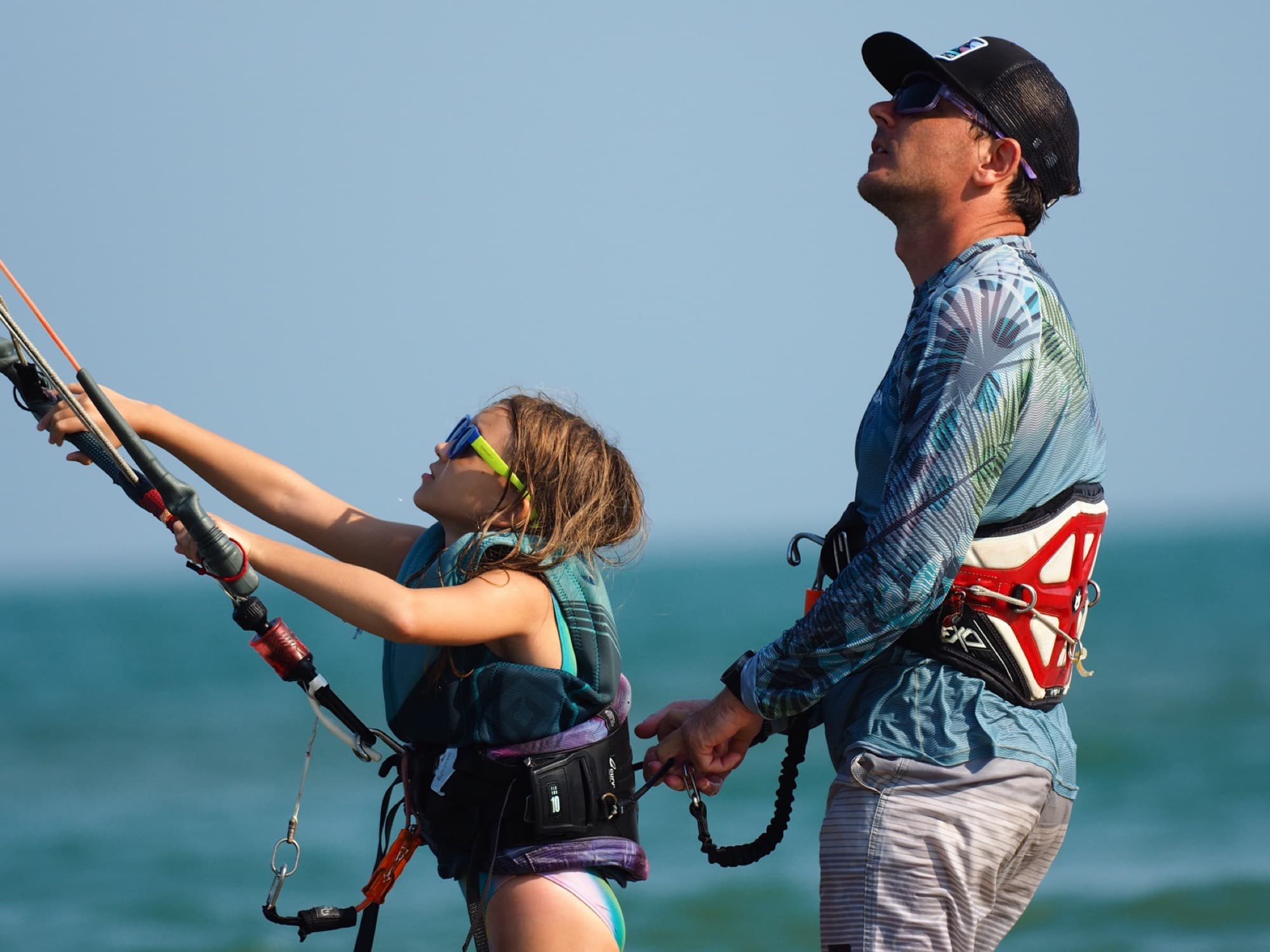
Kite camp in Thailand: the programme, what's included, who it's for
A kite camp isn't just «lessons, but longer». It's when your tuition, accommodation, schedule and the people around you are packed into one trip that revolves around a single thing: getting you up on the board while the wind blows.
22 July 2026 · JollyKite
The difference shows in the details. With ordinary lessons you show up at a set time, learn your hour, and head off. In a camp you live next to the spot, you get up with the forecast rather than the alarm clock, and you ride when the wind arrives — not when you managed to book a slot. Between sessions there's debriefing and theory, and in the evening you're at the table with other beginners who also stood on a board for the first time today.
How a camp differs from ordinary lessons
- Learning around the wind, not the timetable. Wind in Pak Nam Pran doesn't run on a clock: it blows in the morning, you ride in the morning; it kicks in after lunch, the session moves. You don't pay for a calendar slot that landed on a windless afternoon.
- Tuition and accommodation in one place. Some camps include lodging or help you find it right by the station. Wake up, check the flag, go ride.
- Community. Around you are people at the same level: you see others' mistakes from the outside, their progress pushes you on, and the evening debrief gives more than you'd expect.
- Immersion instead of snatched hours. Over a week in a camp you live kitesurfing fully — a skill that takes months in «one lesson a week» mode fits into a single trip.
What a kite camp usually includes
The exact makeup varies by school — worth confirming before you book. But the typical set looks like this.
- Lessons with an IKO instructor — the core of the camp. The format (private, pair, small group) affects your progress more than anything.
- All the gear — kite, bar, board, harness, leash, helmet and vest. Plus a kite matched to your weight and the current wind: the wrong kite steals learning hours.
- Theory and briefings — wind, the window, safety, right-of-way.
- Debrief and feedback — what worked, what didn't, what to do tomorrow. Often with video.
- Water support — a boat or jet ski: beginners drift downwind, that's normal; the question is who picks you up and how fast.
- An IKO certificate at the end — a single method and a clear progression.
And here's what varies and needs a direct question when booking: accommodation (sometimes included, sometimes the school just helps you find it nearby), transfer from the airport or Bangkok, meals (from nothing to full board) and post-camp rental — many schools give graduates a discount. Simple rule: compare camps not by the price line but by what stands behind that price.
The formats you'll find
Beginner camp. For those who've never stood on a board. The goal for the trip is kite control, the water start and first runs. Plenty of theory and basic safety, a calm pace.
Progress camp. For those who already ride but are stuck: no stable start, can't go upwind, want their first jumps. More water, less theory, focus on specific tasks.
Family format. When a couple or a family with kids comes along. The schedule is arranged so the adults get to ride and to spend time with the child; sometimes with a kids' programme. Pak Nam Pran suits this: shallow water and space make it calmer for beginners and children.
Why Pak Nam Pran suits a camp
- Steady, predictable wind. In season there's a stable thermal wind without harsh gusts — exactly what a beginner needs. Learning in gusty wind is hard and frightening.
- Shallow water. Large sandbanks where you can stand up. For a beginner that's half your confidence: you fall, you stand up, you don't flounder in deep water.
- Space. A wide beach and plenty of water — lagoons and groups don't get in each other's way.
- A calm setting. Pak Nam Pran is quieter and more intimate than Hua Hin: fewer crowds, more focus on the water.
Who a camp isn't for
- Those who want to learn in snatches. If you only have a couple of free evenings a week, a camp isn't for you: it's about immersion.
- Those coming for the party, not the tuition. A camp is about the water: everyone's on the spot by day and turns in early for tomorrow's wind.
- Extreme introverts. Community is a camp's strength, but if a group around you drains you, a private format is more honest.
- Those wanting a guaranteed timeframe. No honest camp promises «you'll stand on the board in three days whatever the weather». Results depend on wind, consistency and fitness.
How to choose a camp: what to look at
- What actually is included. Lessons, gear, water support — the base. Accommodation, transfer, meals — confirm separately.
- The teaching format. How many students per instructor, and how much real kite time lands on you. An evasive answer is already an answer.
- Instructors. IKO certification and the language your safety commands come in: a translation between command and action costs seconds.
- Safety. Radio comms, quick-release drills, self-rescue, a boat on the water.
- Place and season. Steady wind and shallow water matter more to a beginner than a pretty picture. Check your dates against the wind season.
- What comes after. Whether there's discounted rental for graduates so you can keep riding.
FAQ
What is a kite camp and how does it differ from ordinary lessons?+
A kite camp is a trip format where tuition, accommodation near the spot, a wind-driven schedule and a community come together. Unlike one-off lessons, you live kitesurfing for several days in a row: you ride when the wind arrives, debrief your mistakes, and mix with fellow beginners.
What's usually included in a kite camp in Thailand?+
Typically: lessons with an IKO instructor, all gear with a kite matched to your weight and the wind, theory and briefings, debriefs with feedback, water support and an IKO certificate at the end. Accommodation, transfer, meals and post-camp rental vary — confirm with the school before booking.
What formats of kite camp are there?+
Three main ones: beginner (for those who've never stood on a board), progress (for riders who are stuck), and family (schedule built around a couple or a family with kids). Many schools mix formats for a given group.
Do I need experience to join a kite camp?+
No. A beginner camp is designed precisely for those who've never stood on a board — from zero, with basic theory and safety. For riders there are progress camps built around specific goals.
Why does Pak Nam Pran suit a kite camp?+
Steady, predictable wind without harsh gusts, shallow water with sandbanks where you can stand, a wide beach with space, and a calm, intimate setting. For a beginner that's half the confidence and safety.
Who is a kite camp not for?+
Those who can only learn in snatches a couple of evenings a week; those coming for the party rather than the tuition; extreme introverts (a private format is more honest for them); and those wanting a guaranteed timeframe — results depend on wind, consistency and fitness.
How much does a kite camp in Thailand cost?+
It depends on the format, hours, dates and what's included (tuition only, or also accommodation, transfer, meals). There's no universal figure — it's easier to price your exact option in the calculator on the site.
What should I bring to a kite camp?+
The school provides the kitesurfing gear. Bring swimwear or a rash guard, sunscreen, a hat, water, and reef shoes if you like. The school will tell you the rest before you arrive.