
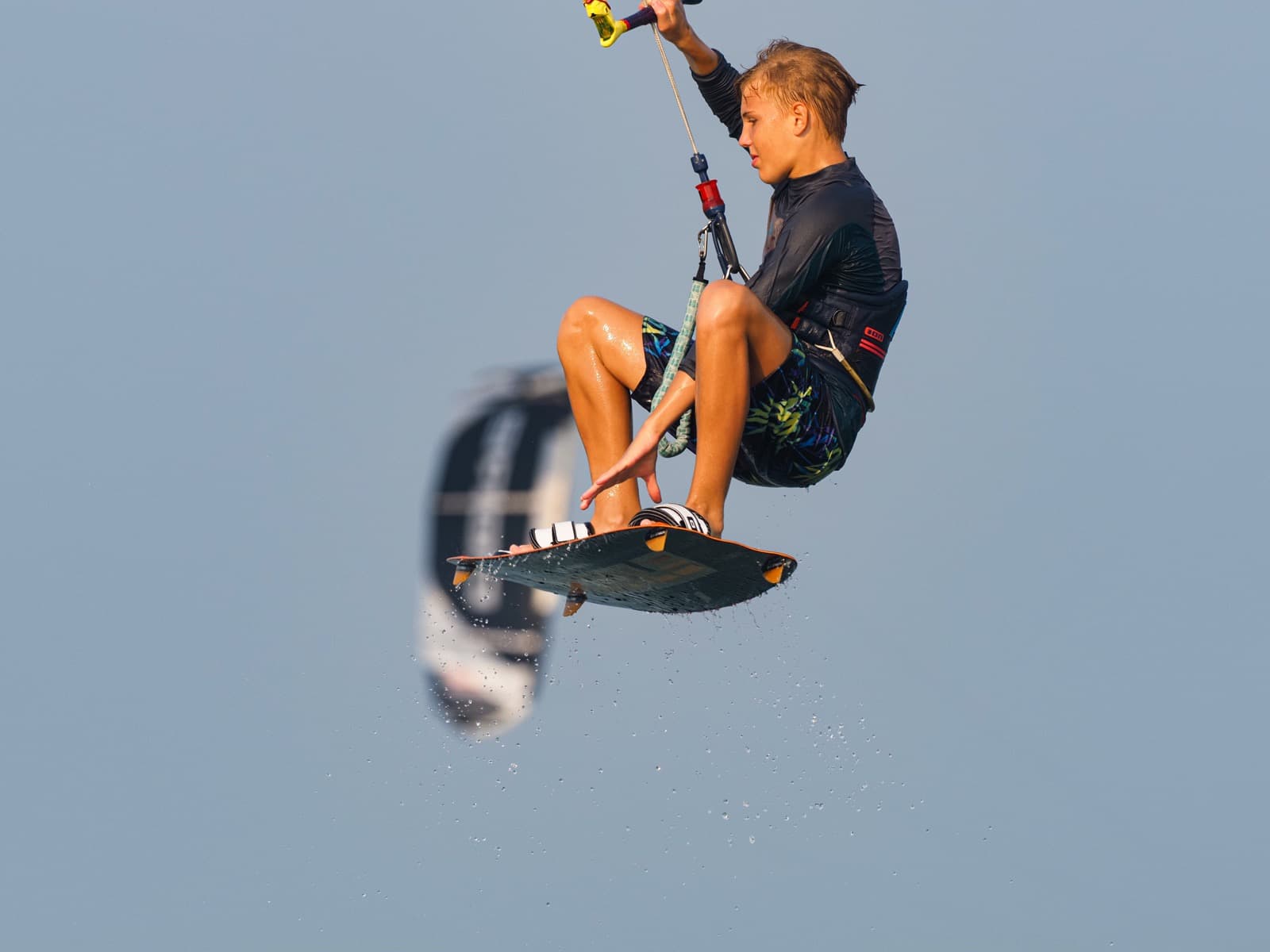
JollyKite Trick School: from zero to megaloop
There is no magic trick in kitesurfing that you learn over a weekend and use to impress the whole beach. There is, however, a clear ladder. Master kite control and the water start opens up. Ride upwind confidently and you're ready for your first jump. Jump consistently and it's time for grabs, rotations and kiteloops. Every step stands on the one below it, and that's the whole point of progression: not skipping steps, but climbing them in order.
4 July 2026 · JollyKite
How to learn tricks: the logic of progression and safety
Before you dive into the list, a few principles. They'll save you months and a lot of frustration.
The order isn't random. Each skill is the foundation for the next. You can't skip to a kiteloop without jumping and landing consistently first. Cutting corners usually means a setback: an injury, a scare, or an ingrained mistake that takes a long time to unlearn.
Kite control first, trick second. Most beginner mistakes aren't a "crooked board" — they're a loss of kite control. If the kite has a life of its own, no trick will work safely. That's why the base levels are about your hands and the kite, not your feet and the board.
Flat water and light-to-moderate wind for learning. New tricks are drilled on flat water in comfortable wind, not in a storm and swell. Falling on flat water isn't scary, mistakes aren't punished harshly, and progress comes faster. The flat shallow water of Pak Nam Pran is made for exactly this.
Helmet, leash, open space. Jumps, rotations and especially unhooked riding demand head protection, a working chicken loop with a quick release, and room to spare downwind. Learning tricks in a crowded spot or close to shore is dangerous for you and everyone around you.
An instructor saves time. From the outside a mistake is obvious instantly; on your own you can repeat it for weeks. On the step from base skills to jumps — and even more so to unhooked — an instructor is both an accelerator and a safety net.
Now, the library itself, from the ground to the megaloop.
Level 1 — Foundation: kite control and the board
The foundation, without which nothing exists. No tricks here: you learn to control the power of the wind and stop fearing it.
- Kite control on land. The very first skill: launching, landing the kite, feeling the wind window, working the bar. Everything begins here, on the sand, before the water. Detailed tutorial →
- Body drag and upwind body drag. Moving through the water behind the kite, without the board: pulling yourself with the kite, steering your direction, returning to the start — and, along the way, retrieving a drifted board. Detailed tutorial →
- Water start — getting up on the board. The key moment of the whole learning process: bring the board under your feet and use the kite's power to rise out of the water and ride. The first time you actually go. Detailed tutorial →
- Riding upwind. The skill that separates a rider from someone chasing their board on foot. Once you can gain upwind, you return to your start and ride in both directions. Detailed tutorial →
- Stopping and slowing down. A controlled stop is safety. Bleed off speed, sit gently into the water, end a run without falls or stress.
Clear this level and you're an independent rider: you start, ride both ways, come back to yourself and stop safely. Only now does it make sense to think about tricks.
Level 2 — First skills: transitions and the first jump
Here you stop simply riding in a straight line and start steering your ride — and by the end of the level you leave the water.
- Transition (turning without stopping). Changing direction on the move, without falling and without a full stop. The first meaningful manoeuvre: you redirect the kite and ride off the other way at the same speed. Detailed tutorial →
- The first jump. The main milestone. You send the kite to the zenith, leave the water and land softly. This is what many people come to kitesurfing for. Detailed tutorial →
- Jumping higher and landing softer. Developing the jump: more height through correct kite work and — more importantly — a soft downwind landing that protects your knees and board.
- Pop. Leaving the water by loading the board and the edge, without a high "parachute" lift from the kite. The base of all freestyle and unhooked riding: almost every advanced trick starts with a pop.
Level 3 — Grabs and rotations
You can jump — now add style and movement in the air. From this level kitesurfing starts to look "like the videos".
- Grabs. In the jump you grab the board with your hand: more control, more style, more confidence in the air. The natural first step into freestyle after a stable jump. Detailed tutorial →
- Backroll. A backward rotation over your back — the most accessible of the real rotations. The kite carries you along an arc, you spin through and land on the move.
- Frontroll. A forward rotation. Fussier than the backroll because of the blind landing moment, but it's the logical next step.
- 360. A full turn of board and body around the vertical axis in the jump. Adds rotational coordination to a jump you already have.
- Board-off. A flashy trick: in the jump you take the board off your feet, hold it with your hand and put it back before landing. Pure show and body control in the air.
Level 4 — Kiteloops and unhooked
The most grown-up milestone. Adrenaline and risk both rise sharply here, so you take this level on only with a confident base and, very preferably, under an instructor's eye.
- The first kiteloop. The kite makes a full loop right in the jump, throwing and dragging you further. Powerful and spectacular — and it demands precise timing: a mistake is punished with a hard landing.
- Downloop for transitions. A downward kite loop that helps you change direction smoothly on the move and keep the pull through the turn. A more practical relative of the kiteloop.
- The first unhooked. You unhook the chicken loop from the harness hook and hold the kite's pull with your hands alone. From here the whole world of wakestyle opens up — but it takes strength, control and a safe release drilled to automatic.
- Raley. Body and board stretch into one line parallel to the water — a classic powerful trick, most often unhooked. The benchmark of flat wakestyle.
- S-bend. A raley with a rotation: a body spin added to the straightened "superman" position. One of the first genuinely difficult unhooked elements.
Level 5 — Advanced freestyle and wakestyle
The top of the library. The territory of experienced riders who work on technique for years: tricks here are built from everything below.
- Handle pass. In an unhooked trick you pass the bar behind your back from hand to hand mid-rotation. The basic language of advanced wakestyle — without it most top combinations don't exist.
- Blind judge. An unhooked trick with a blind landing, back to the direction of travel, followed by a handle pass. It takes a perfect feel for the kite and the body.
- Back mobe / front mobe. Rotations with a handle pass — mobes — are already competitive freestyle: body rotation, kite control and a precise bar pass in one movement.
- Megaloop. A huge kiteloop from great height — the maximum of power and adrenaline in kitesurfing. For the most experienced only, in the right conditions and with full understanding of the risks.
Branches: wave/strapless and foil
Not all progression runs along one straight line. Two big branches split off from the base — separate disciplines with their own learning logic.
- Wave / strapless (wave riding). The wave and a directional board, often without straps (strapless): the kite works almost on its own while you read the wave like a surfer. A separate world with its own feel and its own tricks — taking a hand off the bar, turning on the wave, strapless rotations.
- Foil (hydrofoil). A board with an underwater wing: it lifts you above the water and lets you ride in very light wind. It has its own starting skill — balance on the wing and holding the flight — and its own turns (jibes, tacks). Even experienced riders learn the logic of the foil almost from scratch.
Both branches can be started with a confident base from Levels 1–2. They don't replace the freestyle ladder — they complement it.
Where a beginner should start
If you're only approaching kitesurfing, don't look at megaloops and handle passes. That's a distant horizon, not a goal for your first week. Your task at the start is simple and concrete:
- Kite control on land → feel the wind window and stop fearing the pull.
- Body drag → move through the water behind the kite and retrieve the board.
- Water start → get up on the board and ride your first metres.
- Upwind → ride against the wind and return to your start.
These four items — Level 1 — are the independence programme. Once they're yours, you ride on your own and can calmly add tricks up the list, one at a time. Don't rush to jumps until the base is automatic: a solid foundation is exactly what later lets you learn new things fast and without setbacks.
The easiest way to walk this path without months of trial and error is a structured course with an instructor. How learning works at JollyKite, step by step and broken down by level, is on the training page.
Shall we go learn some tricks?
Where are you on this ladder right now — and what's your next step? Send us your level and goal, and we'll tell you honestly what to learn next and how to build progress without setbacks. More about training and levels is on the training page. Get in touch and choose a format via contacts: WhatsApp +66 98 367 9769, Telegram bot @JollyKite_kite_bot.
FAQ
How do I start learning tricks in kitesurfing?+
With the basics, not with tricks. First you need to control the kite confidently on land, body drag, get up on the board with a water start and ride upwind. Moving on to the first tricks — transitions and the jump — makes sense only once you're an independent rider who starts consistently, rides both ways and stops safely.
In what order should I learn kite tricks?+
By difficulty level, where each next skill builds on the previous one. Roughly: base (kite control, body drag, water start, upwind) → first skills (transition, jump, pop) → grabs and rotations (backroll, frontroll, 360) → kiteloops and unhooked → advanced freestyle (handle passes, mobes, megaloop). Skipping steps is dangerous and inefficient.
What is unhooked in kitesurfing?+
It's doing tricks with the chicken loop released: you hold the kite's pull with your hands alone rather than through the harness. Unhooked opens the world of wakestyle — raleys, handle passes, mobes — but requires strength, good kite control and a safe release drilled to automatic. It's a level for experienced riders, not beginners.
When can I start learning to jump on a kite?+
When the base is automatic: you control the kite confidently, start consistently, ride both ways and — crucially — can ride upwind and stop in a controlled way. A jump without a base means losing control of the kite in the air, which means injury risk. Rushing here doesn't speed you up; it throws you back.
Do I need an instructor to learn tricks?+
For the base an instructor is almost essential: they build correct kite control and back you up on the riskiest first steps. Higher up the list — jumps, rotations, and especially kiteloops and unhooked — an instructor sharply speeds up progress: from the outside a mistake is visible at once, while on your own you can ingrain it for weeks. The most dangerous elements (kiteloops, unhooked, megaloop) are safer to learn only under supervision.