
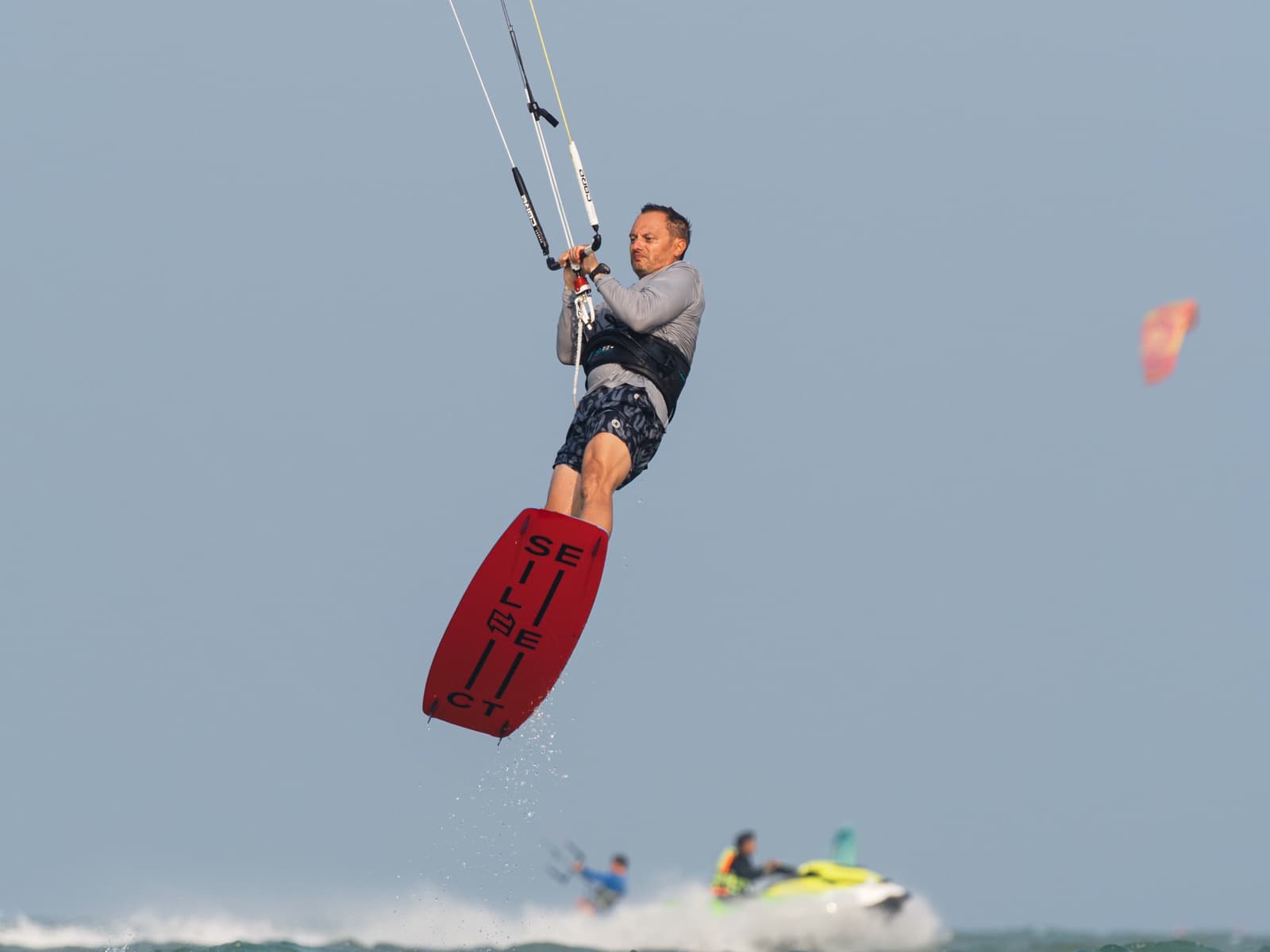
Frontroll on a kite: the forward rotation, step by step
The frontroll (also called a frontloop) is a forward rotation in a jump: you "dive" through your front shoulder and head down-and-forward, make a full rotation and land. It's the logical next trick after the backroll — the technique is largely the same, but with one nuance that makes the frontroll trickier.
27 June 2026 · JollyKite
What you should be able to do before the frontroll
The frontroll isn't a first trick. For it to work, there has to be a solid base underneath it. Before you take on the forward rotation, make sure you have two things:
- A confident jump. You leave the water consistently, control the kite in the air, land softly on bent legs and don't "drop" the kite while doing it. Without a calm, repeatable jump, any rotation becomes a lottery.
- A learned backroll (preferably). The backroll is a backward rotation, and in it you already get used to spinning in the air, keeping the kite still at the zenith and turning through to the landing. The frontroll is built on exactly these sensations, only the rotation goes the other way. If the backroll is "in the bag," the frontroll will come noticeably faster.
If your jump is still shaky, step back — to the first jump on a kite. And if you want to lock in the backroll first, we have a separate breakdown — the backroll on a kite.
The frontroll, step by step
The main thing to understand up front: the rotation is done by your body, not the kite. During the trick the kite stays still at the zenith and simply holds you in the air. The whole rotation is driven by the movement of your head, shoulder and knees. Step by step:
- Approach and edge as for a jump. Ride at a normal speed and edge against the wind — exactly as before an ordinary jump. There's nothing new to do at this stage.
- Jump with a light kite send. Send the kite up with a short movement, leave the water — and immediately fix the kite at the zenith (12 o'clock) and hold it still. This is the key: after takeoff you don't touch the kite again, it just hangs above you.
- Initiate the forward rotation. Drop your head and front shoulder down-and-forward — as if "diving" through your front arm. At the same moment pull your knees up to your chest. It's this head-and-shoulder movement that launches the forward rotation.
- Tuck into a compact body. The tighter you're tucked — knees pulled in, body compact — the faster and cleaner the rotation. An open, stretched-out body spins slowly and sluggishly.
- Get through the "blind" moment. Coming out of the rotation you briefly lose sight of the water — this is normal and unavoidable. Don't freeze: keep turning your body through and, at the end, catch the water and the landing spot with your eyes again.
- Open up and land. Once the rotation is complete, open your body, extend your legs toward the water and land nose slightly downwind on bent legs. Keep the kite flying the whole time — it takes you on the landing.
When all the steps connect, the frontroll takes literally a second. That's why you drill it not "piece by piece in the air" but as one whole movement, gradually making it cleaner.
The blind moment and how to handle it
The "blind" moment is the main difference between the frontroll and the backroll. In the forward rotation, at a certain phase of the spin your head goes down and forward, and for a fraction of a second you stop seeing the water. For those used to the backroll (where the landing is visible almost the whole time), this is unfamiliar and frightening at first.
What to do about it:
- Accept that it's normal. The blind phase is short. You don't need to "wait it out" in fear — you need to keep rotating.
- Don't freeze in the blind phase. The most common problem is that a person instinctively "freezes" when they lose sight of the water and doesn't turn the rotation through. The body stops halfway and the landing comes out messy. The fix is to keep moving: turn all the way through.
- Catch the landing with your eyes at the end. As soon as the rotation comes out of the blind phase, immediately find the water and the spot you're landing on with your eyes. The gaze "catches" the water — and the body automatically prepares to land.
The more confident you are at the backroll and the ordinary jump, the calmer you get through the blind moment: the body already knows that after losing its reference point everything ends with a soft landing.
Common mistakes
Most failed frontrolls come down to the same mistakes. Knowing them in advance will save you many attempts:
- Spinning with the kite, not the body. The most common mistake. People try to "help" themselves by yanking the bar and steering the kite to the side. The kite leaves the zenith, loses pull — and the landing falls apart. After takeoff the kite stays still at the zenith; only the body rotates.
- Freezing in the blind phase and not turning through. As above: you lose sight of the water, freeze — and the rotation doesn't finish. You need to keep rotating and catch the landing with your eyes at the end.
- Over-rotating. The opposite extreme: too sharp an initiation and too tight a tuck give excess rotation, and you fly past the landing spot. The frontroll is easier to over-rotate than the backroll, so make the initiation crisp but not vicious.
- Dropping the kite. If the kite isn't fixed at the zenith and "wanders," it doesn't hold you in the air — the rotation sags and the landing gets hard. Keep the kite still and flying.
- A weak approach. Without proper speed and edging there will be neither height nor time for the rotation. The approach is the foundation of the trick: calm, confident, with good edging against the wind.
What's next
When the frontroll comes out consistently and cleanly on both sides, a whole branch of tricks built on it opens up:
- Frontroll with a grab — the same rotation, but in the air you grab the board with your hand. It adds style and teaches you to control your body during the spin.
- 360 — a full rotation with a spin, the next step up in difficulty.
- Unhooked rotations — tricks done while unhooked from the harness; this is already an advanced level and a big separate topic.
Where exactly to go and in what order to learn tricks is easy to check against the JollyKite Trick School, where the steps are laid out from first jumps to advanced rotations.
We coach all jump tricks under an instructor's supervision, with radio comms on the water and in the safe, flat, shallow water of Pak Nam Pran — which sharply lowers the risks when you start spinning. More on formats and booking is on the /obuchenie page.
Let's go riding?
Send us your dates and level — we'll suggest a format, match the season to your rhythm and plan your trip end to end. WhatsApp +66 98 367 9769, Telegram bot @JollyKite_kite_bot.
FAQ
What is a frontroll on a kite?+
A frontroll (frontloop) is a forward rotation in a jump: you drop your head and front shoulder down-and-forward, as if "diving" through your front arm, make a full rotation and land. The kite stays still at the zenith, and the rotation is driven by the body itself. It's the logical next trick after the backroll.
Why is the frontroll harder than the backroll?+
Mechanically it isn't harder, but it's trickier for two reasons. First, on the way out of the rotation there's a "blind" moment when you briefly can't see the water. Second, the forward initiation is sharper, so the frontroll is easier to over-rotate. On a confident backroll these differences are learned quickly.
What is the "blind" moment in the frontroll?+
It's a short phase coming out of the rotation, when your head has gone down-and-forward and for a fraction of a second you stop seeing the water. This is normal and unavoidable. The key is not to freeze in this phase, to keep turning your body through and, at the end, to catch the water and the landing spot with your eyes again.
What should you be able to do before the frontroll?+
You need a confident, repeatable jump with kite control in the air and a soft landing. It's best to have already learned the backroll — in it you get used to spinning in the air and keeping the kite still at the zenith. The frontroll is built on exactly these skills, only the rotation goes forward.
How do you avoid over-rotating the frontroll?+
Make the initiation crisp but not excessively sharp, and don't tuck tighter than you need for a single rotation. Over-rotation most often comes from too vicious a "dive" of the head and shoulder. And be sure to catch the landing with your eyes coming out of the blind phase — this helps the body stop the rotation in time.