
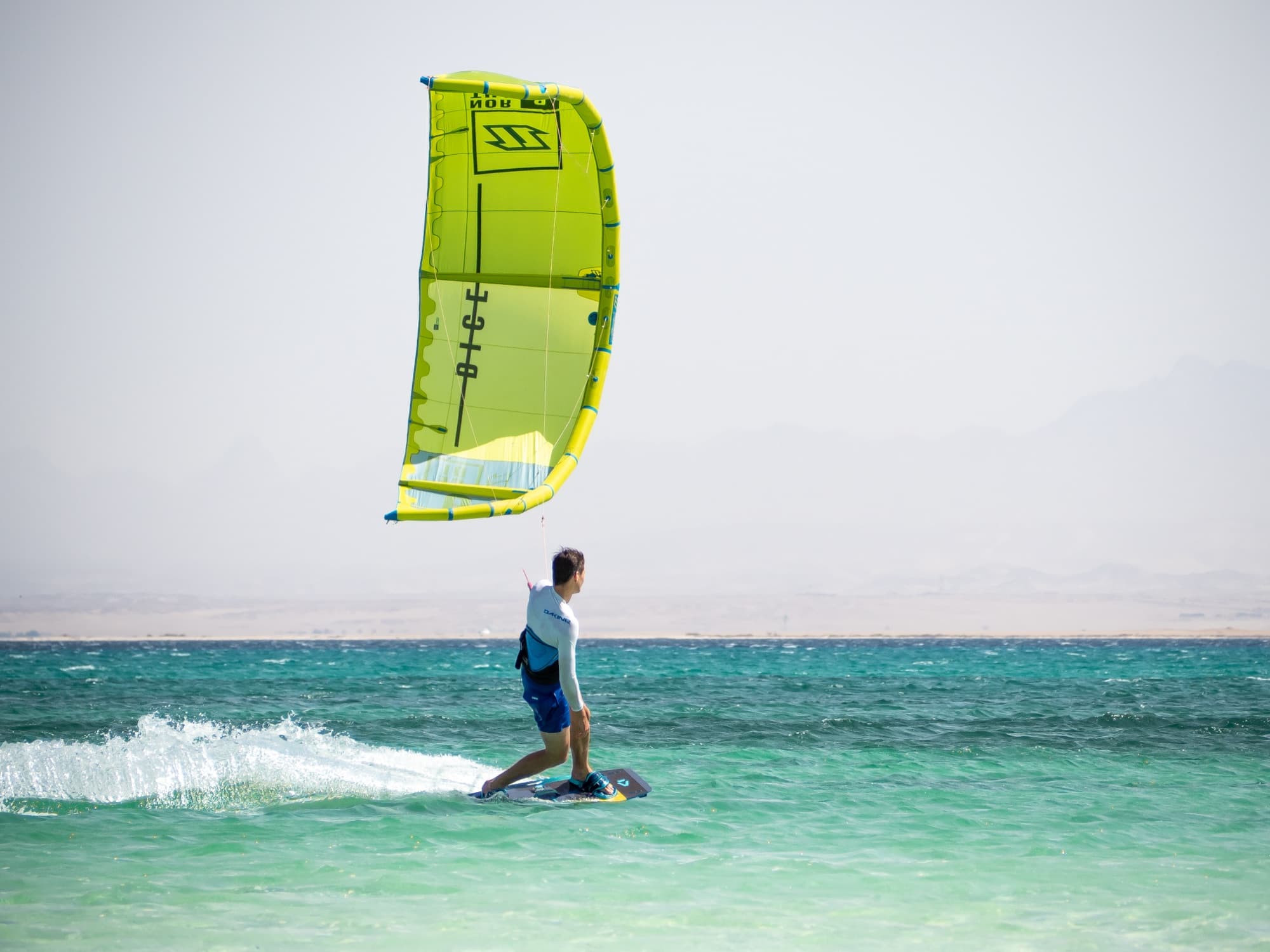
The down-loop transition: changing direction with a kite loop
An ordinary kite transition is a "dead" turn: you ride out to the edge, park the kite a bit higher, switch your edge from heel to toe, and ride back. It works, but the moment you change tack the pull sags, and you often get slightly stalled or pushed downwind. The down-loop solves exactly that problem — it's not just stylish, it's a surprisingly *practical* move.
9 July 2026 · JollyKite
What you need before the down-loop
The down-loop isn't a first trick or a skill from scratch. It's an add-on to two things you should already own, and without them you shouldn't try the loop:
- Clean transitions. You confidently change tack with an ordinary transition — heel to toe and back (jibe) — without losing balance or "sitting down" into the water. If the switch is still hit-or-miss, fix it first: the down-loop is added *to* the transition, it doesn't replace it.
- Basic down-loops and loops in body drag. Before you spin the loop on the board, spin it without the board — in body drag, on the water, holding the bar. The goal is to get used to the yank: when the kite passes the power zone, it pulls you noticeably, and your body should know that feeling in advance, not meet it at speed.
- Calm kite control in the upper window. You can park the kite high (around 45° and above) and hold it there without reflexively steering. A high kite is the down-loop's main safety net: the higher it sits before the loop, the more height it has to spare to complete the loop and climb back up, rather than crashing into the water.
If all three describe you, move on to the technique. If something is weak, close that gap first: the down-loop exposes weak spots immediately and unpleasantly.
The down-loop transition step by step
The main idea to keep in mind: the loop is done on the move, at the moment of the transition, and the kite leads you through it instead of yanking you into a gap. The full sequence is four steps:
- Park the kite high and shed speed. Before the transition, bring the kite up high — around 45° or a touch higher — and ease off your speed a little. A high kite gives height to spare for the loop, and shedding speed makes the yank softer and more predictable. Don't enter the down-loop at full speed with a low kite — that's exactly the scenario where the loop goes into the water.
- Begin the transition and ride downwind. Initiate a normal transition and first point the board downwind. This moment is critical: once you're rolling downwind, your speed and the kite's speed are matched, and the loop ahead will pass smoothly. If you spin the loop *before* you've gone downwind, the yank comes out sharp and sideways.
- Pull the front hand sharply and initiate the down-loop. Already moving downwind, sharply pull your front hand — the one leading in the direction of travel. This sends the kite into a fast downward loop. Keep the pull on the front hand until the kite completes the loop and starts climbing — don't let go halfway. The loop must be *fast*: a lazy, slow loop is the main reason the kite "sits down" in the power zone and knocks you over.
- Follow the kite and exit onto the new tack. While the kite spins the loop, follow it — board pointing downwind, body following the pull. When the kite finishes the loop, climbs back up, and the pull starts to ease — let the bar out away from you, let the kite unwind, switch your edge, and edge onto the new tack. You've gone the other way without ever losing pull.
At first the loop feels fast and "yanky" — that's normal, since the kite really does pass through the power zone. With each attempt (especially if you've already felt that yank in body drag) the movement gets smoother, and the timing of "pull — carry through — release" starts to come together on its own.
Common mistakes
Almost all down-loop transition problems come down to a few typical mistakes. Knowing them in advance, you'll get through the move noticeably faster and more safely:
- Spinning the loop too slowly or too weakly. The most common and most unpleasant mistake. If you pull the front hand lazily, the kite spins the loop slowly and "sits down" in the power zone low in the window — from there it yanks you sideways or drags you downwind. The loop must be fast and decisive: pull, and hold until the kite climbs.
- Not riding downwind before the loop. If you initiate the loop before the board has gone downwind, your speed and the kite's speed aren't matched — the yank comes out sharp and sideways instead of smooth. Downwind first, then the loop. It's not optional, it's part of the technique.
- Releasing the bar too early. If you drop the front hand mid-loop, the kite doesn't finish the loop, stalls, and may fall. Hold the pull through the end of the loop — you only let go once the kite has already climbed and the pull has eased.
- Going out on a big kite in strong wind. The down-loop is a horizontal yank, and its scale is directly tied to kite size and wind strength. A big kite in strong wind turns a soft move into a hard launch. Learn the down-loop on a sensible kite in light or moderate wind.
Safety
The down-loop is a more "practical" and softer move than a full kiteloop, but it's still a kite loop, which means it's still a horizontal yank. Treat it with respect.
The main dangers of the down-loop are a sharp horizontal yank (the kite drags you sideways or downwind through the power zone) and a kite loop that goes into the water (if there wasn't enough height or the loop went too low). Both scenarios are almost always the result of three things: too big a kite, too strong a wind, or too low a start for the loop.
So the rules are simple and non-negotiable:
- Light or moderate wind. Don't learn the down-loop in building, gusty wind — the yank becomes unpredictable.
- Keep the kite high. A high start to the loop (around 45° and above) gives the kite height to spare to complete the loop and climb back up rather than going into the water.
- A sensible kite. No "big" kites at the edge — the bigger the kite, the stronger the yank in the loop.
- Open space and an instructor. Learn where there's room around you, and under an instructor's supervision with radio comms on the water — they'll cue the timing and stop you before a mistake turns hard.
Pak Nam Pran offers nearly ideal conditions for this: flat shallow water, stable seasonal wind, and space to make mistakes calmly. That sharply lowers the risks while learning loops.
What's next
Once the down-loop transition is solid — you spin it both ways, hold the pull through the whole loop, and exit onto the new tack without a gap — you already hold half the mechanics of a real kiteloop. The logical progression looks like this:
clean transitions → the down-loop transition → your first kiteloop.
The down-loop teaches you the key thing: not to fear the yank, to hold the pull through the loop, and to trust the kite to carry you through the power zone. Those are exactly the skills you need for your first kiteloop — the more powerful, more spectacular big brother that loops on the jump. After a confident down-loop, the kiteloop stops feeling scary and becomes the next logical step.
If you're still refining the transition itself, start with the basics — the transition (turn) on a kite. And to figure out which tricks to learn next and in what order, look into the JollyKite Trick School.
We teach all kite-loop moves under an instructor's supervision, with radio comms on the water and in the safe, flat, shallow water of Pak Nam Pran — which sharply lowers the risks while learning down-loops and loops. More on formats and booking is on the /obuchenie page.
Let's go riding?
Send us your dates and level — we'll suggest a format, match the season to your rhythm and plan your trip end to end. WhatsApp +66 98 367 9769, Telegram bot @JollyKite_kite_bot.
FAQ
What is a down-loop on a kite?+
A down-loop is a downward loop of the kite, performed right at the moment of the transition, to change direction smoothly while keeping the pull. The kite spins a small loop beneath itself, passes through the power zone, and carries you onto the new tack without dropping you into a gap. It's the more "practical" and softer relative of the kiteloop.
How is a down-loop different from a kiteloop?+
Scale and purpose. A down-loop is a small downward loop on the move, at the moment of the transition: the yank is softer, the risk lower, and the goal is to change tack smoothly with the pull intact. A kiteloop is a full, powerful kite loop usually spun on a jump: the yank is stronger and more spectacular. The down-loop is the logical preparation for the kiteloop.
Why does it matter to ride downwind before the loop?+
So the yank is smooth. When the board is already rolling downwind, your speed and the kite's speed are matched, and the loop passes softly. If you initiate the loop before going downwind, the yank comes out sharp and sideways — the kite jerks you to the side instead of leading you through the turn. Downwind first, then the loop.
Which hand do you pull for the down-loop?+
The front hand — the one leading in the direction of travel. A sharp pull of the front hand sends the kite into a fast downward loop. You hold the pull on that hand until the kite completes the loop and starts climbing; you must not release halfway — otherwise the kite won't finish the loop and may fall.
Is the down-loop dangerous?+
It's a kite loop, so treat it with respect: the main risks are a sharp horizontal yank and a loop that goes into the water. Both usually happen because of too big a kite, too strong a wind, or too low a start for the loop. That's why the down-loop is learned in light/moderate wind, with the kite parked high, and under an instructor's supervision.