
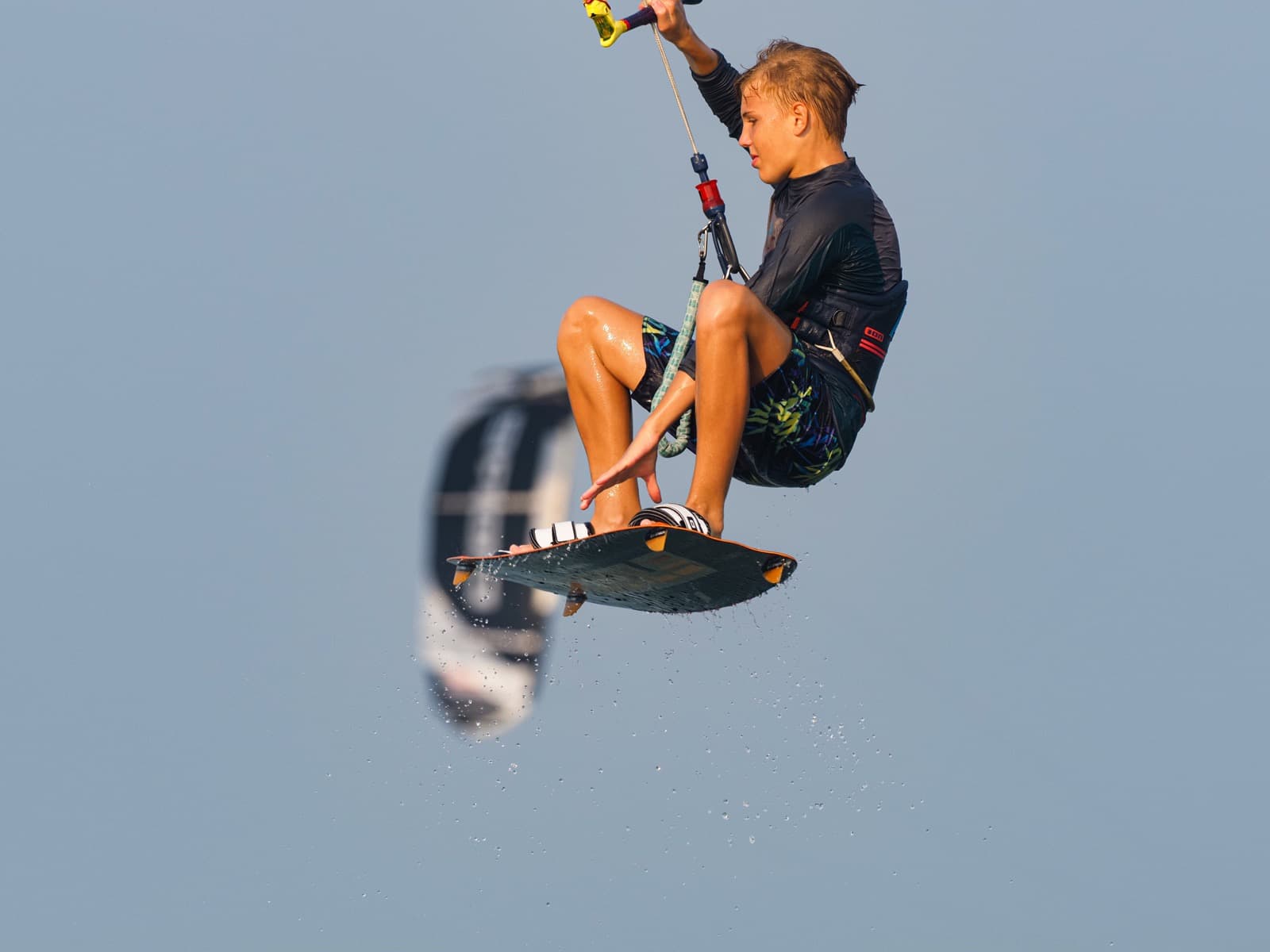
The 360 on a kite: a spin in the air, step by step
Once you jump confidently — going up consistently, keeping the kite under control and landing softly — you'll want to add something new to your jumps. One of the most logical next tricks is the 360: a full rotation of the board and body around a vertical axis right there in the air. It's essentially the same jump, with rotational coordination added: you go up, complete the spin and land nose forward.
27 June 2026 · JollyKite
What you need before the 360
The 360 is built on top of the jump, not a skill from scratch. So before taking on the spin, you need a solid base:
- A stable jump. You should go up predictably, control your height and not "depend on luck." If every jump is different — it's too early.
- Kite control in the air. During the jump you know where the kite is and can keep it in the right position without jerking it.
- A confident landing. You land consistently on bent legs, with the kite still flying and pulling you onward.
- A sense of hang time. You can "hang" in the air at the peak of the jump — that's exactly the time you need to complete the spin.
If even one of these is still shaky — nail the jump first. On an unstable jump the 360 becomes a lottery: now an under-rotation, now a hard landing. With a good base, the spin comes much faster and more safely.
The 360 step by step (hooked)
The basic 360 is learned hooked (in the chicken loop), with the kite high. A high kite at the zenith gives you hang time — the time in the air during which you complete the full circle. Step by step:
- Make a jump with good hang time, kite at the zenith (12 o'clock). This is the foundation of the whole trick. You need height and time in the air — without them you simply won't finish the spin. Send the kite high and go up as on a normal jump, but with the emphasis on hang time, not distance.
- At the peak of the jump, initiate the rotation with your shoulders and gaze. The peak is the moment you're highest and the pull is minimal. This is where you start the spin: lead with your shoulders and gaze in the direction of rotation, and the board follows your body with your legs. Your head and gaze set the direction — you rotate where you look.
- Keep your body compact and the kite steady up top. The more compact your body (arms and legs closer to centre), the easier and faster the rotation goes — like a figure skater. Keep the kite steady up top and don't jerk it: its job is to keep you in the air, not to spin you. The rotation comes from the body, not the kite. Ride the spin out calmly.
- "Catch" the landing with your gaze. As you complete the circle, find the landing spot with your eyes — your gaze comes back in the direction of travel. The board should return nose forward or slightly downwind so it takes you softly onto the water.
- Land on bent legs, keep the kite flying. Your legs work as a shock absorber — you meet the water softly, not on straight legs. The kite keeps flying and pulling you forward, so you ride away immediately rather than stalling.
The key feeling of the whole trick is "a jump plus a body turn," where the kite hangs calmly up top and simply holds you. Once that clicks, the 360 starts working consistently in both directions.
Where to go next: unhooked and the handle pass
What we've covered is the basic hooked 360. In advanced freestyle the 360 is more often done differently: unhooked (released from the chicken loop) and with a handle pass — passing the bar behind your back from hand to hand during the spin. This is a different level of load and coordination: the pull goes directly through your arms, mistakes are less forgiving, and you need a confident unhooked jump before attempting the pass.
So the sequence is simple: first a confident hooked 360 with a high kite, and only then unhooked and the handle pass. The basic spin you learn here stays the foundation for the advanced version too: the same body rotation, the same control of height and landing. For where to go next with tricks, see the JollyKite Trick School.
Common mistakes
Most failed 360s come down to a few typical mistakes. Knowing them in advance, you'll get through the spin noticeably faster:
- Too little height and hang time. The most common cause of under-rotation: the jump is low or "flat," there's no time in the air — and you simply don't finish the full circle. Nail the high jump with hang time first.
- Spinning with the kite instead of the body. The rider tries to "wind" themselves up with the kite, jerking the bar. The kite drops off the zenith, loses pull, and you fall. Keep the kite steady up top and rotate with the body — shoulders and gaze.
- Under-rotation or over-rotation. The board doesn't come back nose forward: you either under-rotated or spun past it. The fix is your gaze — find the landing spot early and lead your body to it — plus a compact body to control the rotation speed.
- Losing the kite. All your attention goes into the spin and the kite "wanders" down or to the side. Keep it in your awareness — on a 360 it should always be up top.
- Hard landing on straight legs. Straight legs don't absorb — the impact goes into your knees and back. Always meet the water on bent legs, with the kite flying.
Let's go riding?
Send us your dates and level — we'll suggest a format, match the season to your rhythm and plan your trip end to end. WhatsApp +66 98 367 9769, Telegram bot @JollyKite_kite_bot.
FAQ
What is a 360 on a kite?+
A 360 is a full rotation of the board and body around a vertical axis, performed in the air. It's essentially a normal jump with rotational coordination added: you go up, complete the circle with your body and land nose forward. The basic 360 is learned hooked (in the chicken loop), with the kite high at the zenith for hang time.
How is the 360 different from a back roll?+
The back roll (and front roll) is a rotation over the shoulder, around a horizontal axis: the body spins "backward" or "forward." The 360 is a turn around the vertical axis, like spinning on the spot, only in the air. The feeling and the fear are different: on a 360 you aren't "thrown over your head," you simply turn around, which many riders find more intuitive.
What do you need before the 360?+
You need a stable jump: a confident takeoff with height control, kite control in the air, a soft landing on bent legs, and a sense of hang time at the peak. The 360 is built on top of the jump, not a skill from scratch. On an unstable jump the spin becomes a lottery.
Should you learn the 360 hooked or unhooked?+
Learn the basic 360 hooked — in the chicken loop, with the kite high at the zenith, which gives hang time and time to complete the spin. It's safer and more intuitive. The unhooked version with a handle pass (passing the bar behind your back) is learned later, in advanced freestyle, once you have a confident unhooked jump.
Why don't I complete the 360?+
Most often it's a lack of height and hang time: too little time in the air. Or you're spinning with the kite instead of your body and losing pull, or you're not leading your gaze to the landing spot. The fix: a high jump with hang time, rotation with the body (shoulders and gaze), a compact body and the kite steady up top.