
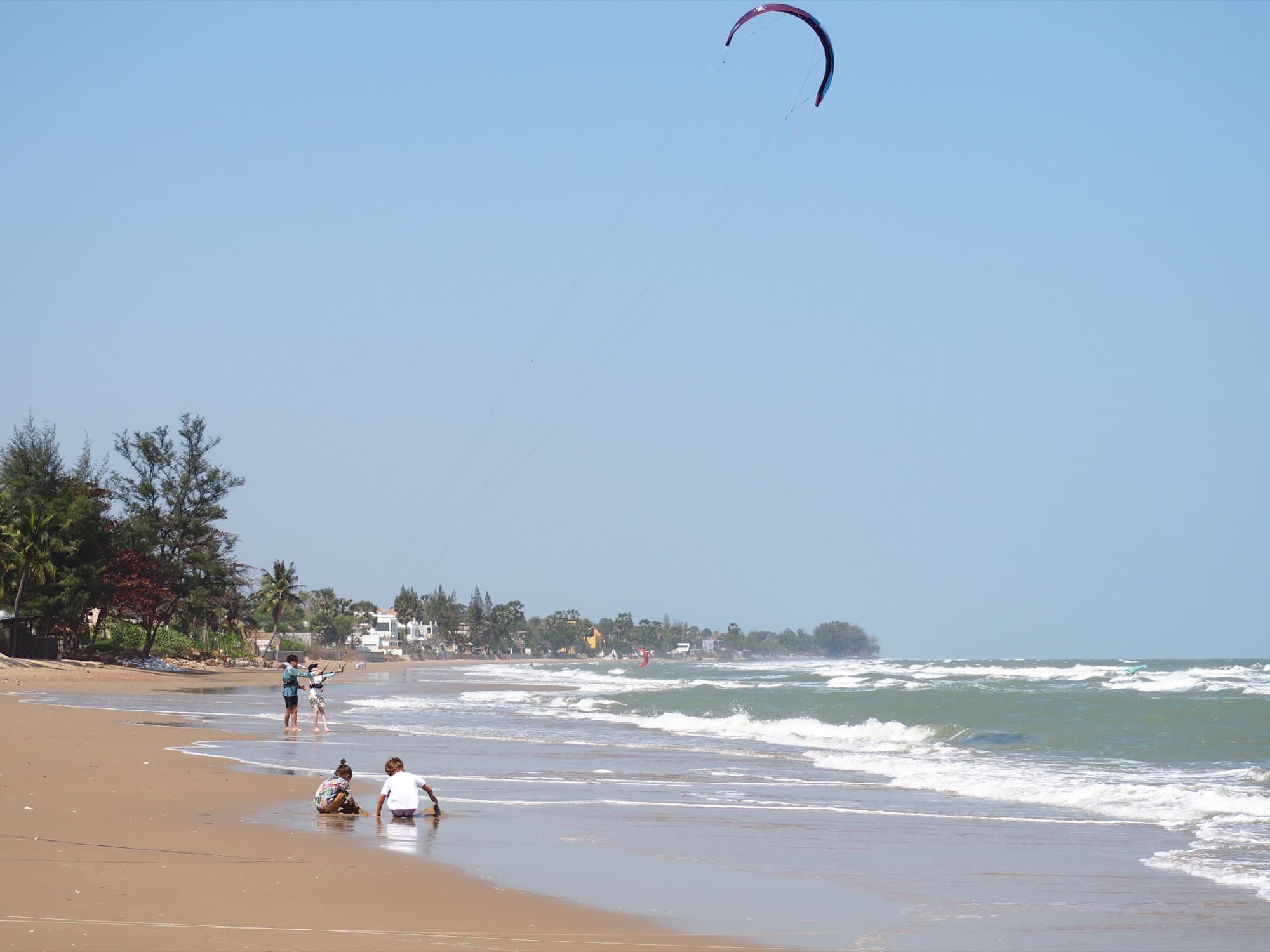
Live Wind in Pak Nam Pran: Forecasts and Current Conditions
«Is it blowing today?» — every kiter's main question at the spot. Pak Nam Pran is our home spot in the Pranburi district, half an hour south of Hua Hin, and the wind here is its own, local thing. This article is about deciding in five minutes whether it is worth riding today: where to check the live forecast, what a typical wind day looks like at our spot, and what wind works best here.
22 July 2026 · JollyKite
Straight up: a forecast is a probability, not a guarantee. The coastal wind is a living, local thing that depends on the breeze and the weather on the day. So the best «instrument» is your eyes at the spot and the advice of those already on the water. How to use that is below.
Where to check the live forecast
Kiters worldwide use two main services, and they work at our spot too.
Windguru — the classic for wind sports. It shows an hour-by-hour forecast: wind speed, gusts, direction, waves. Look at the point for Hua Hin and Pranburi — take the one nearest the coast. The key is not to chase a single number but to read the whole shape of the day: when the wind fills in, how high it builds, when it drops.
Windy — a visual map with animated wind. Handy for the big picture: where the wind comes from, how it hits the coast, what is happening in neighbouring areas. Good for grasping the trend, not just a point forecast.
A note on models. Both services run forecasts from different computed models, and they can disagree. If several forecast models agree, the prediction is generally more reliable. If the models disagree, wind conditions are less predictable — check the latest live wind readings. Do not memorise specific station or point numbers: interfaces change, so it is easier to search by «Hua Hin» or «Pranburi» each time and take the point nearest the sea.
How to read these charts — numbers, gusts and direction — is covered in detail in our wind forecast guide. We do not repeat it here; this is about the spot itself.
A typical wind day at the spot
The rhythm of the day depends on which season you catch. From November until roughly 10 January the north wind works, and it is a morning wind: it usually starts around 8–9 a.m. and holds until about 2 p.m., so the best hours are in the first half of the day. Later in the season the wind is largely thermal — tied to the land heating up and the sea breeze — and the day has a different rhythm.
In the south-wind season the morning is usually calmer. The wind is often still light or just gathering — a good time for breakfast, sorting gear and an unhurried trip to the spot. Sometimes a nighttime gradient wind carries into the morning, but more often the main action is ahead.
Then midday and the afternoon become the working window. As the land warms, the breeze kicks in, the wind builds and steadies. This is the best time for both lessons and riding: the spot usually comes alive in the second half of the day.
Evening — the wind often holds to sunset, and the sunsets over the gulf are a reason of their own to stay on the water. It drops off by night.
This is the typical picture in season, not a timetable. Some days blow steady from morning to evening; others have a short window or fickle wind. The season itself runs roughly mid-November to late April; a month-by-month breakdown is in our wind season guide for Hua Hin and Pranburi, and how the weather falls across the months is in a separate article on Hua Hin weather.
What wind works best here
For comfortable riding and lessons, steady moderate wind is best. A beginner learns most easily in stable, moderate wind: the kite is predictable, speeds are low, mistakes are forgiven more easily. Advanced riders and jumpers want something fresher — that is when the big jumps and tricks switch on.
By direction our spot is friendly: the prevailing seasonal wind hits the coast conveniently for riding, and the sandy entry and roomy water add to the comfort. Gusty, ragged wind is the least pleasant — hard for beginners and for tricks alike. A steady flow always beats a strong but jerky one.
The exact «ideal» wind numbers depend on your weight, kite size and level. So there is no universal figure — there is a range in which you are comfortable. Sorting that out is part of learning to kitesurf from scratch: the instructor matches gear to the day's conditions and your weight.
Ride today or not
A quick way to decide in five minutes.
- Open the forecast on Windguru or Windy for the Hua Hin / Pranburi point. Read the whole day, not a single number: when the wind fills in and how high it builds.
- Compare models. Agreement on good wind means high chances. Disagreement means an uncertain day.
- Factor in the time of day. If it is calm this morning, that is normal — the afternoon breeze may still kick in. Do not write the day off.
- Look at the live picture. Flags, palms, water, riders at the spot — the best indicator. Forecasts get it wrong; your eyes do not.
- Ask those on the ground. Locals and the school always know if it is blowing right now and what to expect by midday.
Above all: do not trust a single number in an app. The wind is alive. Sometimes the forecast promises calm and the spot works — and vice versa.
Not sure? Message us
If you are staring at the forecast and cannot tell whether to head out — just ask. We at JollyKite are at the spot almost every day and see the real picture, not just the charts. We will tell you if it is blowing today, when to come and what to expect for your level.
This especially helps beginners: until you have trained your eye on the forecast, it is easier to ask those already on the water. Our spot is in Pak Nam Pran — there is a separate breakdown of the kite spots of Hua Hin and Pranburi covering where we are and why it is an easy place to learn.
FAQ
Where do I check the wind in Pak Nam Pran and Hua Hin?+
The main services are Windguru and Windy. Look at the point nearest the coast for Hua Hin or Pranburi. Do not memorise station numbers: interfaces change, so search by name. How to read the charts is in our separate wind forecast guide.
When does it usually blow at the spot — morning or afternoon?+
In season the wind is largely thermal: mornings are often calmer, and the working window falls in the day and afternoon, when the land warms and the breeze kicks in. The wind often holds to sunset. This is the typical picture, not a timetable.
Can I trust the wind forecast?+
A forecast is a probability, not a guarantee. If several models agree on good wind, trust it more; if they disagree, the day is uncertain. The best indicator is the live picture at the spot and the advice of those already on the water.
What wind is best for kiting at the spot?+
Steady moderate wind: beginners learn more easily in stable, moderate conditions, while jumpers want something fresher. Ragged, gusty wind is the least comfortable. The exact numbers depend on your weight, kite and level — there is no universal figure.
Should I go riding today?+
Open the forecast for the whole day, compare the models, factor in the time of day, look at the live picture and ask those at the spot. Do not decide on one number in an app. Unsure? Message us and we will tell you the real situation.