
Thailand or Zanzibar for kitesurfing: which is better
Thailand and Zanzibar often end up on the same shortlist when you are deciding where to go riding: both warm, both beautiful, both good for learning from scratch. But for a kiter they are two different kinds of trip. Thailand (Hua Hin and Pak Nam Pran) means a long, steady season, shallow sandy flats and a calm winter base with easy logistics. Zanzibar means, above all, Paje: a scenic shallow sandy lagoon, warm turquoise water and two distinct wind seasons.
29 June 2026 · JollyKite
There is no universal “better” — there is your goal and the time of year you travel. If you want a classic flat lagoon, the exotic and warm water, Zanzibar is very strong. If you care more about a structured, comfortable start, a long even season, lessons in Russian and easy logistics, Thailand is more convenient. This article is not about burying one destination in favour of the other: it is a comparison built around your goal, so you can choose with eyes open.
JollyKite has taught in Thailand (Pak Nam Pran, Hua Hin) since 2014, and we are honest about Zanzibar: Paje is genuinely a great place to learn, with a beautiful lagoon and warm water. Our goal is not to convince you Thailand is better at everything — it is to help you pick the spot that fits your real goal and season.
In short: who should pick Zanzibar, who should pick Thailand
- Go to Zanzibar (Paje) if you want a classic flat sandy lagoon, the exotic and warm water, love scenic places, and are fine watching the tides and matching the season to your level.
- Go to Thailand (Hua Hin / Pak Nam Pran) if you want a reliable structured start, a long even season, shallow flats without tidal surprises, easy logistics and lessons in Russian.
- Key note: on Zanzibar the working part of the lagoon depends heavily on the tide and shifts through the day, and the wind splits into two distinct seasons — the milder winter Kaskazi and the stronger summer Kusi.
Wind and seasons
Zanzibar, Paje. Zanzibar has two wind seasons with very different character. The first is Kaskazi, a north-east wind, roughly from December to February-March: usually 12–20+ knots, milder and steadier, great for beginners. The second is Kusi, a south-east wind, roughly from June to October: stronger and gustier, usually 15–25 knots — a season for more confident, experienced riders. When choosing Zanzibar, it matters which season you land in.
Thailand, Hua Hin and Pak Nam Pran. Here the wind is steady and moderate — usually 13–22 knots, predictable and manageable. The season is long and continuous, from mid-November to early May. The south window (roughly mid-February to early May) is especially calm and soft — a great time to start. It rarely cranks to extremes, a big plus for learning: easier on the head, easier on the body, less stress.
To simplify: Zanzibar gives you a choice of two wind characters to match level and season, Thailand gives you one long even season with predictable moderate wind. For a winter trip both work: in Thailand it is peak season, on Zanzibar it is the mild Kaskazi, convenient for learning.
Water: lagoon and tides vs shallow flats
Paje is a scenic shallow sandy lagoon, protected by a reef. The water is warm, turquoise, shallow — pleasant and safe to learn on: you can stand on your feet, balance comes faster, falling is not scary. But there is an important nuance — the tides. The water level in the lagoon changes a lot through the day: at low tide a wide zone of sand and reef opens up, at high tide the lagoon fills and the working window for riding shifts in time and space. Beyond the reef, in open water, there is chop.
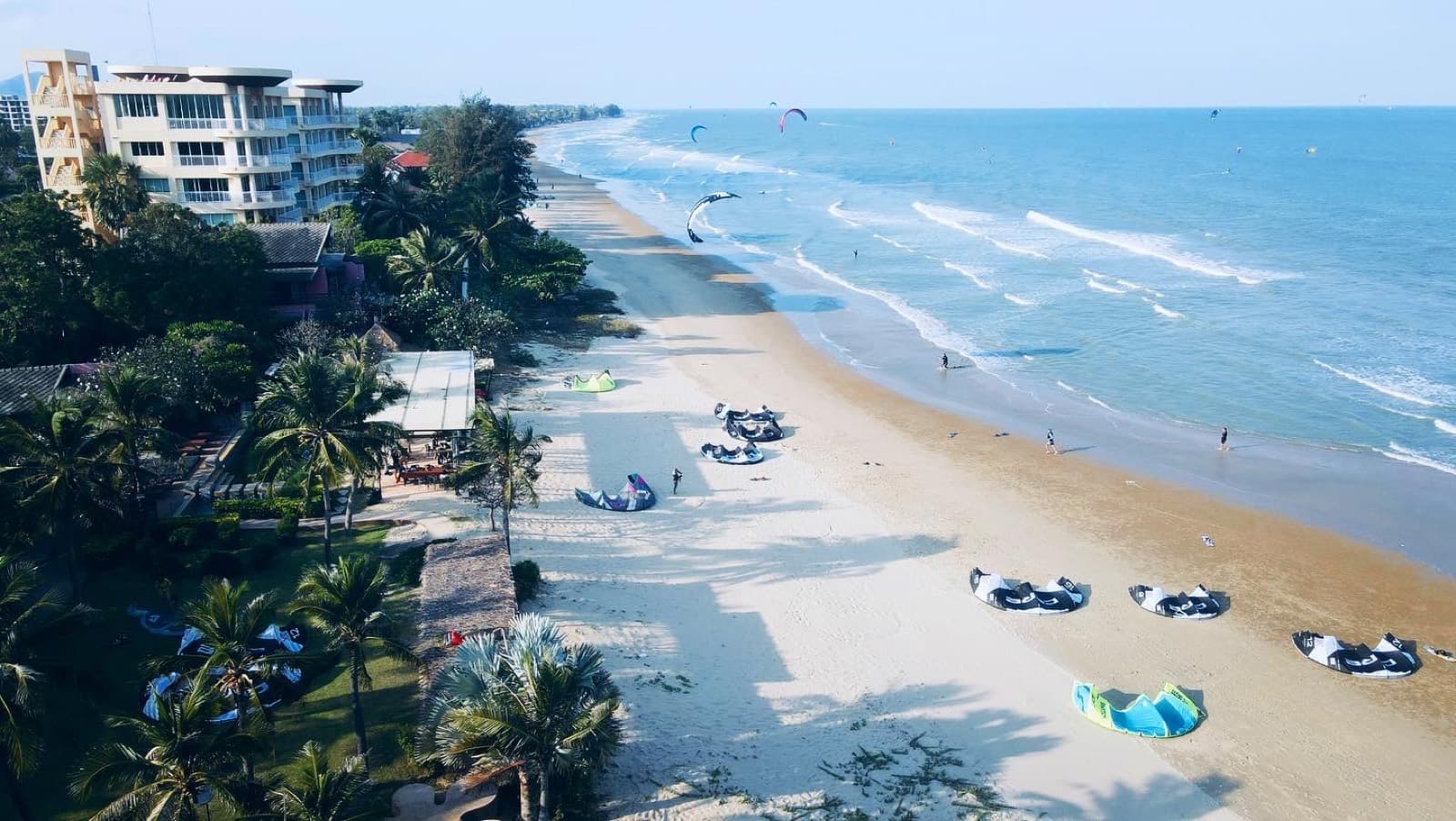
Hua Hin and Pak Nam Pran mean long sandy beaches and a wide shallow zone along an open shore. The water is also shallow and broadly even; with wind comes light chop and small waves. But there is no rigid tie to the tides like in Paje: the working zone is more stable through the day. For structured learning that is convenient — it is easier to build a lesson schedule without adjusting each time to the water level.
Logistics, infrastructure, language
Zanzibar, Paje. Getting to Zanzibar is usually longer and with layovers — it is an island off the east coast of Africa. On the ground the infrastructure is developed by kite-spot standards: Paje has plenty of schools, hotels, cafes and a kite community. Water and air are warm year-round, a wetsuit usually is not needed. The downside for a Russian-speaking rider — lessons are more often in English, and a Russian school on the spot is hit-or-miss.
Thailand, Hua Hin and Pak Nam Pran. Developed infrastructure and comfort: shops, cafes, accommodation for every taste, everything civilised and predictable. Logistics are easy — about 2.5–3 hours from Bangkok, with Hua Hin airport nearby and familiar, straightforward flights. The destination is safe and family-friendly, and for a Russian-speaking rider there is an important bonus — the JollyKite school with lessons in Russian on a structured method.
Learning from scratch
Zanzibar (Paje) is objectively good for starting out. A shallow sandy lagoon where you can stand on your feet, warm water and the mild winter Kaskazi (December–March) create friendly conditions for the first steps. You just need to match the season to your level and keep the tides in mind, since the lesson schedule adjusts to them.
Thailand (Hua Hin and Pak Nam Pran) gives steady moderate wind, shallow water without a rigid tidal dependency and — crucial for a Russian-speaking rider — lessons in Russian on a structured school method. A long continuous season and predictable wind make progress smooth and calm, and the south window (February–May) is especially comfortable to start in. If you are still choosing a region in general, see our overview of kitesurfing in Asia, the piece on the Asian kite season month by month and the related Thailand vs Sri Lanka comparison.
Comparison table
| Zanzibar (Paje) | Thailand (Hua Hin / Pak Nam Pran) | |
|---|---|---|
| Water | Sandy lagoon, shallow, tide-dependent | Shallow flats, open shore, light chop |
| Seasons | Two: Kaskazi (Dec–Feb/Mar), Kusi (Jun–Oct) | One long: mid-Nov — early May |
| Wind (winter) | Kaskazi, NE, 12–20+ knots, milder | Steady, 13–22 knots, peak season |
| Tides | Important: working zone shifts through the day | Less influence, zone more stable |
| For beginners | Good: lagoon, warm water, mild Kaskazi | Good: steady, predictable, lessons in Russian |
| Logistics | Further, with layovers | ~2.5–3 h from Bangkok, has airport |
| Language of lessons | More often English | Russian, JollyKite school |
| Atmosphere | Exotic, Africa, scenic | Comfortable family resort |
Our honest verdict
- Want a classic flat sandy lagoon, the exotic and warm water, love scenic places and are fine watching the tides and the season → your option is Zanzibar, Paje.
- Want a structured comfortable start, a long even season, shallow flats without tidal surprises, easy logistics and lessons in Russian → your option is Thailand, Hua Hin and Pak Nam Pran.
- Often it is a seasonal choice: in winter both work, and in summer, when Thailand's season is over, Zanzibar gets the strong Kusi for confident riders.
The key is to honestly match the spot to your goal, level and season. If a classic lagoon, the exotic and warm water sound like you, look toward Zanzibar. If a structured comfortable start, a long even season and lessons in Russian sound closer, we would love to see you in Pak Nam Pran.
FAQ
Where is it better to learn kitesurfing from scratch — Thailand or Zanzibar?+
Both spots are good for starting out. In Zanzibar (Paje) there is a beautiful shallow sandy lagoon, warm water and the mild winter Kaskazi wind, pleasant for the first steps — you just need to match the season and keep the tides in mind. In Thailand (Hua Hin and Pak Nam Pran) there is steady moderate wind, shallow flats without a rigid tidal dependency and lessons in Russian on JollyKite's structured method, especially comfortable in the south window (February–May). For a reliable, predictable start Thailand is a touch more convenient; for the exotic and a classic lagoon — Zanzibar.
When is the kitesurfing season in Zanzibar?+
Zanzibar has two wind seasons. Kaskazi — a north-east wind roughly from December to February-March, usually 12–20+ knots, milder and friendlier for beginners. Kusi — a south-east wind roughly from June to October, usually 15–25 knots, stronger and gustier, for more experienced riders. Between these seasons the wind is less stable.
Do the tides matter in Paje?+
Yes, the tides are an important nuance of Paje. The water level in the lagoon changes a lot through the day: at low tide a wide zone of sand and reef opens up, at high tide the lagoon fills and the working window for riding shifts. So riding on Zanzibar is tied to the tide schedule, and it is worth planning ahead. In Thailand there is no such rigid dependency — the working zone is more stable through the day.
Where is logistics easier — Thailand or Zanzibar?+
Logistics are easier to Thailand: about 2.5–3 hours from Bangkok, with Hua Hin airport nearby and familiar, straightforward flights. Zanzibar is an island off the east coast of Africa, usually longer to reach and with layovers. On the ground both destinations have developed infrastructure, but Thailand also offers lessons in Russian.
Can you combine Thailand and Zanzibar by season?+
Yes, that is a common scenario. In winter both destinations work: Thailand is in peak season (mid-November to early May), and Zanzibar has the mild Kaskazi, convenient for learning. In summer, when the Thai season is over, Zanzibar gets the strong Kusi (June–October) for confident riders. So it is often not an either-or choice but a question of when to go where.