
How much it costs to learn kitesurfing in Thailand: what you’re actually paying for
A beginner course in Thailand costs anywhere from 11,000 THB to 27,000 THB — and both numbers are honest. The 2.5x spread isn’t marketing: for one price you get three hours in a group of four; for the other, nine hours one-on-one, with radio comms, a support boat, and a kite matched to your body weight. The hour costs roughly the same. What you get out of it doesn’t.
12 July 2026 · JollyKite
So the conversation about price shouldn’t start with a price list. It should start with a question: what exactly are you buying? Below is the honest breakdown — what makes up the price of a course, what makes up the budget of the whole trip, and where you can cut costs versus where you absolutely shouldn’t. We don’t quote our own prices here: they depend on format, hours and dates, and it’s easier to work them out in the calculator.
All market figures below are approximate, as of mid-2026, based on published prices from schools in Hua Hin, Pranburi and Phuket. Check with the specific school — prices move.
Why price per hour is a bad benchmark
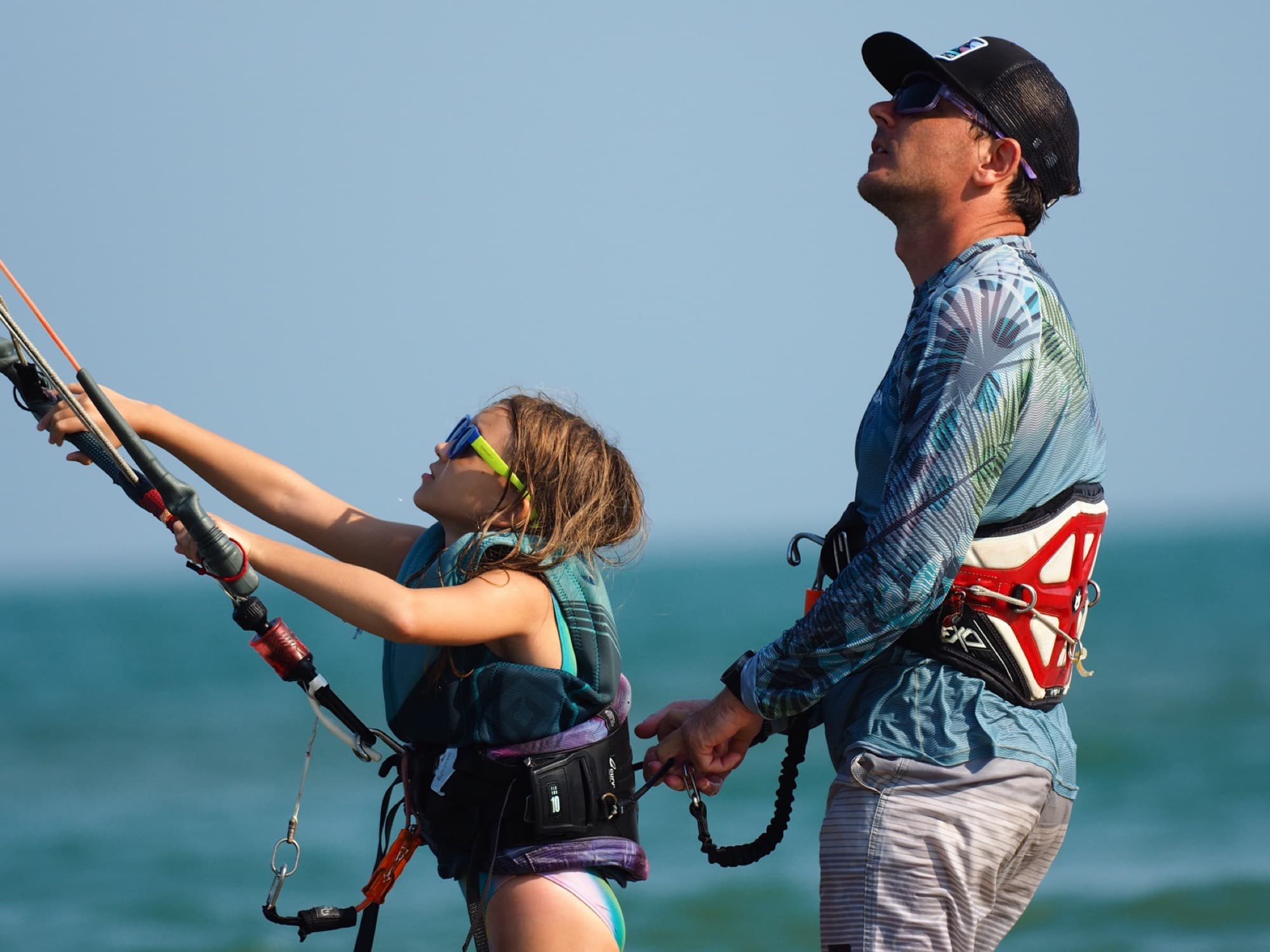
An hour of instruction isn’t a product. It’s a container, and almost anything can be inside it. Picture two two-hour lessons. In the first, there are four of you to one instructor: while he sets up a kite for one student, three stand on the sand. Your actual time with a kite in your hands is maybe twenty minutes. In the second, you’re alone: those two hours are entirely yours. Same hour on the price list. Wildly different amounts of learning.
So don’t ask how much an hour is. Ask what’s inside the hour. What should be included:
- All the gear — kite, bar, board, harness, leash, helmet and impact vest. If the price list says the kite is charged separately, that isn’t a course, it’s a trap.
- A kite matched to your weight and the current wind. The wrong kite either drags you around or leaves you waiting on the sand for a gust. You paid for both.
- Radio comms. An instructor in your ear corrects you on the water within a second. Without a radio, he waves from the beach and you guess.
- Group size. One-to-one, one-to-two or one-to-five — the number that changes everything.
- A support boat or jet ski. Beginners drift downwind. That’s normal. The question is who picks you up, and how fast.
- School insurance and a safety protocol. Not don’t worry, it’s all fine, but a specific answer to: what happens if something goes wrong?
- The instructor’s language. Safety commands are learned by ear and executed without thinking. If a translation sits between the command and the action, you lose a second.
- Certification. IKO means a single method and a clear progression, not a piece of paper.
The right question is: what does it cost to get me to independent riding? Not what an hour costs.
Private vs group: count the result, not the hour
A group hour is cheaper — that’s a fact. Around the region, group lessons typically run 1,200–1,800 THB per hour, private lessons 1,500–2,600 THB (approximate, mid-2026). A real difference. But you should count by result, not by hour.
Getting a beginner to a confident water start takes around 9–12 hours. In a group, part of that time goes to waiting, so a group usually needs more hours to reach the same skill. Sometimes the group still wins on the total. Sometimes it doesn’t. It all comes down to the ratio: how many people per instructor, and how many minutes of kite time land on you personally.
How to check: ask the school directly — how many students per instructor, and how much actual kite time will I get? If the answer is evasive, you already have your answer. Two friends or a couple taking turns is a sensible compromise. Five strangers in a group is a queue on the sand.
What makes a course more or less expensive
- Format: private costs more per hour but is denser in results.
- Duration: a 9–12 hour package almost always beats single lessons per hour.
- Season: peak season books out early; shoulder season means deals but less reliable wind.
- IKO certificate: usually already included. If a school charges extra for it, ask what else is extra.
- Equipment: new kites cost more to maintain — and show up in the price. Old, tired kites handle worse: the saving costs you extra hours.
- Post-course rental: many schools discount rental for their graduates — treat it as part of the package.
A one-off taster lesson (usually 2–3 hours, around 4,000 THB in the region) is a fine way to find out whether the sport is for you. As a way to actually learn, it’s the most expensive one going: every next single lesson starts by repeating the last.
The full trip budget
The course isn’t the only line item. Flights are the biggest and least predictable one: it depends on your departure city, dates, connections and how far ahead you book. We won’t guess — check the aggregators. The gap between three months out and next week is often 2x.
Visa. As of May 2026, Russian citizens enter Thailand visa-free for 30 days (previously 60). Before you fly, you must fill in the TDAC digital arrival card. It’s free and filed online on the official immigration portal. If you need longer, an extension at an immigration office costs 1,900 THB and gives you another 30 days.
Airport transfer. Suvarnabhumi to Hua Hin: bus — roughly 300–350 THB per person, 3–4 hours; minivan or shuttle — roughly 200–400 THB per person; private car — roughly 2,500–3,500 THB for a car carrying 3–4 people. Add another 30–40 minutes from Hua Hin to Pak Nam Pran.
Accommodation. Around Hua Hin and Pak Nam Pran: guesthouse or simple room — 700–1,500 THB a night; mid-range hotel or apartment — 1,500–3,000 THB a night; monthly studio or condo — roughly 10,000–20,000 THB a month; house or villa monthly — from 30,000 THB up. Budget 7,000–20,000 THB for a week of lessons, depending on your standard.
Food. Thai street food or a local canteen — 60–150 THB a dish; café or restaurant — 250–400 THB per person; per day per person — realistically 400–800 THB, unless you live in beachfront restaurants. That’s roughly 3,000–5,500 THB for a week. Local transport: a scooter runs 250–300 THB a day, or 3,000–4,000 THB a month. If your accommodation is near the school, you may not need one.
The course. Market benchmarks for the region: a beginner course of 9–10 hours — from 11,000–12,000 THB (chain schools, small groups) up to 18,000–27,000 THB (private, everything included); a taster lesson of 2–3 hours — around 4,000 THB; the IKO certificate is normally included.
Rental after the course. A full set (kite, board, harness) — roughly 2,000–3,200 THB a day; a week — roughly 14,000–20,000 THB. Board only — around 1,000 THB a day; kite only — around 2,000 THB. A beach fee for riders with their own gear (pump, showers, rescue boat) — around 300 THB a day. Many schools discount rental for their graduates — ask in advance.
Insurance. No insurance is legally required to enter Thailand — but a standard travel policy does not cover kitesurfing. You need an extreme-sports add-on that names kitesurfing explicitly. It costs noticeably more than the base policy; check the exact figure with your insurer. This is not the line item to save on.
In total, give or take, for a week in Pak Nam Pran including a course and excluding flights: course of 9–12 hours — 11,000–27,000 THB; accommodation — 7,000–20,000 THB; food — 3,000–5,500 THB; return transfers — 700–7,000 THB; local transport — 0–2,000 THB; visa — 0 THB or plus 1,900 THB; insurance — per your policy. That’s a wide spread, honestly so: it depends on where you sleep and how you learn.
Where you must not cut costs
Equipment. An old kite holds the window worse, reacts more slowly, and has worn lines and safety systems. You’ll learn slower and be more scared. The price difference is a thousand baht. The experience difference is the whole course.
The instructor. A badly taught start takes weeks to unlearn. We regularly take on people who learned somewhere cheap and came back to relearn — that’s a course paid for twice.
Safety. Radio comms, quick-release drills, self-rescue, a boat on the water, school insurance. No haggling here — just cross off any school that doesn’t have them. You can save on accommodation, food and transfers: a guesthouse instead of a resort, a local canteen instead of a restaurant, a bus instead of a private car — real money, and none of it touches your learning.
What to buy after the course — and when
Short answer: not right away. For the first few weeks after your course, ride rental gear. You don’t yet know which style suits you, what board fits you, or what kite sizes you need for your weight and your usual wind. Buying a first setup in a rush is the surest way to sell it at a loss six months later.
- Harness. The most personal item, cheaper than a kite or board, and the difference between yours and the rental one is immediate. Buy it first.
- Kite. Once you know your weight, your wind and your style. Size by calculation, not by catalogue.
- Board. Last: on rentals you’ll get to try several and work out what you actually want.
One insider tip: at the end of the season (usually March–April) schools sell off their rental gear. The kites are alive, serviced, and priced well below new. Ask.
Timing: don’t pay for windless days
A course without wind is paid waiting. In Pak Nam Pran the wind season runs roughly from mid-November to late April, with more and less reliable windows inside it. Plan with slack: for a 9–12 hour course, allow 5–7 days rather than 3. The wind doesn’t follow your schedule, and any school promising to finish in three days whatever the weather is not telling you the truth.
FAQ
How much does it cost to learn kitesurfing in Thailand?+
A beginner course (9–10 hours) in the region runs roughly from 11,000–12,000 THB at chain schools with small groups, up to 18,000–27,000 THB for private, all-inclusive tuition. Figures as of mid-2026 — confirm with the school. You can price your exact format and dates in the calculator on our site.
How many hours does a beginner need to ride independently?+
Usually 9–12 hours with an instructor. That gets you to a confident water start and your first runs. After that you need solo practice — the pace varies with fitness, wind and lesson format.
What should the price of a kite course include?+
All equipment (kite, bar, board, harness, leash, vest), a kite matched to your weight and the wind, the instructor’s time, radio comms, water support, and an IKO certificate at the end. If any of that carries a surcharge, count it into the price and compare schools on the total.
Private or group — which is better value?+
A group hour is cheaper (roughly 1,200–1,800 THB versus 1,500–2,600 THB), but group time includes waiting, so you need more hours. Count the cost of the result, not the cost of the hour.
How much does kite gear rental cost after the course?+
A full set (kite, board, harness) runs roughly 2,000–3,200 THB a day, or 14,000–20,000 THB a week. Board only is around 1,000 THB a day. Many schools discount rental for their graduates.
Do I need a visa to come and learn in Thailand?+
Since May 2026 many nationalities, including Russian citizens, get 30 days visa-free. You must file the free TDAC digital arrival card before flying. A 30-day extension at an immigration office costs 1,900 THB. Check the rules for your passport.
Do I need insurance for kitesurfing?+
Not legally, but practically yes. Standard travel policies don’t cover kitesurfing: you need an extreme-sports add-on that names it explicitly. Check the wording before you fly.
Should I buy my own gear right after the course?+
No. Ride rentals for the first few weeks — you don’t yet know what sizes and what board suit you. Buy the harness first, then the kite, then the board. At the end of the season schools sell off rental gear, which is a good way to get a first setup cheaply.