
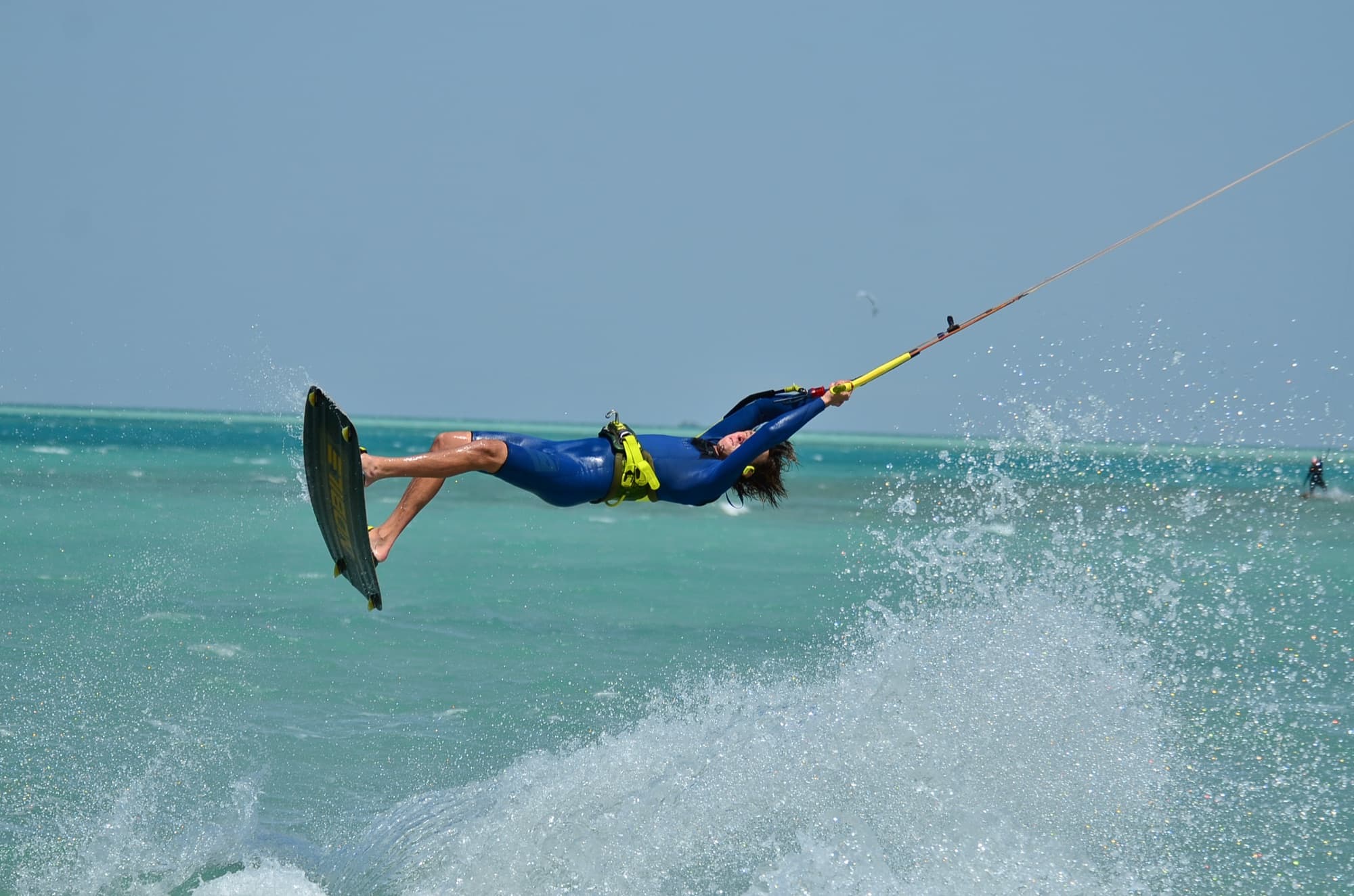
The S-bend on a kite: a raley with a rotation
The S-bend is a powered raley with a forward rotation of the body added on top. You do the same stretched-out "superman" raley, but at the top you wind your body into a turn over the back shoulder. The result is a dynamic combination: a long body, a powerful pop, and a rotation that folds the flight into an expressive S-shaped line.
9 July 2026 · JollyKite
What you need before the S-bend
The S-bend builds on the powered raley, it isn't a separate skill from scratch. Before you add the rotation, you need a solid unhooked base:
- A confident powered raley. You reliably perform the stretched "superman" raley unhooked: you load cleanly, pop, extend into a line and land in control. If your raley is still hit or miss, it's too early to add a rotation.
- Some experience with unhooked front rotations. You've already tried rotating forward while unhooked and understand how the body enters the turn and how to find a reference on the exit. The S-bend combines a raley and a front rotation, so you need to know both elements separately.
- Stable unhooked control in moderate wind. You calmly hold the bar unhooked, control the kite and board on the load, and don't lose composure as the pull builds. Without this, a powered pop with a rotation quickly becomes uncontrolled.
If all three describe you, move on to the technique. If one is weak, fix it first: with powered tricks, the price of a raw base is hard crashes, not just failed attempts.
The S-bend step by step
The main idea: full extension of the raley first, and only then the rotation. The S-bend is a raley plus a turn, in exactly that order. Rotate too early and the trick collapses into an ordinary frontroll. Here's the sequence:
- Approach as for a powered unhooked raley. Bear off downwind, bring the kite to about 45° and clearly below 12 o'clock — this keeps the power under control. Unhook from the harness and progressively edge hard against the wind, loading the system. The load should be powerful but manageable: you gather energy, you don't rip the pop with a jerk.
- Pop into a big extended raley. Make a powerful pop and stretch into that "superman" position: body in a long line, front leg straight, torso open over the water. This is the foundation of the trick — without a full, clean raley the rotation has nothing to build on.
- Only after full extension, begin the forward rotation. Once the body is already stretched into a line, throw your head and shoulders over the rear shoulder, initiating the forward turn. The board and legs lag behind — they come into the turn later, following the torso. This timing, "extend, then rotate," is the essence of the S-bend.
- Keep the body long and commit through the whole rotation. Arms slightly bent, head over the bar, torso stretched — don't tuck or pull in mid-air. Unlike the compact backroll, here the body stays long the whole turn. Full commitment to the movement is what carries the rotation to a clean exit.
- At three-quarters of the turn, spot the landing. At about three-quarters of the rotation, catch the water with your eyes, pull the bar toward you and turn your face downwind. This gives a soft, controlled landing. Once you've landed, hook back into the harness.
At first everything happens fast, and the "extend → rotate" order is easy to rush. That's normal: with each attempt you start to feel the pause at the top of the raley into which the rotation slots. The first clean S-bends come exactly when this timing arrives.
Why an S-bend isn't a frontroll
A fair question: if the S-bend has a forward rotation, how is it different from an ordinary frontroll? The answer is in the raley and the timing.
A frontroll is a forward rotation more or less straight off the pop: the body enters the turn without stretching into a line. The S-bend works differently: you first do a full powered extended raley — the "superman" position with a straight front leg — and only then add the rotation. It's this sequence that gives the characteristic S-shaped trajectory: a long body flies extended first, then folds into a turn.
That's why the S-bend is considered a separate, more serious trick: it requires a confident powered raley as a foundation and precise timing on top of it. Rotate too early and the raley doesn't get to open up — instead of an S-bend you get an ordinary frontroll. That's not a riding error but a different trick. Understanding the difference matters so you don't fool yourself with an "almost" S-bend.
Common mistakes
Almost all S-bend difficulties come down to a few typical mistakes. Knowing them in advance, you'll get through the trick noticeably more safely:
- Rotating too early. The most common mistake. Start the rotation before fully extending the raley and you get a plain frontroll, not a real S-bend. The fix is timing: stretch fully into a line first, and only then throw your head and shoulders into the turn.
- Tucking and pulling in mid-air. The S-bend is a long body the whole turn. Tuck your knees and curl up as in a backroll and you lose both the character of the trick and its S-shaped line. Keep the torso stretched and commit through the whole rotation.
- The kite drifting too high. If the kite rises above 12 o'clock, you lose both power and control: the trick becomes sluggish and unpredictable. The kite should stay below 12 — that's what keeps the power and guards against losing control.
- Ripping the pop instead of loading cleanly. Without a progressive, powerful edge the energy gathers unevenly: the pop becomes jerky and the rotation crooked. A clean load on the approach is the foundation of a powerful S-bend.
Safety and progression
The S-bend is a powered trick, and its main danger lies precisely in that power. A big load and a pop with rotation produce hard crashes: falls onto the chest or back, catching the board's rail. So you approach it not on bravado but through careful progression.
A few principles that lower the risk:
- Moderate wind. Don't attempt an S-bend at the edge of your power. In moderate, predictable wind you control both the pop and the landing.
- Kite below 12. Keep the kite at about 45° and below the zenith. This keeps the power within manageable limits and guards against losing control in the air.
- Build up from simple. Don't try to throw a full powered S-bend right away. Start from a low raley-to-front — a low raley transitioning into a front rotation — and gradually add height, power and rotation amplitude until you reach the full S-bend.
- With an instructor. Powered unhooked tricks are safer to learn under supervision: the instructor sees your timing from the outside, spots you, and keeps dangerous habits from setting in.
This article explains the mechanics, but it doesn't replace in-person coaching. The S-bend hinges on the feel of the load, the timing and air control — these are learned on the water, under supervision, not from text.
What's next
Once the S-bend is solid — you extend the raley cleanly, hit the rotation timing precisely and land in control — you hold one of the key building blocks of advanced wakestyle. From here a branch of more complex unhooked combinations and rotation variations opens up, and the S-bend is their foundation.
If you're still working toward a powered raley, start there — the raley on a kite. If you're just getting comfortable unhooked, go back to the basics — your first unhooked. And to figure out which tricks to learn and in what order, look into the JollyKite Trick School.
We teach all powered unhooked tricks under an instructor's supervision, with radio comms on the water and in the safe, flat, shallow water of Pak Nam Pran — which sharply lowers the risks while learning the S-bend. More on formats and booking is on the /obuchenie page.
Let's go riding?
Send us your dates and level — we'll suggest a format, match the season to your rhythm and plan your trip end to end. WhatsApp +66 98 367 9769, Telegram bot @JollyKite_kite_bot.
FAQ
What is an S-bend on a kite?+
The S-bend is a powered raley with a forward rotation of the body added on. You do the stretched "superman" raley, and at the top you wind your body into a turn over the back shoulder, so the flight folds into an expressive S-shaped line. It's one of the first genuinely serious unhooked tricks, approached once you already confidently command the powered raley.
How is an S-bend different from a frontroll?+
Timing and the presence of a raley. A frontroll is a forward rotation almost straight off the pop, without extension. In an S-bend you first do a full powered extended raley with a straight front leg and only then add the rotation. It's this "extend, then rotate" sequence that gives the characteristic S-shaped trajectory. Rotate too early and you just get a frontroll.
What do you need before the S-bend?+
A solid unhooked base: a confident powered raley, some experience with unhooked front rotations, and stable unhooked control in moderate wind. The S-bend combines a raley and a front rotation, so you need to know both elements separately. If your powered raley is still unstable, fix it first.
When do you begin the rotation in an S-bend?+
Only after full extension of the raley, when the body is already stretched into a line and the front leg is straight. Then you throw your head and shoulders over the rear shoulder into a forward turn, while the board and legs lag behind and come later. Rotating too early is the most common mistake: the raley doesn't get to open up, and the S-bend turns into a frontroll.
Is the S-bend dangerous?+
It's a powered trick, and the main danger is hard crashes from the big load and the pop with rotation: falls onto the chest or back, catching the rail. The risk is lowered by moderate wind, the kite below 12 o'clock, gradual progression from a low raley-to-front to the full S-bend, and working under an instructor's supervision. It's not a replacement for in-person coaching.