
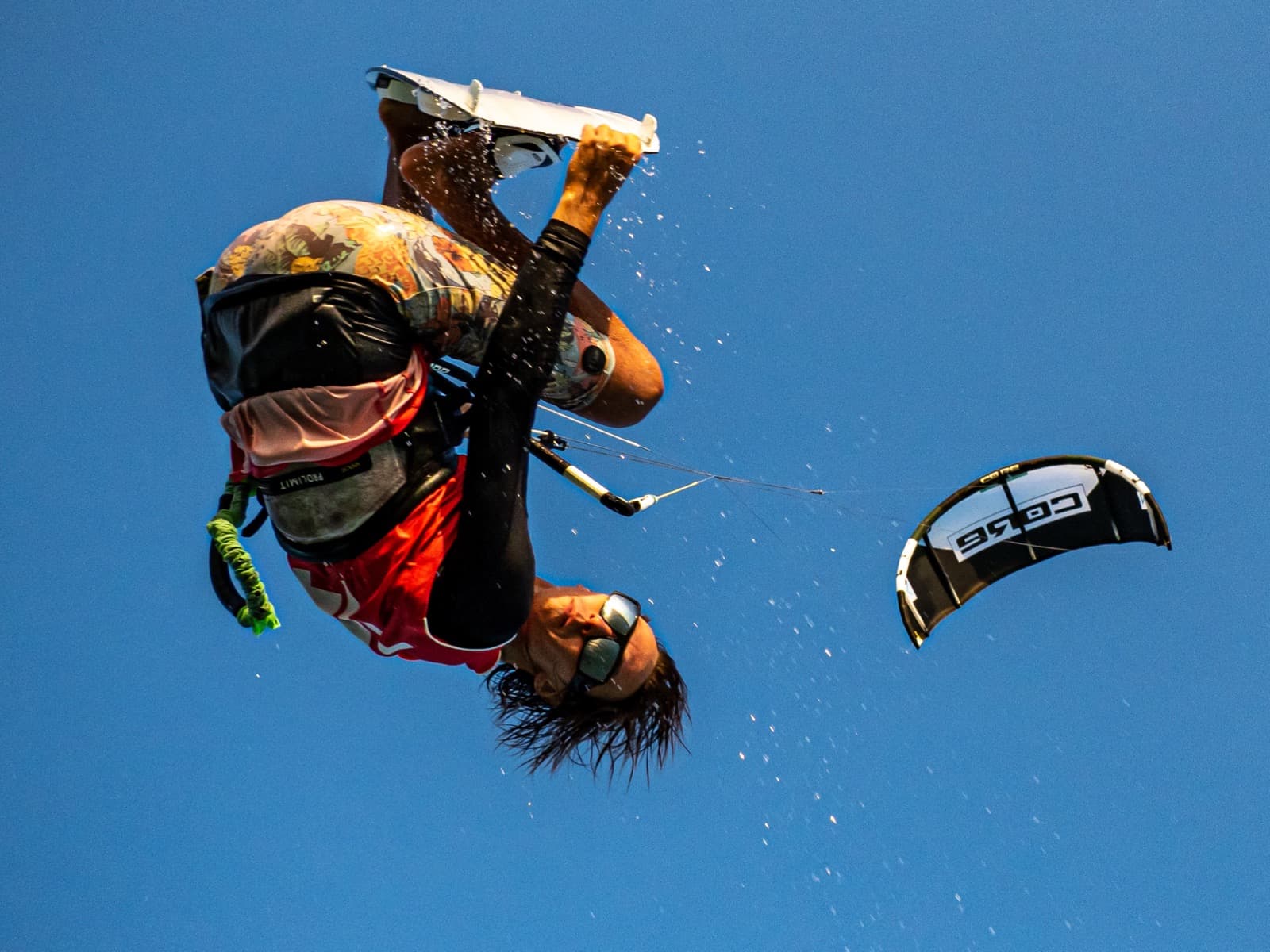
Pop in kitesurfing: getting airborne off the edge
The pop is a sharp, low and explosive takeoff powered by the energy of an edged board, without lifting the kite up. The first tool that leads into freestyle isn't a big jump with the kite sent to the zenith — it's this.
2 July 2026 · JollyKite
What pop is and how it differs from a jump
Pop is leaving the water through loading the board and the edge against the kite's pull, without a high "parachute" send of the kite upward. You edge hard, store energy in the board like in a compressed spring, and release it sharply — the board throws you up. The takeoff is sharp, low and explosive, literally a "snap."
The easiest way to understand pop is to compare it with a regular jump:
- In a regular jump the kite gives you height. You send the kite to the zenith (to 12 o'clock), it catches you and lifts you — the height comes from the kite's upward movement. The takeoff is smooth and "parachute-like"; you hang under the kite.
- In a pop the edge gives you height. The kite is kept low and barely moved. All the takeoff energy comes from the edged, loaded board, which you unload at the right moment. The takeoff is sharp and low, and the kite stays at the edge of the window.
This difference is fundamental. A jump teaches you to work the kite; a pop teaches you to work the edge and the board. Pop is exactly what freestyle is built on: almost every trick relies on a low explosive takeoff, where the kite isn't used as a "crane" and your hands and body are free for the trick.
What you need to know before the pop
Pop isn't the first skill on the water, and it makes sense to approach it only on a certain base. The prerequisites are simple, but without them a clean pop won't happen:
- Go upwind confidently. If you still slip downwind, you won't be able to hold a steady edge under load — and that edge is the basis of the pop.
- Hold a stable edge. You should be able to press on the edge for a long time, evenly, without slipping or losing balance. A pop is the controlled loading of that very edge.
- Control the kite with a single position. For a pop the kite needs to be locked low and barely touched. If the kite still "wanders" and you're constantly steering it, build confidence in steady flight first.
If these things already come easily and don't require attention, you're ready to try the pop. If not, calmly finish off the base: we teach each of these skills in lessons, and there's no point skipping them for the sake of tricks.
Pop step by step
Let's break down a clean hooked pop step by step. Do it on flat water and comfortable, steady wind — that way the board holds the edge better and the takeoff is predictable.
- Build speed while riding and lock the kite low. Reach a comfortable speed and set the kite at the edge of the window — at about "1 o'clock" (or "11 o'clock" if you're going the other way), not at the zenith. From here, don't move the kite: it holds steady pull, and that's it.
- Edge hard against the wind. Press on the back, heel-side part of the edge, lean your body back and down, load the board with your whole weight. It's as if you brace against the kite's pull and ride "biting" into the water — energy builds up in the board like in a compressed spring.
- At the moment of maximum load, release the edge sharply. Straighten your legs and remove the pressure — the board, freed from the load, springs you up like a spring. That's the "snap." It's important to catch the peak of the load: release exactly when the edge is loaded to the maximum.
- Pull your knees up and keep the bar close. In the air, pull your legs toward you and keep the bar close to your body. All this time, don't yank the kite — it stays where it was. The board, not the kite, has already given you the height.
- Land nose slightly downwind, on bent legs. Point the board's nose a little downwind, meet the water on soft, bent legs and set the edge gently. A soft landing absorbs the impact and immediately returns you to riding.
At first the takeoff will be quite small — that's normal. The goal of the first attempts isn't height but the right feeling: load the edge — release it — "snap" up. Height comes on its own once the movement becomes clean.
Hooked and unhooked
Pop is learned in two stages, and it's important not to skip the first.
- Hooked pop. First you do the pop without unhooking the bar from the harness hook. The harness holds the kite's pull, and you calmly focus on the main thing — loading and unloading the edge. It's safer and clearer, and everyone starts with the hooked pop.
- Unhooked pop. Once the hooked pop is stable, you move to the unhooked version: the bar comes off the hook, and you hold all the kite's pull with your hands. Unhooked is already the entry into real freestyle, because most tricks are done exactly with the loop unhooked. But both the load on your arms and the cost of a mistake are higher here, so unhooking makes sense only after a confident hooked pop and always under an instructor's supervision.
Don't rush to unhook. A clean, repeatable hooked pop is already half of freestyle, and it's exactly what gives you the base everything else rests on later.
Common mistakes
Most pop problems come down to a few typical mistakes. Knowing them in advance, you'll feel the right takeoff faster:
- Sending the kite instead of loading the edge. The most common mistake: instead of loading the edge, you send the kite up out of habit. You get a regular jump, not a pop. Remember: in a pop the kite stays low and still, the board gives the height.
- Edging weakly. If the edge is loaded weakly, no energy builds up in the board — and there's nothing to release. Without a strong, confident edge there's no pop.
- Straightening the legs too early or too late. You need to release the edge exactly at the peak of the load. Too early — the board hasn't "charged" yet; too late — the energy is already gone. It's a matter of timing, and it's built by repetition.
- Looking at the board. A dropped gaze throws off your balance and edge. Look ahead and slightly upwind, not down at your feet.
- Tensing up. A stiff, tense body loads the edge poorly and doesn't give a clean release. The calmer and more composed your body, the cleaner the "snap."
What's next
Once the pop is stable and repeatable both ways, all of freestyle opens up to you. Grabs (grabbing the board in the air), your first rotations and unhooked tricks all start from a confident pop. The logical next step is to add a board grab to the pop: we cover this in detail in the article grabs on the kite. And to see the whole trick map and understand what to learn in what order, look into the JollyKite Trick School.
If the pop is still hard, you may be missing the jump base — the ability to work the kite and calmly leave the water. In that case it makes sense to go back to the article your first jump on the kite and finish it off, and only then move on to the pop.
We teach all these skills under an instructor's supervision, with radio comms on the water and in the safe, flat water of Pak Nam Pran — which sharply lowers the risks while learning tricks. More on formats and booking is on the /obuchenie page.
Let's go riding?
Send us your dates and level — we'll suggest a format, match the season to your rhythm and plan your trip end to end. WhatsApp +66 98 367 9769, Telegram bot @JollyKite_kite_bot.
FAQ
What is pop in kitesurfing?+
Pop is a sharp, low and explosive takeoff from the water through loading the board and the edge against the kite's pull, without a high send of the kite upward. You edge hard, store energy in the board like in a spring, and release it sharply — the board throws you up with a "snap." Pop is the base of all freestyle and unhooked riding.
How does pop differ from a regular jump?+
In a regular jump the kite gives you height: you send it to the zenith and it lifts you up. In a pop the edge gives you height: the kite is kept low and barely moved, and the whole impulse comes from the edged, loaded board that you unload at the right time. A jump teaches you to work the kite, a pop to work the edge and the board.
What do you need to know before the pop?+
Before the pop you need to go upwind confidently, hold a stable edge under load, and control the kite with a single position without constantly steering it. The controlled loading and unloading of the edge is built on this base. Without it a clean pop won't happen.
Do you need to unhook to do a pop?+
No, you always start with a hooked pop — on the hook, without unhooking the bar from the harness. The harness holds the pull while you focus on loading the edge. The unhooked pop is learned later, once the hooked version is stable — it's the entry into real freestyle and always under an instructor's supervision.
Is it dangerous to learn the pop?+
Pop requires a base and care, but with the right approach it's learned safely. It's taught on flat water and comfortable, steady wind, first on the hook, under an instructor's supervision and with radio comms on the water. This format sharply lowers the risks and helps you feel the right takeoff faster.