
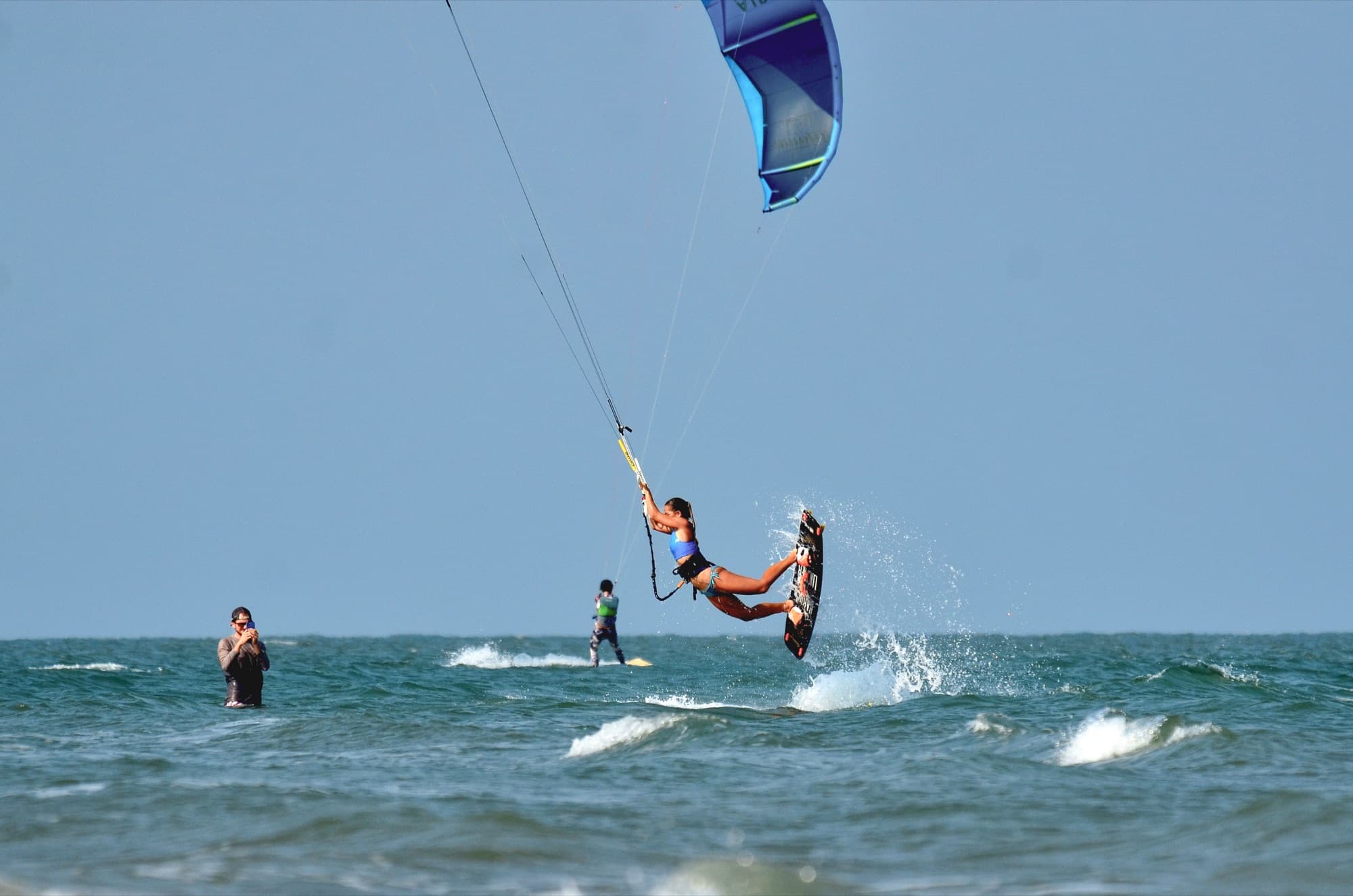
Your First Unhooked Session: How to Unhook Safely
Unhooked riding means disconnecting the chicken loop from the harness hook while keeping hold of the control bar. You hold all of the kite's pull with your arms instead of transferring it through the harness hook. Unhooking is not the same as activating the quick-release system. It's where freestyle begins. Raleys, handle passes, mobes — all of wakestyle grows out of one skill: unhooking and holding the kite's pull with your hands. While the chicken loop sits on the hook, your body hangs passively on the hardware and real new-school tricks are simply impossible.
9 July 2026 · JollyKite
What you need to be able to do and set up before unhooking
Unhooking is an add-on to confident riding, not a beginner trick. Before you unhook, you need a solid base and a properly prepared setup.
Controlled riding. You ride steadily in both directions, go upwind calmly, hold the kite at the right point of the window, and don't reflexively hang on the bar. Without this, unhooking is simply dangerous.
A stable kite with no back-stall. The key point: trim the kite so it parks in the window on its own — without constant steering and without a back-stall, where the canopy falls backward. When you're unhooked, your hands are busy with the pull, and the kite has to fly predictably without your input.
Understanding trim. Before unhooking, you trim the kite: take off the excess pull and make the bar tame in your hands. An over-powered kite is a direct route to getting ripped off the edge when unhooked. Learn to feel how trim regulates the pull, and enter your first unhook with the power noticeably backed off.
Leash setup — critical. On modern SLE/bow kites, the leash is switched into what's called semi-suicide mode for unhooking. This means that when the quick release fires, the kite isn't fully depowered as in normal riding but partially keeps its pull — otherwise the released chicken loop would fly out of your hands and the kite would get away. This setup changes how the whole safety system behaves, and you need to understand it before the first attempt, not figure it out on the fly. More on the leash and safety in a separate piece: the leash and kite safety.
Knowing the quick release and safety systems. Your hand should find the chicken-loop quick release on autopilot, without looking. Unhooked emergency scenarios are different, and your hand has to know the way to the release before you need it.
If you're unsure about any of these points, work through them with an instructor before attempting to unhook. That saves you not dozens of attempts but, potentially, your health.
Your first unhook step by step
The main idea: keep your attempts short. The goal of the first session isn't to ride unhooked for a hundred metres but to feel the pull transfer into your hands and calmly come back. Unhook — feel — rehook. And repeat many times.
- Ride slightly downwind to take the tension off. Before unhooking, bear away slightly downwind — this lowers the pull on the chicken loop and makes it light. Keep your hands centred on the bar, closer to the chicken loop, not wide. You must not unhook while loaded and edging against the wind — it'll rip you.
- Unhook and keep riding downwind. Calmly unhook the chicken loop from the harness hook and keep moving slightly downwind, without edging hard against the wind. Stay relaxed and keep the bar close to you. The pull is now in your hands — feel it, but don't fight it.
- Rehook smoothly. Without rushing, guide the chicken loop back onto the harness hook. The rehook should be calm and precise: a jerky rehook costs you control more often than the unhook itself.
- Keep attempts short and repeat. Unhook → feel the pull → rehook → repeat. Don't stay unhooked for long in your first sessions. A short cycle reinforces the correct movement and doesn't let fatigue or panic build up. Long runs come later, once the transition is automatic.
The first seconds of being unhooked feel abrupt: the pull that used to live on the harness is suddenly in your hands and shoulders. That's normal. With each short attempt your body learns to meter the effort, and unhooking stops being a fight.
Common mistakes
Almost all first-unhook problems come down to a few typical mistakes:
- Too much pull. Unhooking on an over-powered kite or while edging against the wind. You take the pull off first — with trim and by bearing away downwind — and only then unhook.
- Edging against the wind while unhooked. Instinct pulls you to edge as in normal riding, but unhooked this sharply increases the pull in your hands and threatens to rip you off the edge. First attempts go only slightly downwind.
- Hands too wide on the bar. A wide grip causes parasitic steering: the kite starts to wander through the window on its own. Keep your hands centred, closer to the chicken loop.
- A rushed rehook. A jerky rehook upsets the kite and your balance. Rehook calmly and precisely — it's as much a part of the skill as the unhook itself.
- Long attempts at the start. The urge to ride a bit longer leads to tired arms and loss of control. Short cycles are safer and teach you faster.
Safety: why the rules are so strict
Unhooking demands its own seriousness about safety, and here's why. When you're hooked in, the kite holds you by the harness hook, and the quick release will fully depower the canopy at any moment. Unhooked, the logic is different: the pull is in your hands, and the leash is set to semi-suicide mode so you don't lose the kite. That means when you make a mistake, the system behaves differently from what you're used to.
The main danger is an accidental semi-death-loop (an uncontrolled kite loop that keeps its pull) or getting ripped off the edge if the kite is over-powered or the wind picks up. In light wind on a small kite, the cost of a mistake is mild; in strong wind it isn't. That's why the rules for learning unhooked are strict and non-negotiable:
- Light wind. Less pull means a lower cost of mistakes. The first unhook happens only in comfortable, light wind.
- A small kite. A smaller canopy forgives mistakes and doesn't rip the bar out of your hands.
- Short attempts. Less time unhooked means fewer chances to compound an error.
- Understanding the quick release and leash before practice. You must know in advance how your leash is set and where the quick release is, not find out at the moment of getting ripped.
- Always with an instructor. A coach sees the wind, your kite and your body from the outside, backs you up and stops you before a mistake becomes dangerous.
This article gives you the logic and the preparation, but it doesn't replace in-person lessons. Unhooking is one of those skills where the gap between "read about it" and "did it with a coach" is especially large.
What's next
Once your first unhook is calm — you unhook, ride, rehook without strain and hold the pull with your hands — all of wakestyle opens up. The logical next step is the raley: the foundational unhooked trick from which real new-school freestyle begins. We break it down here: the raley on a kite. After that come handle passes and mobes, but all of it is built on a confident, relaxed unhook.
To figure out which tricks to learn and in what order, look into the JollyKite Trick School. And if you want to get into the gear side — read about the leash and safety here, and about choosing and gripping the bar here.
We teach unhooking only under an instructor's supervision: in light wind, on a smaller kite, with radio comms on the water and in the flat, shallow water of Pak Nam Pran — which sharply lowers the risks while learning. More on formats and booking is on the /obuchenie page.
Let's go riding?
Send us your dates and level — we'll suggest a format, match the season to your rhythm and plan your trip end to end. WhatsApp +66 98 367 9769, Telegram bot @JollyKite_kite_bot.
FAQ
What is unhooked in kiteboarding?+
Unhooked riding and tricks are done with the chicken loop released, holding the kite's pull with your hands only rather than through the harness hook. It's the foundation of wakestyle: real new-school freestyle tricks — raleys, handle passes, mobes — are performed from the unhooked position. While the chicken loop is hooked in, such tricks are impossible.
What do you need to set up before your first unhook?+
Before unhooking you set up trim and the leash. You trim the kite to remove excess pull so it parks stably in the window without a back-stall. On modern SLE/bow kites the leash is switched to semi-suicide mode for unhooking so you don't lose the kite when the quick release fires. You also need to know in advance exactly where the quick release is and how it works.
Is it dangerous to unhook the chicken loop from the harness hook?+
Yes, unhooking requires extra caution. The main risks are an accidental semi-death-loop or getting ripped off the edge in strong wind, plus the changed behaviour of the safety system due to the semi-suicide leash setup. That's why the first unhook is done only in light wind, on a small kite, with short attempts and always with an instructor.
What wind should you learn unhooked in?+
Light, comfortable wind and a small kite. Less pull means a milder cost for any mistake: an unhook, getting ripped off the edge or a jerky rehook in light wind pass almost without consequence. In strong wind, unhooked mistakes become dangerous, so you must not learn in fresh wind.
What should you learn after unhooking?+
Once unhooking, a short run and rehooking feel calm, you move on to the first unhooked trick — the raley. Real wakestyle freestyle starts there, followed by handle passes and mobes. All of them build on a confident, relaxed unhook, so you bring that to automatic first.