
Property in Pak Nam Pran and Sam Roi Yot: an up-and-coming part of Thailand
When people say "seaside property in Thailand", three addresses usually come to mind: Phuket, Pattaya, Samui. Sometimes Hua Hin. But there's an area that stays in the shadow of those names, even though as a place to live by the sea it's in many ways more interesting: Pak Nam Pran and the Khao Sam Roi Yot national park — a stretch of coast about 30 kilometres south of Hua Hin.
10 July 2026 · JollyKite
Where it is and why it's beautiful
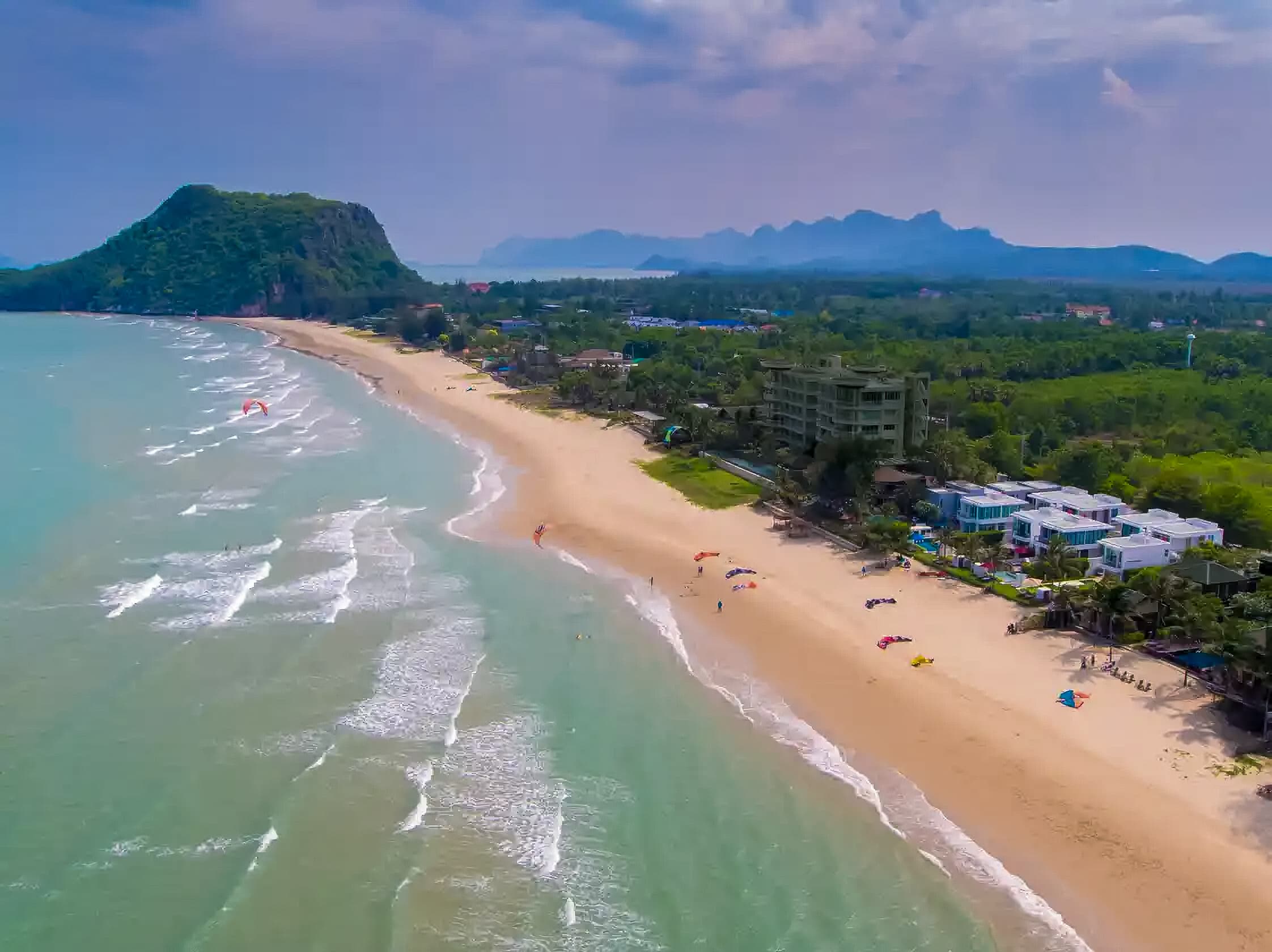
Pak Nam Pran is the coastal part of the Pranburi district in Prachuap Khiri Khan province. Drive south from Hua Hin along the sea, and after about forty minutes a different Thailand begins: no high-rises, no dense resort sprawl, long sandy beaches and a quiet you no longer find at the big resorts.
Nature is the heart of it. The shore faces east, so you can watch the sunrise over the sea right from the beach. A wide sand strip runs along the water, limestone mountains line the horizon, and a little to the south begins the Khao Sam Roi Yot national park — the "Mountain of Three Hundred Peaks". It's one of mainland Thailand's most scenic parks: sharp limestone pinnacles, coastal mangrove forests and wetlands, the Phraya Nakhon cave with its famous royal pavilion lit by a shaft of sunlight through a collapsed roof, viewpoint trails and crowd-free beaches. Nearby are the Pranburi mangrove channels, explored by kayak and boat, and the mouth of the Pran river that gave the village its name (Pak Nam Pran literally means "mouth of the Pran river").
And yet the area isn't cut off from civilisation. Hua Hin — with its hospitals, malls, restaurants and airport — is half an hour away by car. Bangkok is about three hours. So you live by a quiet sea, but everything you need is a short drive away. We cover the area and its beach in more detail in our Pranburi (Pak Nam Pran) article, and the park in the Khao Sam Roi Yot piece.
Why the area has potential
To understand why this coast is worth looking at now, it helps to compare it with the well-known destinations.
Phuket, Pattaya, Samui and largely Hua Hin itself are mature, saturated markets. They're already built up and divided, prices are high, and the beaches and infrastructure run at their limit. Entering them today means paying for the fame and competing with thousands of similar buyers. That's not bad — a mature market is predictable. But there's almost no "early" upside left.
Pak Nam Pran and Sam Roi Yot are a different stage. Here:
- a lower entry point — for the price of a one-bedroom seaside flat at an overheated resort, you can consider a house with land or a spacious villa;
- lower building density — the coast still breathes, there's no forest of high-rises, nature is right there rather than "around the corner from a building site";
- visible early growth — new projects are appearing, the coastline is being improved, the area gets better known year by year;
- little quality content — far less is written about this coast in various languages than about Phuket. For someone arriving early, that's the window of opportunity — both in choice of properties and in price.
It's only fair to state the flip side too. Early growth always means not just potential but uncertainty. There's less choice of ready-built property here, a thinner rental market, and nobody guarantees the pace or timing of growth. "Promising" doesn't mean "guaranteed to appreciate" — it means the area has reasons to grow, but you'll still need to check the specific property, the developer and the legal side just as carefully as anywhere. More on that below and in the separate cluster articles.
What's being built and improved
The "early growth" claim is easy to verify — just drive around the area. In recent years a notable number of new projects have appeared along Pak Nam Pran, and most of them are pool villas — single- or two-storey, on plots from roughly 300–400 up to 1,000 square metres. Among the projects actually being built and sold near Pranburi are names like *Moda Melody*, *Talaycation Hua Hin–Pranburi*, *The Mountain Estate*, *L'UX Villa* and others; in neighbouring Hua Hin new projects number in the hundreds. This isn't the odd one-off build but a forming market: different developers, formats and budgets — roughly from 5–7 to 15–18 million baht per villa, depending on size, plot and proximity to the sea.
Besides villas, plots of land are on sale in Pak Nam Pran too — both for self-build and for investment. That's another signal: land is actively coming to market, the area is being "parcelled out" for future homes.
A separate story is the improvement of the coastline. Along the beach, work has been ongoing in recent years: reinforcing the shore with sea walls, building and renewing promenades and footpaths, tidying up the coastal zone. For a resident this means pleasant walks and a protected shore; for someone looking at the area with the future in mind, it's a clear sign — the place is being invested in and improved, which means it's developing.
> ⚠️ Specific project names, prices and timelines are given as a guide for mid-2026 — this is not advertising or a recommendation. Before any decision, check the current status of a project, the developer's reputation and the documents.
Sport and events — the area's driver
There's a common stereotype: a quiet seaside in Thailand is a "retirees' dormitory" where all that's left is watching sunsets. It doesn't fit Pak Nam Pran. This is a surprisingly lively, sporty region, and that, in our view, is its strength.
First, wind and kitesurfing. A wide shallow beach with calm water and a steady seasonal wind has made Pak Nam Pran one of Thailand's best kite spots. People ride here, learn, run kite safaris, and in season there are kitesurfing competitions too. This isn't a few individuals' hobby — it's an established community with its own atmosphere. JollyKite has been part of this life since 2014: we teach kiting and know every gust of wind and every rock on this shore. More about the spot itself is on the spot page.
But the area's sport isn't limited to kiting. The surroundings of Pak Nam Pran and Sam Roi Yot offer motocross (the terrain and open space invite it), marathons and trail runs among the limestone mountains and the park, cycling routes and water activities. Sporting events are held here regularly, drawing participants from across Thailand. That changes the very character of the place: people come here not to "wind down" but to move, train and live actively.
For anyone choosing the area to live in or to invest in, this is an important nuance. Sport and event life mean a flow of people, recognition, and reasons to keep coming back. An area with movement and community develops differently from a quiet dormitory: it has its own energy, not just a beach and quiet.
Who it suits
This coast isn't for everyone, and that's fine. It will suit you if you recognise yourself in one of these profiles:
- Those who want to live by the sea in a calm but not "dead" place. Quiet and nature — but with movement, sport and community nearby. Not the resort crush, not the back of beyond, but the golden mean.
- Families. Safe, clean, spacious, nature and the park nearby, and all of Hua Hin's "grown-up" infrastructure half an hour away. We've written separately about living here with kids: Hua Hin with children.
- Sporty people and kiters. If you ride or want to learn, living right by the spot is a dream. The wind, water and community are already here.
- Those eyeing the area's early growth. Not "quick money", but entering a promising place at an early stage, with a clear view of both the risks and the potential.
- Those who winter in Thailand and think about their own place. If you've spent more than one winter on this coast, the thought of your own home is natural. Where to start — we cover in the Hua Hin wintering article.
If, on the other hand, you need nightlife, malls under your window, a developed short-term rental market and a wide choice of ready flats "here and now" — it's more honest to look at Hua Hin itself or the big resorts. Pak Nam Pran's strength is different.
Where to start and what to keep in mind
Suppose the area has caught your interest. Here's what matters at the start — briefly, without diving into legal detail (there are separate articles for that).
The main rule about land. In Thailand a foreigner cannot own land directly, in their own name. That applies to houses with land and to villas. But legal routes exist: a condominium unit can be held freehold (full ownership) within a quota, while a house or land is held through a long-term lease (leasehold), usufruct, superficies, or owning the structure separately from the land. Which option suits you depends on the property and your goals. A detailed breakdown is in the article on whether a foreigner can buy property in Thailand.
About the fears. There are many myths around buying property in Thailand — from "they'll take it all away" to "it's all a scam". Some fears are well-founded, some aren't. Where the real risk is and where the panic is unwarranted, we've honestly covered here: Fears and myths about buying property in Thailand.
Three things you shouldn't start without:
- A licensed Thai lawyer. Not a "developer's helper" but an independent specialist who checks the title, documents and deal structure for your case.
- Due diligence on the property and seller. Who owns it, whether the title is clean, whether there are encumbrances, what exactly you're buying — land, a structure, a lease right.
- A cool head. Haste is especially damaging in an "early" market. A promising area won't vanish in a week; time spent checking isn't a loss but insurance.
Again: this article gives a picture of the area, not a step-by-step guide to a deal. Any specific decision should come only after consulting a lawyer and checking the current rules.
In short
Pak Nam Pran and Sam Roi Yot are a quiet but lively coast half an hour from Hua Hin: clean beaches, limestone mountains, mangroves and a national park, with sport, kiting, events and community right alongside. Compared with the overheated Phuket, Pattaya and Samui, the entry point here is lower and early growth is visible: new villas, plots for sale, an improving seafront. This is neither a guarantee of profit nor a reason to rush — it's an area with genuine reasons to develop, worth a look early and with a cool head. The legal side and the real risks we cover in the separate cluster articles.
Come and see for yourself
The best way to understand the area is to see it. Come to our spot, take in the beach, the wind and life by the sea with your own eyes, and we'll tell you honestly how it really is — no varnish, no pressure. Write to us: WhatsApp +66 98 367 9769, Telegram bot @JollyKite_kite_bot. More about the spot is on /spot; to get in touch use /kontakty.
FAQ
Where are Pak Nam Pran and Sam Roi Yot?+
This is a stretch of coast in Prachuap Khiri Khan province, about 30 km south of Hua Hin. Pak Nam Pran is the coastal part of the Pranburi district, and just to the south begins the Khao Sam Roi Yot national park with its limestone mountains, mangrove forests and beaches. Hua Hin is about half an hour away by car, Bangkok roughly three hours.
Why is this area considered promising?+
Unlike the saturated and expensive Phuket, Pattaya and Samui, the entry point here is lower and early growth is visible: new villa projects are appearing, plots are on sale, the coastline is being improved, and the area grows better known year by year. At the same time there's still little quality content and competition. Note: "promising" does not mean "guaranteed to appreciate" — an early market carries both potential and uncertainty.
Can a foreigner buy property here?+
Yes, legal routes exist, but they depend on the type of property. A foreigner can hold a condominium unit freehold (full ownership) within a quota. Land cannot be owned directly in your own name, but a house or plot is held through a long-term lease (leasehold), usufruct, superficies, or by owning the structure separately from the land. The specific option is chosen with a licensed Thai lawyer.
What's being built here?+
Mostly pool villas on plots from a few hundred square metres up, and plots of land for self-build are also on sale. Indicative villa prices run from roughly 5–7 to 15–18 million baht depending on size and proximity to the sea. Alongside this, the coastline is being improved with sea walls, promenades and footpaths.
What does the area live on besides property?+
It's a lively sporting region. Pak Nam Pran is one of Thailand's best kite spots, where people learn, ride and hold kitesurfing competitions. Nearby there's motocross, marathons and trail runs, cycling and water activities, and regular sporting events. It's a place with movement and community, not a quiet "retirees' dormitory". The JollyKite school has operated here since 2014.