
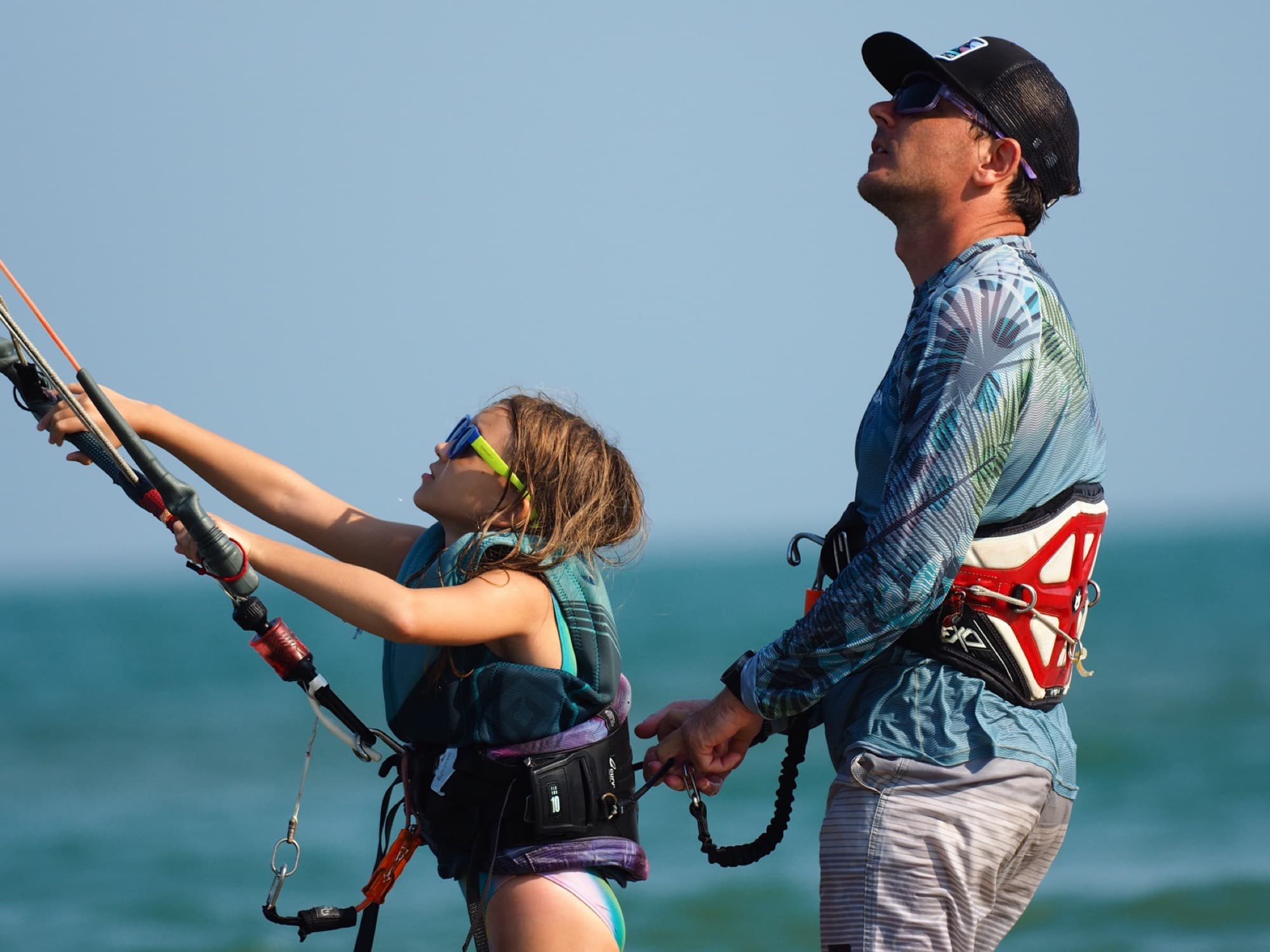
Can you learn to kitesurf in a week? Honest expectations
Learning to ride in a week is realistic. Becoming an advanced rider who jumps confidently and lands tricks is not — that's not the work of a single trip. But "riding both ways on your own and coming back to where you started" is an achievable goal for a week. With one caveat we'll cover below: it all hinges on the wind.
5 July 2026 · JollyKite
How many hours you need to learn to ride
Going from a complete beginner to independent riding usually takes 8–16 hours on the water. Most often that's about four windy days of 2 hours each. So the arithmetic is simple: if your week includes at least 4 windy days, you have time to cover the whole basic path.
Why the range — 8 to 16 hours? Everyone's pace is different, and that's normal. Some get up on the board on their third lesson; others need a few more repetitions for the body to memorise the "kite stroke plus footwork" combo. So a week is realistic, but we advise planning it with a buffer of days, not down to the wire. Why — see the wind section below.
What a week actually gives you
In a week with decent wind, you can cover the whole base and come out an independent beginner. Specifically, that means:
- kite control — you steer the kite smoothly across the sky, hold it in the right zone, meter the power and confidently use the safety system;
- body drag — you move through the water on the kite's pull, including upwind (which is what lets you get back to a drifted board);
- water start — you combine the kite stroke with footwork, push out of the water and stand on the board;
- first rides — you ride standing up, first a couple of metres, then longer and steadier;
- the basics of going upwind — you start heading into the wind and returning roughly to where you started.
Put simply: "riding both ways on my own and coming back to the start" — that's what "learning to ride" means. That's exactly the result a week of lessons leads to.
What WON'T fit into a week
You will not become an advanced rider in a week. The following usually doesn't fit into that time:
- confident upwind in any conditions — carving cleanly against the wind in any strength and on any water comes with practice; that's for later sessions;
- jumps and tricks — a separate level and a separate story. If jumps and freestyle are what you want, welcome to the Trick School — but that's later weeks and trips.
Nothing to be discouraged about. After a week you're already riding for pleasure, and from there progress comes on its own as you log time.
The key condition — wind
Here's the "but". Kitesurfing depends entirely on wind. On a windless day there are no lessons on the water: the kite won't fly, and no method changes that. A week is "realistic" exactly to the extent that the wind cooperates.
Which means two simple things.
- Plan your week with a buffer of days. If you need 4 windy days, don't budget exactly 4 — leave a buffer. Then a couple of windless days won't wreck the whole programme and you can calmly make up the hours.
- Come in season. In Pak Nam Pran the season runs from mid-November to early May — that's when the wind is reliably workable. Coming off-season sharply lowers your chances of finishing in a week. A detailed month-by-month wind breakdown is in our article on the wind season in Hua Hin and Pranburi.
In short: come in season + build in a buffer of days = a week genuinely works.
What affects your speed
Why does one person finish in 8 hours while another needs 16? Here are the main factors:
- Individual pace. Everyone learns differently — that's normal and no reason to rush.
- Fitness and swimming. Basic stamina and confidence in the water help: the body tires less, the mind stays freer.
- Lesson format. Progress is faster one-on-one than in a group: all the instructor's attention is on you.
- Wind stability. Steady, predictable wind makes learning noticeably easier and faster than gusty conditions.
- Regularity. Better to train every day than every other day: the body doesn't "forget" the movement between sessions and the skills set more firmly.
How to make it in a week
If the goal is to get the most out of the week and come out an independent rider, here's a working checklist:
- Come in season — mid-November to early May in Pak Nam Pran. This is the foundation; without it the rest is moot.
- Take private lessons or a small group — progress is faster and hours are spent more efficiently.
- Train every day — don't stretch the learning out to "every other day".
- Avoid long breaks — every break sets you back a little; the body has to "warm up" from scratch again.
- Choose a spot with steady wind and flat water. Pak Nam Pran is exactly that: steady wind, flat shallow water, plenty of space. Mistakes here aren't scary — and progress comes faster.
Do these five things and the week turns from "I might make it" into "I comfortably make it".
Prices and lesson formats are on the /obuchenie page. To estimate the budget for the whole trip, use the calculator.
Let's go riding?
Send us your dates — we'll suggest how to plan your week around the wind, pick a format and plan your trip end to end. WhatsApp +66 98 367 9769, Telegram bot @JollyKite_kite_bot.
FAQ
Can you learn to kitesurf in a week?+
Yes, learning to ride independently in a week is realistic — provided there's wind. Going from scratch usually takes 8–16 hours on the water, i.e. about four windy days of 2 hours each. Becoming an advanced rider with jumps and tricks in a week, though, isn't possible — that's the work of several trips.
How many hours does it take to learn to ride a kite?+
Usually 8–16 hours on the water — typically about four windy days of 2 hours each. The exact time depends on your pace, fitness, lesson format (private is faster than a group), wind stability and regularity.
What can stop you from learning in a week?+
The main thing is wind. Kitesurfing depends entirely on it: on a windless day there are no lessons on the water. So plan your week with a buffer of days and come in season (in Pak Nam Pran, mid-November to early May) so that a couple of windless days don't derail the programme.
What will I cover in a week of lessons?+
Kite control, body drag (including upwind), water start, first rides and the basics of going upwind — that is, "riding both ways on my own and coming back to the starting point". That's what "learning to ride" means.
Can you learn to jump on a kite in a week?+
No. Jumps and tricks are the next level, which doesn't fit into a starting week. First you master confident riding; jumps and freestyle are a separate story (the Trick School) and the work of later weeks and trips.