
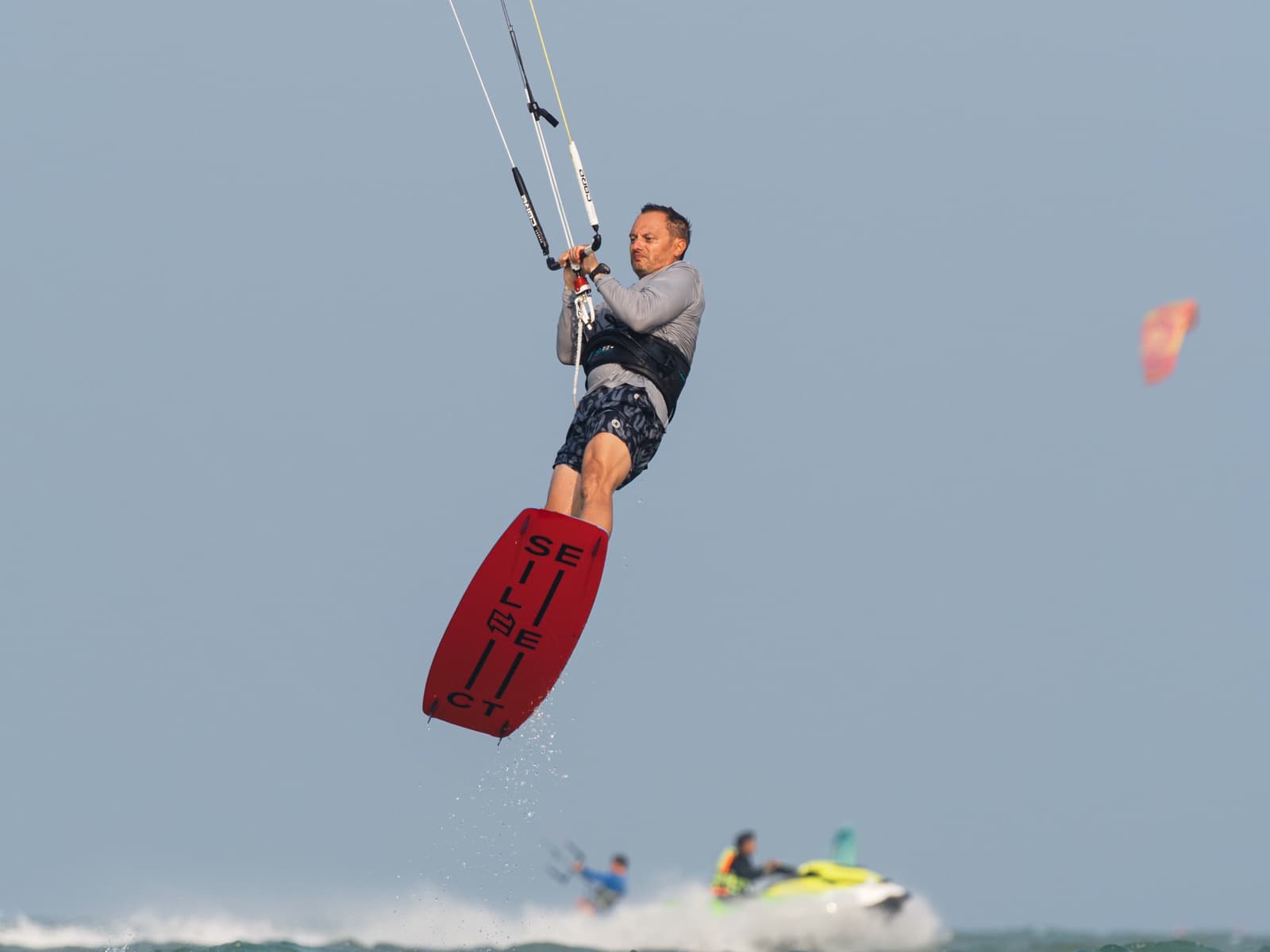
How to jump higher and land softer on a kite
Both height and a soft landing are technique, not recklessness and not arm strength. The people who jump higher aren't the ones who yank the bar harder — they're the ones who catch the moment more precisely. The people who land softly aren't the lucky ones — they're the ones who redirect the kite forward in time.
2 July 2026 · JollyKite
What you should already be able to do
This tutorial is for those who have already done their first jump and ride confidently on the water. If you haven't jumped yet, start with the basics — the first jump on a kite: it covers the approach, the take-off and kite control in the air. Chasing height before you've mastered the basic jump isn't a good idea — it's the most common way to get a hard landing.
Before going higher, you should reliably be able to:
- ride upwind confidently and hold steady speed — without this you can't edge properly;
- do a basic jump with a controlled take-off and landing, even if it's still low;
- see the kite in the air and know where it is without constantly looking at it;
- use the quick release and know the sequence of actions if something goes wrong.
If that's in place, you can work on height and softness. If something is missing, build the basics first: at height, mistakes cost more.
How to jump higher
Height comes from two things: edging (loading the rail against the wind) and the precise timing of sending the kite through the zenith. Strength has almost nothing to do with it — synchronisation is what matters.
- Set a good edge against the wind. Before the jump, load the board's rail, cutting it into the water against the wind — much like before a pop. This rail load stores energy: the harder and cleaner your edge, the bigger the "spring" that fires you upward.
- Send the kite from ~2 o'clock (or 10) to the zenith. At the moment of maximum rail load, steer the kite from around 2 o'clock (or 10 o'clock, depending on the tack) up to the zenith (12 o'clock). The movement should be clear but not jerky: don't yank the bar, steer the kite up confidently.
- Catch the timing of the take-off. The take-off happens as the kite passes through the zenith and the board "fires" off the loaded rail. It's a sync: the rail unloads exactly when the kite gives maximum vertical pull. Catch that moment and you're up.
- Don't confuse strength with precision. The stronger the edge and the more precise the timing, the higher the jump. Yanking the bar to the stop isn't needed and is even harmful — it throws off the timing. What works is the sync of "edge + send through the zenith," not brute force.
If your jump comes out low and hard, it's almost always due to a weak edge or sending the kite without loading the board. More on that in the mistakes section.
Hang time (the float)
After take-off there's a moment you can control — hang time in the air, the float. It's what turns a short "hop" into a clean, controlled jump and at the same time sets you up for a soft landing.
- At the top, bring the kite slightly forward. Once you're up, gently steer the kite a little forward — to 11 or 1 o'clock (depending on the tack). From the zenith the kite simply holds you; shifted slightly forward, it starts to pull you gently forward.
- Let the kite extend the flight. This gentle forward pull prolongs the hang: you fly longer and farther instead of dropping like a stone right after the top. That's the float.
- Keep your body compact. Don't fall apart in the air: body collected, board under you, eyes in the direction of travel. This makes it easier to steer the kite and prepare for the landing.
The float isn't a separate trick but the link between height and a soft landing. The better you control it, the softer you'll land.
A soft landing
The most important part is the landing. A hard "splat" straight down hits your knees and back and kills the desire to jump. A soft landing is always the result of the kite being redirected forward in time, while you land downwind on bent legs.
- Before touching down, redirect the kite forward and down. This is the key moment. As you approach the water, steer the kite forward and down so it "catches" you and pulls you DOWNWIND. The landing then becomes soft and sliding instead of a flat drop straight down.
- Land on the nose of the board, slightly downwind. The board should touch the water nose-first, pointed a little downwind, moving in the direction of travel. That way you don't slam into the water but "ride out" the landing — the kite pulls you forward and the impact is absorbed.
- Absorb the impact with your knees. Land on bent legs, cushioning with the knees, just like a jump on land. Don't land on straight legs and don't slap the board down flat — that's exactly the hard "splat."
- Keep the kite flying until you've fully landed. Don't "drop" the kite to the zenith the instant you touch the water. The kite should stay controlled and pulling forward to the very end — until you're fully riding. Drop it early and you lose the pull and land hard.
The chain is simple: redirect the kite forward + land downwind + bent legs = a soft landing. Remove any one of the three and the landing gets harder.
Common mistakes
A low, hard jump almost always comes down to one of these mistakes. Knowing them, you'll quickly see what to fix:
- A weak edge before the jump. Without rail load there's no "spring" — the jump comes out low no matter how you send the kite. First a clear edge against the wind, then the send.
- Sending the kite without loading the board. If you send the kite up without edging, the jump will be low and hard: there's no sync between the rail unloading and the vertical pull. Height comes from the "rail + kite" combination, not from the kite alone.
- Forgetting to redirect the kite forward. The most common cause of a hard landing. If the kite stays at the zenith, it doesn't pull forward — and you drop straight down with a "splat." Always steer the kite forward and down before touching down.
- Landing on straight legs or a flat board. Straight legs don't absorb the impact; a flat board slaps the whole surface onto the water. Bent knees and the nose of the board downwind are a must.
- Dropping the kite to the zenith on landing. If you abandon kite control at the moment of touchdown, the forward pull disappears and the landing turns hard. Keep the kite flying to the end.
Safety
A big jump is about control, not adrenaline at any cost. A few rules that keep progress safe:
- Space downwind. Jump where there's plenty of open space downwind: a jump always drifts you a little. No people, shallows, jetties or shore in the drift zone.
- A helmet when needed. If you're going for height or riding in a crowded spot, a helmet is worth wearing.
- A working quick release. Before the session, check the release system and remember the sequence of actions. A big jump with loss of kite control is dangerous — the quick release should work without hesitation.
- Kite control before height. A big jump without kite control in the air is more dangerous than it looks. Confident control first, then height.
We teach all these skills under an instructor's supervision, with radio comms on the water and in the safe, flat, shallow water of Pak Nam Pran. Under supervision, progress in height comes faster and with fewer risks. More on formats and booking is on the /obuchenie page.
Let's go riding?
Send us your dates and level — we'll suggest a format, match the season to your rhythm and plan your trip end to end. WhatsApp +66 98 367 9769, Telegram bot @JollyKite_kite_bot.
FAQ
How do you jump higher on a kite?+
Height comes from two things: a good edge against the wind before the jump (loading the rail stores energy, like in a pop) and the precise timing of sending the kite through the zenith. You steer the kite from around 2 or 10 o'clock up to the zenith (12 o'clock) with a clear movement — at the moment of maximum rail load. The take-off happens as the kite passes through the zenith and the board fires off the rail. Synchronisation matters, not strength: there's no need to yank the bar to the stop.
How do you land softly on a kite?+
Before touching down, redirect the kite forward and down so it catches you and pulls you downwind. Land on the nose of the board, slightly downwind, on bent legs, cushioning with the knees. Keep the kite flying until you've fully landed — don't drop it to the zenith. The chain "redirect forward + land downwind + bent knees" gives a soft, sliding landing instead of a hard drop straight down.
Why does the landing come out hard?+
Most often the cause is forgetting to redirect the kite forward: it stays at the zenith, doesn't pull, and you drop flat. Other causes are landing on straight legs or a flat board, or dropping the kite at the moment of touchdown and losing the forward pull. The fix is one thing: redirect the kite forward and down, land downwind on bent legs, and keep the kite flying to the end.
Do you need a helmet for jumping on a kite?+
A helmet isn't always mandatory, but it's justified when working on height and in crowded spots. The main things for jump safety are space downwind in the drift zone, a working quick release and kite control in the air. A big jump without kite control is dangerous, so you master control first and height second — and ideally under an instructor's supervision.
What matters more for height — strength or timing?+
Timing. The people who jump higher aren't the ones who yank the bar harder — they're the ones who catch the moment more precisely. Height comes from a sync: a strong edge against the wind stores energy, and sending the kite through the zenith delivers vertical pull exactly when the board fires off the rail. Brute force and yanking the bar to the stop only throw off the timing and make the jump lower.