
Kiteboarding slang: how we talk on the spot
Picture this: you show up at the beach for the first time, proudly carrying your shiny new kite, and everyone around is speaking what sounds like an alien language. "It's absolutely nuking today, I'm totally overpowered, getting dragged!" "I can't make it upwind, gonna get washed down again!" "Hey, your chicken finger popped out." And you just stand there: the words are English, but the meaning is zero. Congratulations — you've entered the kite tribe. It's a whole subculture with its own language, and that language is, frankly, sometimes funny, sometimes absurd, and occasionally a little unprintable.
27 June 2026 · JollyKite
About the wind: when it blows and when it doesn't
Wind is the number-one topic for any kiter. We talk about it more than weather, politics and lunch combined. So naturally there's a whole pile of words for it.
- Nuking / cranking / honking — all mean it's blowing hard. The more dramatic the word, the stronger the wind. *"It's nuking today — grab your smallest kite."* If someone on the spot says it's "honking", expect a big session.
- Overpowered / lit — there's too much wind (or too much kite) and you're getting overpowered, dragged around, losing a bit of control. *"I'm overpowered, getting yanked."* "Lit" can be good or bad depending on tone — sometimes it means perfectly powered up and stoked.
- Skunked / no wind — the sad opposite: there's no wind, or barely any. *"Skunked again, sitting on the beach."* Getting "skunked" is when the forecast promised and the wind didn't deliver.
- Gust — a sudden, unexpected burst of wind. *"I was just standing there, then a gust hit and I nearly lost the kite."*
- Wind freak — either a windy spot (where it always blows) or the kiter who's obsessed with wind, checks the forecast five times a day and bolts to the beach at the first hint of a breeze. Recognise yourself? Welcome to the club.
About the gear: same hardware, our words
Every piece of kit has an official name — and a nickname. Guess which one you hear more on the beach.
- Chicken loop — the loop you hook into your harness. Yes, it's really called a chicken — from the English term, not because you're scared (though at the start, who knows).
- Chicken finger — a little safety pin that holds the loop on the hook so it doesn't pop out by accident. *"Your chicken finger popped out, you're about to unhook."* Sounds alarming, and rightly so — it's worth keeping an eye on.
- Bar — the control bar in your hands. The most basic word, you'll use it constantly.
- Lines — the kite lines. Long and thin, but don't try fishing with them.
- Harness — the thing around your waist that you hook into. "Get your harness on" means it's time to gear up.
- Hook — the hook on the harness that the chicken loop clips into.
- Handle pass / safety handle — the loop handle at the back of the harness you grab onto in a self-rescue. (The Russian community has a much more, ahem, anatomical name for it — but we'll keep it polite here.)
About riding and tricks: what we do on the water
When it comes to the actual riding, the vocabulary gets especially rich — because there are so many ways to mess up (and to ride beautifully).
- Going upwind — riding against the wind to gain ground. *"Stay higher upwind or you'll get blown down."* Going upwind is one of the first real skills: without it you keep drifting downwind and end up walking back.
- Downwinder — a ride with the wind from point A to point B. A great feeling: you start in one place and come out a couple of kilometres later somewhere else, where ideally a car is waiting (if you planned it) or a long walk is (if you didn't).
- Kiteloop / looping — sending the kite through a full loop. *"He's looping out there, scary to watch."* Sounds wild, rides even wilder.
- Boost / send it — to jump high. *"I sent it so hard I thought I'd never land."* "Send it" is basically a philosophy: close your eyes, commit, and go big.
- Drop the kite — to crash the kite onto the water. Happens to everyone, no shame. *"Dropped the kite again, going to relaunch."*
- Flagging — when the kite is depowered and flapping helplessly on the wind like a flag, usually after you pulled the safety. A sad sight, but a safe one.
- Pumping — inflating the kite with the pump before a session. The morning ritual and a little arm warm-up. *"Let me pump up and we'll head out."*
About the water and the spot: where and in what conditions
The water has moods too, and each one has a name.
- Washing machine — a powerful shorebreak or wave zone that spins and tumbles you like laundry. *"Don't go in there, it's a washing machine."* A place beginners should steer clear of.
- Chop — small, frequent, messy ripples on the water. Riding chop is like riding a washboard: rattly, but survivable.
- Crowd — too many people on the water at once. *"The spot's packed on weekends, come on a weekday."* The bigger the crowd, the higher the chance of tangling lines with someone.
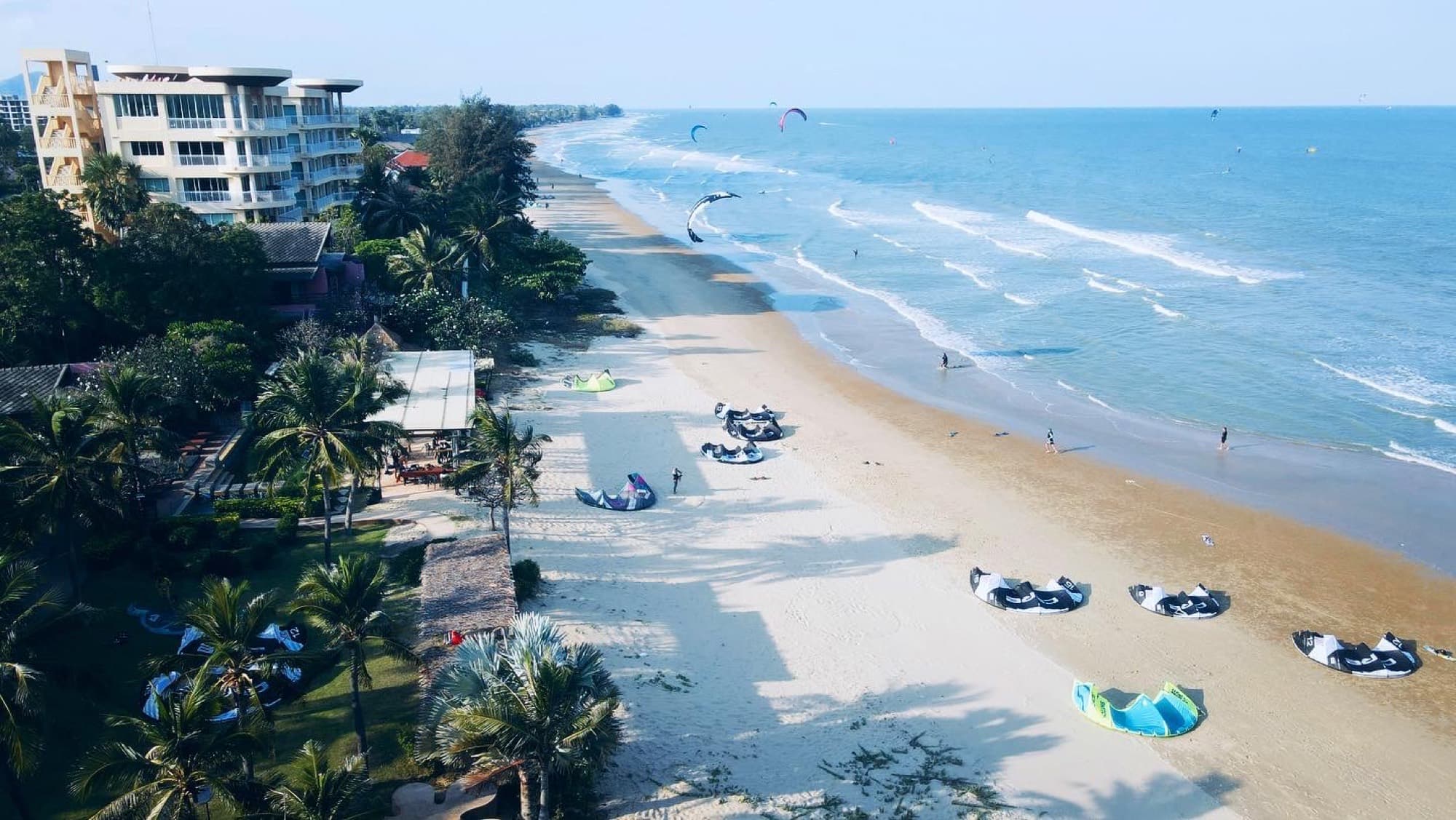
- Spot — the riding location itself. A basic word you can't do without. Our spot is the beach in Pak Nam Pran, and in our humble opinion it's one of the best.
How it sounds live: a couple of dialogues with translation
To give you the full flavour, here are some typical beach conversations — and their translation into plain human.
Dialogue 1. — How is it out there? — Nuking! I'm overpowered on the 9, getting dragged. Grab a 7.
*Translation:* "The wind is very strong. I took a 9-metre kite and it's too much — it's dragging me across the water. You'd better take a smaller kite, a 7-metre one."
Dialogue 2. — Where'd you ride? — Did a downwinder, but I hit the washing machine, dropped the kite, then flagged for five minutes.
*Translation:* "We rode with the wind from one point to another. But I got caught in a strong wave zone, crashed the kite onto the water, and then it flapped helplessly for about five minutes while I sorted myself out."
Dialogue 3. — Check your chicken finger! — My what? — It popped out of the chicken loop, you're about to unhook on the water!
*Translation:* "Check your safety pin (chicken finger). It came out of the loop (chicken loop), and you might accidentally unhook from the harness right there on the water." (Not a joke, by the way — it really is worth watching.)
See? It sounds like gibberish, but it's really just basic safety and wind talk — in kiter language.
Want to understand all this yourself? Come and learn with us
Here's the honest truth: learning this dictionary from an article is fun, but it really sticks only on the water. When you're "overpowered" yourself and feel in your body what it means. When the instructor shouts "go upwind!" and you finally feel how to hold ground against the wind. When you "send it" for the first time — that's when the word makes sense.
At JollyKite we don't just teach technique — we gently pull you into the tribe. By the end of your course you'll not only ride but also chat freely in kiter slang, get the beach jokes, and call the wind "skunked" yourself when it lets you down. That's part of the fun.
If you want a serious, "grown-up" glossary with proper terms, we have a kitesurfing terms glossary too. And if you want to figure out how to pick your first kite, check out our article how to choose a kite. But the best way to learn the language of the spot is to come to the spot.
Let's go riding?
Send us your weight, level and preferred dates — we'll match a kite to the wind, teach you to ride, and have you talking kiter slang your own mother wouldn't understand. Booking and prices are on the /obuchenie page, contact us via /kontakty. WhatsApp +66 98 367 9769, Telegram bot @JollyKite_kite_bot.
FAQ
What does "overpowered" mean for kiters?+
Being "overpowered" (in Russian slang "dozit", "peredoz", "v doze") is when there's too much wind or too much kite and you're getting dragged across the water, losing control. It usually means your kite is too big for the current wind. *"I'm overpowered, getting yanked"* means it's time to grab a smaller kite. It's not a diagnosis, just the kiter way of saying "the wind's got the better of me."
What is the "safety handle" (the cheeky Russian "zhoporuchka")?+
It's the loop handle at the back of the harness or by the chicken loop that you grab onto in a self-rescue. Officially it's the self-rescue handle, but the Russian-speaking community gave it a much more anatomical nickname. No mystery — kiters just love calling things by their (very) literal names.
What does "nuking" mean?+
"Nuking" (also "cranking", "honking") means it's blowing hard. The more dramatic the word, the stronger the wind, usually. *"It's nuking today — grab your smallest kite."* The opposite is "skunked" or "no wind", meaning there's barely a breeze.
How is slang different from real kite terms?+
Terms are the official, standard language: chicken loop, depower, upwind, kiteloop. They're in the manuals and sound the same everywhere. Slang is the informal, tribal language: "washing machine", "kook", "send it". It's alive, funny and varies from spot to spot. Terms help you learn correctly and safely; slang helps you fit in on the beach. We also have a separate glossary of proper terms.
Where can I learn to understand kiter slang?+
Best of all — on the water, in a real community. The words stick when you live what they describe: being overpowered, going upwind, your first boost. At JollyKite we teach technique and quietly immerse you in the language of the spot, so by the end of your course you'll both ride and chat freely in kiter slang. Sign up on the /obuchenie page.