
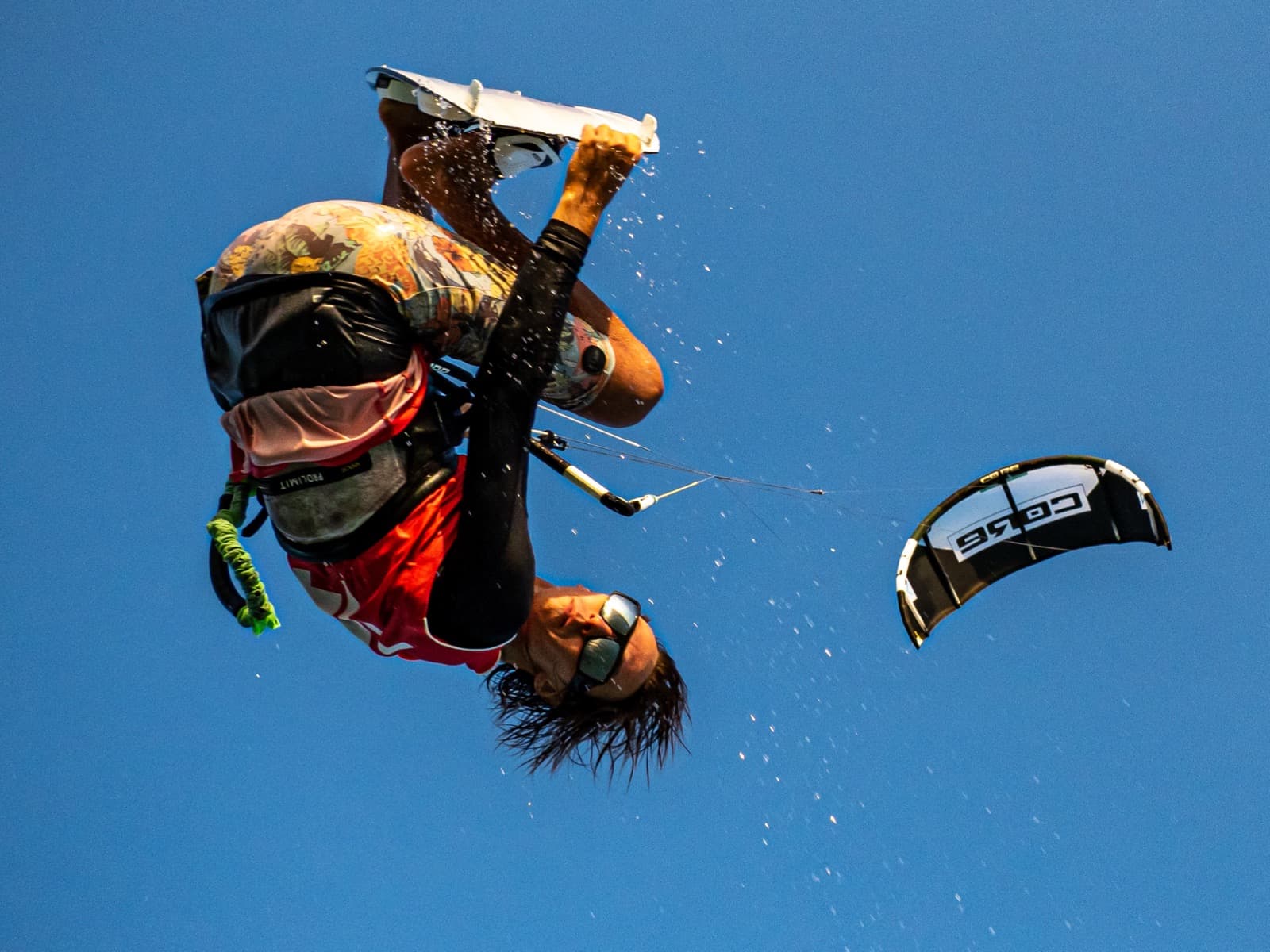
CORE XR8: a big-air / freeride kite review
The CORE XR8 is built for height. It's the eighth generation of the legendary XR booster — the kite you jump higher and hang longer on than on almost any other wing. But the best part of the XR8 is that it stayed friendly. Huge lift and hang time here live alongside early planing, a wide range and a forgiving character, so even a confident beginner can grow on it.
22 July 2026 · JollyKite
What the XR8 is and who it's for
The XR8 is the big-air and powered-freeride flagship of the CORE range. In short: it's a kite for jumps, boosting and beautiful floats, but with a very broad range of use.
Officially CORE positions it as a high-performance freeride/big-air kite, while deliberately making it more all-round and progression-oriented than earlier XRs. The idea is simple: let a beginner grow on the same gear as their idols. So the XR8 is equally good for someone just learning to jump high and for an advanced rider squeezing maximum height out of the kite.
Who it suits: - a confident beginner who wants to grow in jumps on one kite for a long time; - a freerider who wants a single powerful all-rounder for boosting and hang time; - an advanced big-air rider who values height and predictability.
Construction: why the XR8 is so stable
A kite's character comes from its frame. On the XR8 it's a five-strut Deltabow shape — a stiff "exoskeleton" that holds the profile under load and barely deforms in gusts. Hence the XR's trademark stability: the kite sits calmly at the edge of the wind window and behaves confidently in turbulence.
The leading edge is ExoTex 2: thinner, stiffer and tougher than before (noticeably more tear-resistant). The struts are lighter, the canopy is CoreTex 2 triple-ripstop. Altogether the XR8 came out stiffer, lighter and livelier than earlier XRs, without losing the stability the series is loved for.
How the XR8 jumps: hang time and early planing
Jumping is the XR's main discipline. And here the XR8 works on a "sheet-and-go" principle: to fly high you don't need surgical bar work and perfect timing. A big "sweet" power range forgives imprecision — which is why beginners to big air love it.
Worth a separate note is the early planing. The XR8 uses the Intelligent Arc system: when you sheet in, the canopy changes its profile and adds power "on demand". That helps you get planing and jump earlier — valuable both in light wind and for those just learning height.
And in the air the XR8 gives you what it's chosen for: long, controlled float. You don't drop like a stone; you glide — with time to grab, steer the kite and land softly.
Loops, drift and depower
Loops. On the XR8 they're noticeably cleaner and more predictable than on the XR7: a thinner leading edge and a stiff frame give better response, the kite enters the loop faster and catches you more reliably after it. These are safe, confident loops for big air — not the most aggressive on the market, but exactly what you need to build difficulty without stress. If your goal is extreme megaloops in strong wind, look toward the XR Pro (below).
Drift. The XR isn't a pure wave kite, but the XR8's lighter frame improved drift and overhead behaviour. You can head into waves on it — stability and depower help on the line. But if waves are your main discipline, it's more honest to take a specialist: the CORE Section or Nexus.
Depower and range. One of the XR8's aces is a very wide working range. Sheet in and power builds predictably; sheet out and the profile flattens, power leaves, the kite stays calm. That lets you ride comfortably overpowered and soften big landings. A single size covers a wide wind window.
Sizes and range
The standard XR8 range is roughly:
5 · 6 · 7 · 8 · 9 · 10 · 11 · 12 · 13.5 m
Plus XR8 LW light-wind versions at 15 and 17 m for very light wind.
Approximate wind ranges (twin-tip, ~75–85 kg rider) — as a guide, not a law:
- 6 — ~20–38
- 8 — ~15–33
- 9 — ~13–30
- 10 — ~12–28
- 12 — ~10–24
- 13.5 — ~9–22
- 15 LW — ~8–20
- 17 LW — ~7–19
The real range depends on your weight, board and style. How to pick a size for yourself is in the article "How to choose a kite size by weight and wind".
Bar setup and CIT modes
The XR8 is optimised for CORE's proprietary Sensor bar — light and precise, with well-thought-out safety. A general breakdown of the bar is in "The CORE Sensor bar: a breakdown", and on bars in general "Kite bars".
The main fine-tuning tool is CIT (Core Intelligent Trim): three points on the leading-edge bridle that shift the kite's character to the task:
- Wave / drift — softer bar, slightly more pivotal turns, better drift and depower; for waves and relaxed riding.
- All-round / freeride — balanced response and power; the everyday default.
- Freestyle / big air — more direct, sharper steering, maximum power and lift; for big jumps and powered loops.
You can also change the rear-line attachment points at the wingtips: closer to centre means heavier bar and slower turns, toward the edge means lighter bar and faster turns. That's how you tune bar pressure and steering speed to your weight and style.
Who the XR8 is NOT for
Honestly about the limits:
- The pure freestyler and wakestyler. The XR8 is about height, not unhooked pop and slack. For freestyle and loops take the CORE GTS, and for a pure C character the Impact.
- The wave rider for whom waves are everything. The XR8's drift is good for a five-strut kite but doesn't reach the specialists. Waves as a main discipline — the CORE Section or Nexus.
- Those who compete and want extreme megaloops. Here you want the sharper, faster XR Pro.
XR8 or XR Pro: what's the difference
A common question is whether to take the XR8 or the top-end XR Pro. In short: the XR Pro isn't "an XR8 in Aluula" — it's a separate, more aggressive kite.
- Frame. The XR8 is on Dacron ExoTex 2; the XR Pro is fully on Aluula, roughly 10% lighter, thinner and stiffer, with a reworked profile for speed and height.
- Character. The XR8 is controlled, forgiving, a "daily-driver flagship"; the XR Pro is sharper, faster, more demanding, and rewards aggressive riding. For an average rider the XR8 is both more pleasant and more useful.
- Loops and height. The XR Pro enters the loop faster, catches more sharply and, in skilled hands, jumps higher. It's a choice for advanced and competitive riders.
The bottom line is simple: the XR8 for most people, and the XR Pro deliberately chosen for maximum height and megaloops. The XR Pro doesn't replace the XR8 — it sits above it. A separate detailed comparison will follow in the article "CORE XR Pro vs XR8".
Short summary
- What it is: CORE's big-air and freeride flagship, the 8th-generation XR.
- Strengths: huge lift and hang time, early planing, a very wide range, high stability, clean and predictable loops.
- Character: sheet-and-go, forgives imprecision — you can grow on it from a confident beginner.
- Sizes: ~5–13.5 m, plus LW 15 and 17 m.
- Setup: Sensor bar, CIT modes (wave / all-round / freestyle), wingtip attachment points.
- Not for: pure freestyle (GTS/Impact), pure waves (Section/Nexus) and extreme megaloops (XR Pro).
Try the XR8 on the water before you buy
The best way to know whether it's your kite is to fly it for real. During lessons and progression at JollyKite you can try different CORE models and sizes and feel that XR hang time — before you even think about buying your own set. Kites are part of the gear; we match them to your weight and the wind of the day.
Buying your own XR8 makes sense once you already jump confidently and know that height is your thing. Then we'll help you pick a size for your weight and spot and build a set. Want to just ride your own gear or try a kite — there's gear rental in Pak Nam Pran; something tore — kite repair.
Where the XR8 sits in the big picture is in the review "The CORE kite range". From scratch to jumping — "Learn kitesurfing from scratch". On the board — "How to choose a kiteboard".
Shall we go riding?
Send us your weight, level and preferred dates — we'll let you try the XR8 and match a size to the wind, plus a board and harness to you. Booking and prices are on the /obuchenie page, contact us via /kontakty. WhatsApp +66 98 367 9769, Telegram bot @JollyKite_kite_bot.
FAQ
What is the CORE XR8 for?+
The XR8 is CORE's big-air and powered-freeride flagship. People take it for high jumps, long hang time and beautiful floats, plus a very wide wind range and early planing. It's also versatile and forgiving, so it suits growing in jumps from a confident beginner level.
Who is the XR8 for, and who not?+
Good for: a confident beginner growing in jumps; a freerider wanting a powerful all-rounder; an advanced big-air rider. Not the best choice for: a pure freestyler or wakestyler (take the CORE GTS or Impact), a wave rider for whom waves are everything (Section or Nexus), and those who compete and want extreme megaloops (XR Pro).
What sizes does the CORE XR8 come in?+
The standard range is roughly 5, 6, 7, 8, 9, 10, 11, 12 and 13.5 m, plus XR8 LW light-wind versions at 15 and 17 m. The exact size is matched to your weight, board and spot; roughly 8–10 m covers mid-range wind for a ~75–85 kg rider.
How do you set up the CORE XR8?+
The kite is optimised for the CORE Sensor bar. Fine-tuning is via CIT modes (three points on the bridle): wave/drift — softer and driftier, all-round — the default, freestyle/big air — sharper and more powerful for jumps. You also change the rear-line points at the wingtips: closer to centre means heavier bar and slower turns, toward the edge means lighter and faster.
Is the XR8 suitable for a beginner?+
Yes, for a confident beginner it suits — CORE deliberately made the XR8 more progression-oriented and forgiving: sheet-and-go, a big sweet range, stability and easy relaunch. Learning from absolute zero is better on a school all-rounder under an instructor, but growing in jumps on the XR8 is comfortable and lasts a long time.
How does the XR8 differ from the XR Pro?+
The XR8 is on a Dacron ExoTex 2 frame — controlled and forgiving, a "daily-driver flagship". The XR Pro is fully on Aluula, roughly 10% lighter and stiffer, with a reworked profile: sharper, faster, loops more aggressively and in skilled hands jumps higher, but more demanding. Most people will suit the XR8; the XR Pro is a deliberate choice for advanced riders after maximum height and megaloops.
Is the XR8 good for loops?+
Yes — for big air the XR8's loops are clean and predictable, noticeably better than the XR7's: the kite enters the loop faster and catches more reliably. These are confident, safe loops for building difficulty. For extremely fast and aggressive megaloops in strong wind the XR Pro is better.
Will the XR8 work for waves?+
As a backup, yes: the lighter frame improved drift and overhead behaviour, and stability and depower help on the line. But the XR8 isn't a wave specialist. If waves are your main discipline, it's more honest to take the CORE Section (pure wave) or Nexus (an all-rounder leaning to waves).