
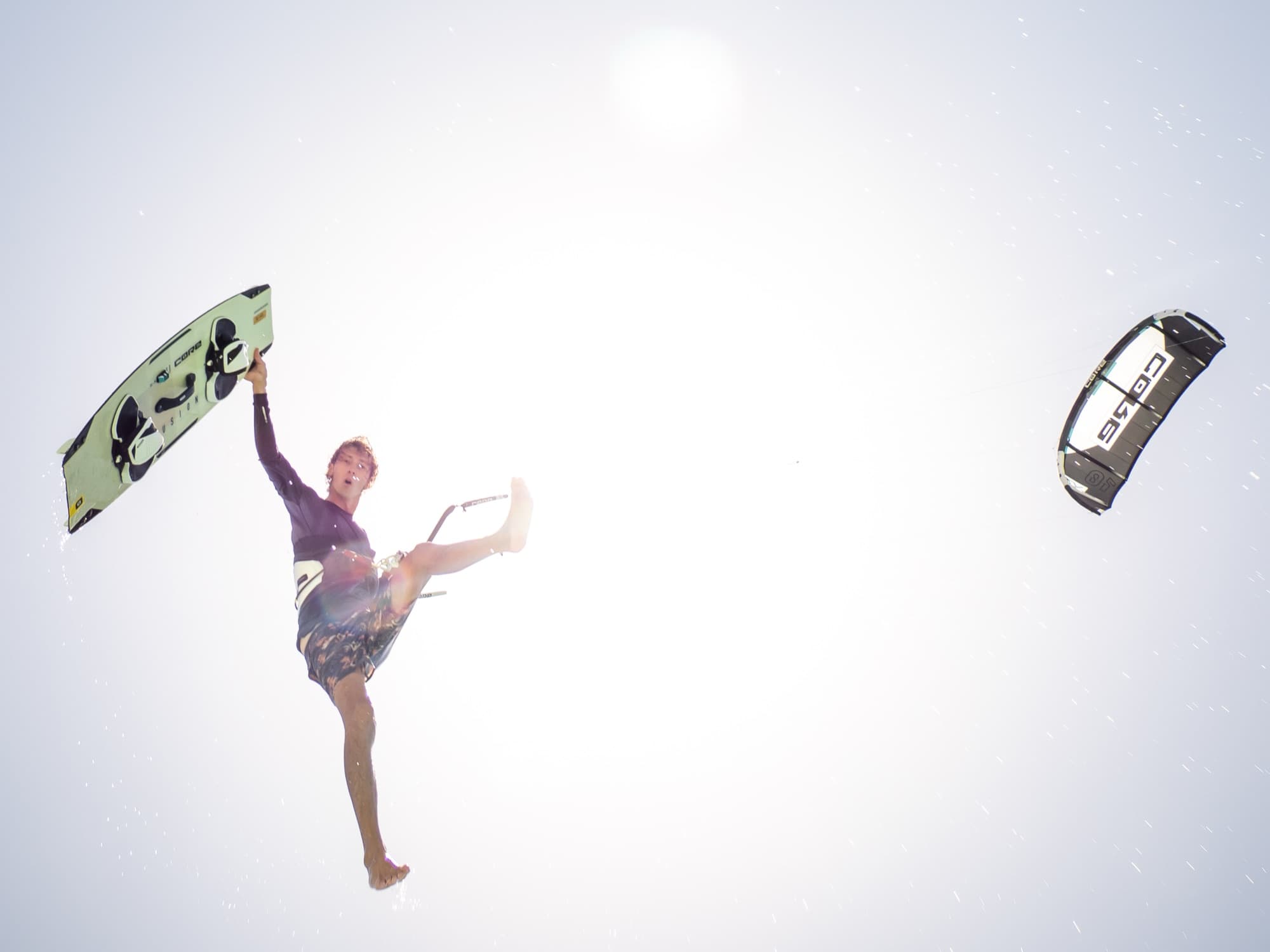
Board-off on a kite: taking the board off and putting it back mid-jump
The board-off is one of the most spectacular tricks in kiteboarding. In a jump you take the board off your feet, hold it in your hand, can stretch it out to the side to show it off, and then put it back on your feet and land softly. From the outside it looks as if you parted with your board for a second in mid-air — and it ended up back under you. In reality it's pure control of your body and kite during the hangtime: the trick isn't about strength, it's about calm, timing and a margin of height.
9 July 2026 · JollyKite
What you need before the board-off
The board-off is an advanced trick, and it's worth approaching when your base is already solid. Before you take the board off in the air, you should have three things.
- A high, stable jump with good hangtime. The main condition is time in the air. To manage to grab the board, take your feet out, put the board back and catch the straps with your toes, you need several seconds of hangtime. On a low, short jump you simply won't have time to put the board back on. If you still jump low or land hard, work on the jump itself first — we have a separate article on how to jump higher and land softer.
- Kite control in the jump. You should confidently hold the kite at the zenith (12 o'clock) during the hangtime and not "drop" it when your attention goes to your hands and feet. The kite at the zenith gives maximum and stable hangtime — that's the working foundation of the board-off.
- Grab experience. Being able to take the board in your hand in the air (a grab) is the direct lead-in to the board-off. Essentially the board-off starts with a grab: first the hand finds the board, and only then the feet come out of the straps. If grabs are still unfamiliar, start with them — we cover them in the article grabs on a kite.
If all three points already come calmly and confidently — you can move on to the trick itself.
The board-off step by step
The key logic of the trick is simple: first the hand holds the board, then the feet come out, then the board goes back on the feet — and all of this has to happen before you land. Let's go step by step.
- Make a high jump and send the kite to the zenith. Pop and send the kite to 12 o'clock — that gives maximum hangtime. At the top of the jump you have a few seconds of relative "calm," and those are exactly what you use for the trick. Don't rush — first make sure you're hanging stably.
- Grab the board with your hand first — like a grab. This is the critical moment. Before you take your feet out, your hand should already be holding the board. Take the board (by the rail between the bindings, or by the edge) with whichever hand is comfortable — now the board is under control, and even when your feet come out it won't go anywhere.
- Take your feet out of the straps. Once the board is firmly in hand, pull your feet out of the straps. You can stretch the board out to the side and "show" the trick for a moment — that's the spectacular board-off grab. Don't linger too long: remember you still have to put the board back.
- Put the board back under your feet — this is the main moment. Bring the board to your feet and catch the straps with your toes. This is the most important and most nerve-wracking part of the trick: this is where it's decided whether you put the board back on or land without it. Act calmly and precisely — bring the board to your feet and your feet to the board, meeting halfway.
- Stabilise and land. Once your toes are in the straps, level out your body, point the nose of the board slightly downwind and land on bent legs, softening the impact. The kite at this moment is flying and gently pulls you forward — that helps make the landing smooth.
The whole trick fits into a single hangtime. That's why height matters so much: the more time in the air, the calmer steps 2–4 go and the higher the chance of a clean landing with the board on your feet.
How not to lose the board
The board-off is a trick where the board is, for a second, "no one's." So safety here is taken more seriously than the trick itself.
- You need a margin of height and time. Don't try a board-off at the limit of your jump. A margin of height is a margin of time to put the board back. If height is tight, better not to take your feet out at all.
- Learn in an empty area. A board released from your hand at height flies off downwind and can hit people or someone else's gear. Learn the board-off where there's no one around — that rule isn't up for debate.
- Use a board leash early in learning. A leash (a safety cord to the board) at the learning stage greatly reduces the risk of losing the board entirely — it stays with you even if you let it slip. Keep in mind that a leash itself carries a risk of the board recoiling, so use it consciously and wear a helmet; as you gain confidence, many switch to a board-off without a leash.
- Do it with an instructor. An instructor will prompt you when to grab the board and when to put it back, watch your height and the zone, and help break the trick into safe lead-up drills. You can book a lesson on the /obuchenie page.
The main idea is simple: the board-off is exactly as safe as your margin of height, the clear zone around you and your control of the board in hand.
Common mistakes
Almost all board-off problems come down to a few recurring mistakes. Knowing them in advance, you'll bring the trick to a clean execution faster.
- Not enough height. The most common reason for failure: the jump is too low and you simply don't have time to put the board back before landing. Raise your height and hangtime first, then take the board off.
- Taking the feet out without grabbing the board first. If you pull your feet out of the straps before your hand has the board, it instantly flies away — and the trick turns into losing the board. The order is strict: hand on the board first, then feet out of the straps.
- Panic on the return. Putting the board back is a tense moment, and in a hurry it's easy to miss the straps. Sharp, fussy movements get in the way of catching the straps with your toes. Calm, smooth bringing-together of board and feet works better than a jerk.
- Dropping the kite from the zenith. When all your attention goes to your hands and feet, it's easy to "let go" of the kite and have it leave 12 o'clock. Hangtime disappears immediately, and there's no time left for the return. Keep the kite at the zenith throughout the whole trick.
- Landing without the board. The finish of a board-off is a landing with the board on your feet. If you didn't manage to put it on, a landing without the board is hard and uncontrolled. So at the slightest doubt about height, better not take your feet out and postpone the trick until a more confident jump.
What's next
When the board-off comes out consistently and with a clean landing, what you have in hand is no longer a single trick but the skill of controlling your body and board in the air — and that's the base for a whole family of freestyle elements. The logical continuation is to figure out what to learn next in the JollyKite Trick School, and to bring the jump itself to even greater height and softness in the article how to jump higher and land softer.
If grabs aren't yet automatic — step back to the article grabs on a kite: a confident grab directly prepares your hand for the board-off.
We coach all advanced tricks under an instructor's supervision, with a safety briefing and in the suitable flat-water conditions of Pak Nam Pran — which sharply lowers the risks while learning. More on formats and booking is on the /obuchenie page.
Let's go riding?
Send us your dates and level — we'll suggest a format, match the season to your rhythm and plan your trip end to end. WhatsApp +66 98 367 9769, Telegram bot @JollyKite_kite_bot.
FAQ
What is a board-off on a kite?+
A board-off is a trick where, in a jump, you take the board off your feet, hold it in your hand (you can stretch it out to the side and show it — that's the board-off grab), and then put the board back on your feet before landing. It's a spectacular element about controlling your body and kite during the hangtime in the air.
What do you need before a board-off?+
You need three things: a high, stable jump with good hangtime, confident kite control at the zenith (12 o'clock) during the jump, and grab experience — the ability to take the board in your hand in the air. The board-off is built on top of this base, so it's worth approaching when the jump and grabs already come calmly.
How do you avoid losing the board during a board-off?+
The main rule is to grab the board with your hand first and only then take your feet out. Besides that, you need a margin of height and time for the return, it's better to learn the trick in an empty area (a released board flies off downwind), and early in learning a board leash helps. And be sure to keep the kite at the zenith so you don't lose your hangtime.
Do you need a board leash for a board-off?+
At the learning stage a board leash reduces the risk of losing the board entirely — it stays attached to you. That said, a leash itself carries a risk of the board recoiling, so use it consciously and with a helmet. As confidence grows, many switch to a board-off without a leash, especially in an empty area.
Why can't I get the board back on?+
Most often the reason is not enough height: on a short jump you simply don't have time to put the board back before landing. Other reasons are panic and sharp movements on the return (missing the straps), losing the kite from the zenith (hangtime disappears), or trying to take your feet out before the board is in hand. Raise your height and hangtime first, act calmly, and keep the kite at 12 o'clock.