
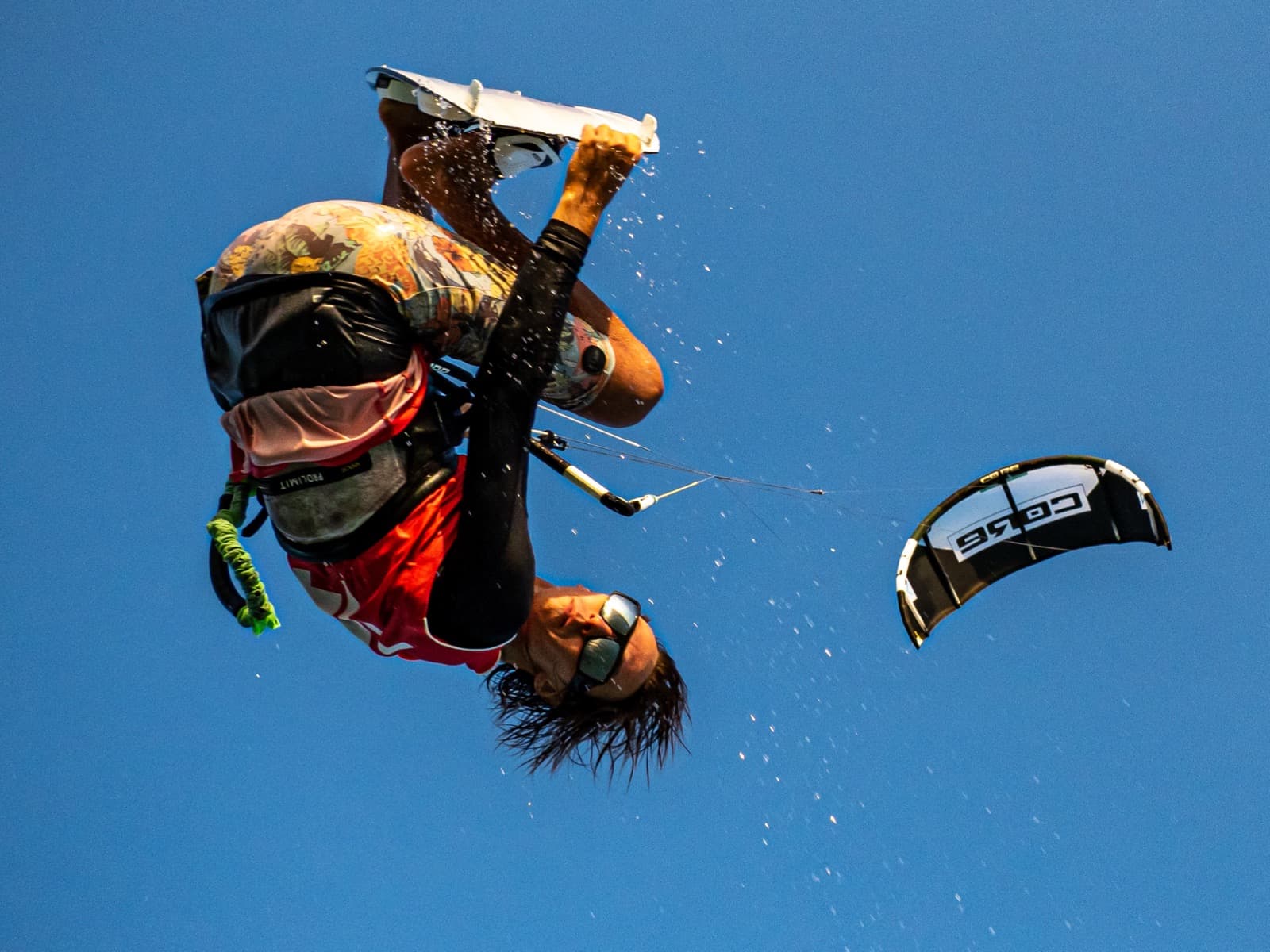
The backroll on a kite: your first rotation
The backroll (also called a backloop) is a backward rotation through your back and shoulder, right in the jump. It looks impressive, but it's actually the most accessible rotation of all.
27 June 2026 · JollyKite
What you need before the backroll
The backroll is an add-on to the jump, not a separate skill from scratch. So before you try a rotation, you should have a solid base:
- A confident jump with a controlled landing. You take off predictably, you know how high you'll go, and you consistently land on the board, nose slightly downwind, without falling. If your landing is still "hit or miss," it's too early to add a rotation.
- Riding upwind. After any trick you get pushed off a little. If you can ride back upwind, you don't lose your spot or drift downwind with every attempt.
- Calm kite control at the zenith. The key mechanic of the backroll is to leave the kite at 12 o'clock and not touch it. You need to be able to park the kite at the zenith and hold it there without reflexively steering.
If all three describe you, you can move on to the technique. If one of them is weak, fix it first: it'll save you dozens of failed attempts.
The backroll step by step
The main idea to keep in your head the whole time: the body initiates the rotation, not the kite. The kite stays at the zenith and barely moves, while you spin yourself — using your head, your shoulder and the edged board. Here's the full sequence:
- Approach as for a normal jump. Build up speed and edge against the wind — the rail bites into the water, your body leans slightly back. It's the same preparation as for a jump: the cleaner the edge, the more energy you gather for both takeoff and rotation.
- Pop with a light kite send. Take off with a *small* upward send of the kite — not sharp, not strong. After the pop, park the kite at about 12 o'clock (the zenith) and don't move it during the rotation. This is counterintuitive: you'll want to "yank" the kite to spin — but that's exactly what you must not do.
- Initiate the rotation with your body, not the kite. Once you're off the water, sharply throw your head and rear shoulder back and look back over your shoulder. The board you edged on the approach adds rotational momentum — your body starts to spin backward through your back. The rotation is born here, in this head-and-shoulder movement, not in your hands on the bar.
- Tuck your knees and stay compact. The tighter you tuck, the faster the rotation goes — like a skater pulling their arms in. Tucked knees and a compact body spin you faster and cleaner than a loose, "open" body.
- "Spot" — find the landing with your eyes. Coming out of the rotation, catch the water or the horizon with your eyes. That moment — when you've "locked onto" the water — is the signal to open up and prepare to land. Spotting turns a "blind" rotation into a controlled one.
- Open up and land. Straighten your legs toward the water, open your body, and land on the nose of the board slightly downwind — softly, absorbing the impact with your legs. Keep the kite flying (moving, with pull) so it catches you on the landing rather than dropping you.
At first everything happens fast, and it feels like there's no time to spot. That's normal: with each attempt the rotation feels "slower," and you start to catch the water in time. The first clean backrolls usually come exactly when this control of your gaze arrives.
Why the backroll is easier than the frontroll
A fair question: if there's a backward rotation and a forward one, why start with the backward one? The answer is in the landing.
In a backroll you rotate backward through your back, and as you come out of the rotation your gaze naturally meets the water — the landing is not blind. You see where you're coming down, you can spot the water and adjust your legs. That gives you control and confidence.
The frontroll (forward rotation) works the other way around: the water enters your field of view later, the landing is more "blind," and it's harder to catch. So in the learning logic the backroll comes first: it lets you feel the rotation in the jump while keeping visual control of the landing. Once you've mastered the backroll, you carry that feeling of rotation over to the frontroll already prepared.
Common mistakes
Almost all backroll difficulties come down to a few typical mistakes. Knowing them in advance, you'll get through the trick noticeably faster:
- Spinning with the kite instead of the body. The most common mistake. Instead of throwing the head and shoulder, you "yank" the bar, trying to spin with the kite. The kite leaves the zenith, pulls the wrong way, throws off your trajectory — and instead of a clean rotation you get a wrecked jump. Remember: the kite stays put, the body spins.
- Under-rotation from an open body. If your body is loose, your legs dangle and your knees aren't tucked, the rotation slows down and you don't come round in time for the landing. The fix is tucking: pull your knees in, stay compact.
- Not spotting the landing. Without finding the water with your eyes, the landing becomes a lottery. Train yourself to consciously catch the horizon/water as you exit the rotation.
- Dropping the kite. If the kite is "abandoned" and not flying on the landing, it won't catch you — you'll get a hard fall. The kite must stay flying with pull, ready to pick you up.
- Weak edging before takeoff. Without a clear edge against the wind, you won't gather energy for either height or rotation. A clean edge on the approach is half the success.
What's next
Once the backroll is solid — you spin it both ways and land confidently — a whole branch of rotations opens up. The logical progression looks like this:
backroll → backroll with a grab → frontroll → 360.
First add a *grab* to your backroll — grabbing the board with your hand in the air: it doesn't make the rotation harder, but it teaches you to control your body and board in flight, and it makes the trick noticeably better-looking too. Then move on to the frontroll — the forward rotation you'll already be prepared for after the backroll. And after that — the 360, a full turn that combines body rotation with the kite moving through the window.
If you're still working toward jumps, start with the basics — your first kite jump. And to figure out which tricks to learn next and in what order, look into the JollyKite Trick School. Ready for the forward rotation — head here: the frontroll on a kite.
We teach all takeoff tricks under an instructor's supervision, with radio comms on the water and in the safe, flat, shallow water of Pak Nam Pran — which sharply lowers the risks while learning rotations. More on formats and booking is on the /obuchenie page.
Let's go riding?
Send us your dates and level — we'll suggest a format, match the season to your rhythm and plan your trip end to end. WhatsApp +66 98 367 9769, Telegram bot @JollyKite_kite_bot.
FAQ
What is a backroll on a kite?+
A backroll (or backloop) is a backward rotation through your back and shoulder, right in the jump. It's the most accessible "real" rotation because during it the kite barely moves: it stays at the zenith and is easy to control, so all your attention stays on your body. That's why the backroll is the logical first trick with a rotation.
What do you need before the backroll?+
A solid base: a confident jump with a controlled landing, the ability to ride upwind, and calm kite control at the zenith. The backroll is an add-on to the jump, not a skill from scratch. If your landing is still unstable, fix the jump first, then add the rotation.
How do you avoid under-rotating the backroll?+
The key is tucking. Pull your knees in and stay compact: the tighter you are, the faster the rotation and the easier it is to come round for the landing. An open, loose body slows the rotation and causes under-rotation. You only open up at the exit, when you "spot" the water.
Why is the backroll easier than the frontroll?+
Because of the landing. In a backroll you rotate backward, and your gaze naturally meets the water on the exit — the landing isn't blind, you see where you're coming down. With a frontroll the water enters your view later, and the landing is harder to catch. That's why the backroll is learned first.
Do you spin the backroll with the kite or the body?+
With the body. Park the kite at about 12 o'clock (the zenith) and don't move it during the rotation. The rotation itself is initiated by your head and rear shoulder (thrown sharply back, looking over your shoulder) plus the momentum from the edged board. Trying to spin with the kite is the most common mistake: the kite leaves the zenith and pulls the wrong way.